The decentralized artificial intelligence ecosystem surrounding Bittensor (TAO) has encountered significant headwinds, with its native token registering a sharp correction over the past several trading sessions. Following a brief period of optimism driven by integration milestones and rising liquidity, TAO has experienced consistent daily losses, shedding nearly 7% in a single 24-hour window alone. This downward trajectory has jeopardized the token’s recent bullish momentum, leaving market participants to reassess the asset’s short-term viability as broader macroeconomic and crypto-market pressures mount.
Main Facts and Immediate Price Action
The recent market data highlights a severe cooling off for Bittensor. Beginning Monday, September 7, TAO entered a persistent red streak, recording consecutive days of losses that have severely tested key psychological and technical support levels. This downturn has effectively erased a substantial portion of the gains accumulated during its recent push toward a three-month high of $277.
Derivatives and spot markets have mirrored this underlying weakness. Open Interest (OI) in TAO futures contracts plummeted by 14.3% within a 24-hour period, signaling a mass exodus of speculative capital and a steep decline in leveraged participation. Concurrently, the Cumulative Volume Delta (CVD) for spot markets has continued its downward slide since Monday. This convergence of declining Open Interest and falling spot CVD points directly to an acute lack of institutional and retail demand. Without fresh capital entering the ecosystem, market analysts warn that the token risks extending its losing streak, threatening deeper retracements before any sustainable accumulation phase can begin.

Background and Chronology of the Rally
The current retracement stands in stark contrast to the bullish sentiment that characterized Bittensor’s performance earlier in the quarter. The recent upward push—which carried the asset from sub-$200 levels to nearly $280—was largely catalyzed by its official go-live on Raydium, a leading automated market maker (AMM) and liquidity provider built on the Solana blockchain.
This integration significantly expanded TAO’s accessibility, allowing decentralized finance (DeFi) participants to trade the asset with greater liquidity and efficiency. The integration pushed the altcoin to a three-month peak of $277, igniting hopes among retail investors that a sustained recovery toward the $300 threshold was imminent. However, historical structural resistance levels have once again proven formidable. The failure to sustain momentum above $270 has triggered profit-taking among early swing traders, accelerating the subsequent sell-off.
Technical Analysis and Macroeconomic Influences
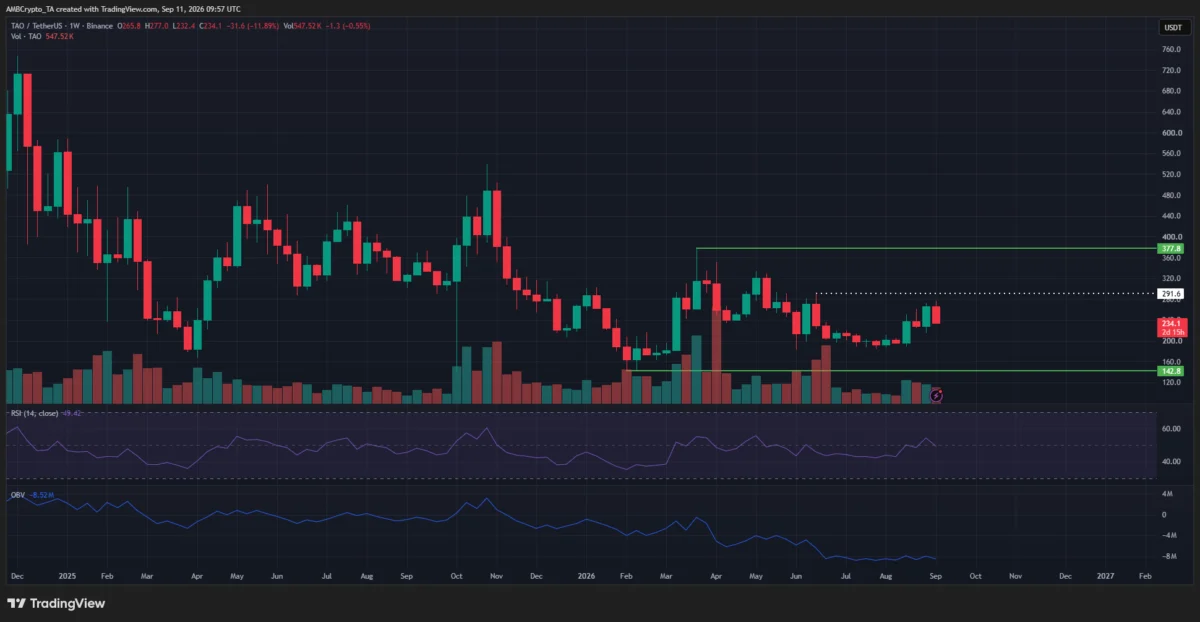
A granular examination of Bittensor’s historical price action reveals persistent structural challenges on both weekly and daily timeframes. In April 2025, the weekly chart established a critical swing low at $167.8. This level was definitively breached in February 2026 when a weekly candle closed at $163.2, confirming a broader bearish swing structure that has continued to weigh on long-term investor sentiment.
Key structural boundaries currently dictate the asset’s technical outlook. On the weekly timeframe, major swing points are identified at $142.8 on the downside and $377.8 on the upside. Additionally, the $291.6 mark remains a crucial inflection point; a decisive break above this barrier could clear the path for intermediate bullish consolidation. However, momentum indicators present a cautionary picture. The Relative Strength Index (Index) on the weekly timeframe hovers at a neutral 49, reflecting indecision among market participants. Meanwhile, the On-Balance Volume (OBV) has maintained a steady downtrend since October, underscoring persistent capital outflows that align with broader bear market conditions.

On the daily chart, the shadow of the $291.6 swing high from June looms large, sitting just beneath the major psychological and technical supply zone at $300. Overcoming these entrenched resistance levels will require aggressive and sustained buy-side demand. Industry analysts note, however, that securing such momentum may prove difficult if correlated assets like Bitcoin (BTC) face persistent weakness. Recent struggles by Bitcoin to decisively reclaim and hold the critical $80,000 threshold have weighed heavily on the broader altcoin sector, dampening risk appetite across the board.
Market Reactions and Trading Strategies
Professional traders and market makers are adopting a cautious stance in light of the ongoing correction. With derivatives volume drying up and spot demand failing to materialize near current prices, risk management has become the primary focus for short-term participants.
Rather than chasing falling knives, institutional swing traders and retail investors are increasingly looking toward deeper historical support zones for potential accumulation entries. Market consensus highlights the $190 region as a logical demand area where sidelined capital might re-enter the market in anticipation of a technical relief rally. Conversely, breaking above the $300 supply zone remains a prerequisite for bulls attempting to invalidate the prevailing macro-downtrend and restore long-term confidence in the asset.
Broader Impact and Implications for the AI Crypto Sector
Bittensor’s recent price volatility underscores the complex interplay between fundamental sector growth and macroeconomic liquidity constraints within the decentralized artificial intelligence narrative. As a prominent project bridging blockchain technology and machine learning models, TAO often acts as a bellwether for the broader AI token sector.

The inability of high-profile altcoins to maintain structural breakouts—even following major network integrations like the Raydium deployment—suggests that market participants remain hyper-sensitive to overall crypto market liquidity and macro headwinds. As the digital asset market navigates this phase of consolidation and liquidity reassessment, the performance of foundational tokens like Bittensor will likely continue to reflect broader sentiment shifts, serving as a critical test for the sustainability of niche sector narratives in a cautious macroeconomic environment.