As the landscape of Layer-1 (L1) blockchains continues to evolve, the competition to capture developer mindshare and on-chain liquidity has intensified. Among the most closely watched contests is the rivalry between Sui [SUI] and Aptos [APT]. Both networks were born from the remnants of Meta’s Diem project and both utilize the Move programming language, yet their divergent paths in developer adoption and ecosystem growth have begun to paint a clear picture of market leadership. While technical specifications often dominate early-stage discussions, the maturity of these ecosystems is increasingly defined by sustainable on-chain activity and the ability to retain developer talent during volatile market cycles.
The Origin Story: A Shared Legacy
To understand the current divergence between Sui and Aptos, one must look back at their common foundation. Both projects emerged from the Move programming language, a domain-specific language designed by Meta for its ill-fated Libra/Diem initiative. Move was built with a focus on safety, security, and parallel execution, aiming to solve the throughput limitations that plagued earlier generations of smart contract platforms.
When Meta officially shuttered the Diem project in 2022, the talent pool fragmented. Mysten Labs, the developers behind Sui, and Aptos Labs, the team behind Aptos, both moved to capitalize on the intellectual property and engineering breakthroughs associated with Move. While the two chains share a technical DNA, they have adopted different architectural philosophies. Aptos has largely focused on modularity and high-frequency throughput, whereas Sui has leaned into an object-centric data model that allows for massive horizontal scaling. By 2026, these architectural choices have resulted in distinct operational trajectories.

Developer Traction: The Metric of Resilience
Developer activity serves as the leading indicator for a blockchain’s long-term viability. According to recent data from Electric Capital, a leading authority on developer ecosystem metrics, the disparity between the two chains has become statistically significant. Sui currently hosts approximately 954 monthly active developers, effectively doubling the 465 developers reported on the Aptos network.
This divergence is not merely a vanity metric; it represents a fundamental difference in how each ecosystem has fostered its community. Developers gravitate toward platforms where tooling is intuitive, documentation is robust, and the path to monetization is clear. Sui’s ability to attract nearly twice the talent of its closest competitor suggests that its object-centric model may be proving more approachable or efficient for decentralized application (dApp) developers.
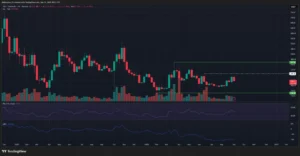
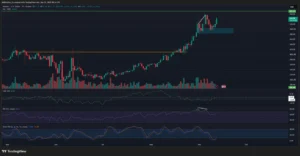
This developer lead has translated into tangible market resilience. During the challenging 2025 bear market, where liquidity across the broader crypto asset class faced significant contraction, Sui demonstrated a defensive posture superior to its peer. While the broader market experienced double-digit drawdowns, SUI finished the year down roughly 65%. In contrast, APT recorded a decline of approximately 80.7% over the same period. This suggests that the ecosystem’s stickiness—driven by high developer engagement—provided a buffer against the selling pressure that hit broader altcoin markets.
DeFi Dominance and the TVL Benchmark
Total Value Locked (TVL) remains the primary barometer for the health of a DeFi ecosystem. It reflects the amount of capital committed to lending protocols, decentralized exchanges, and yield-generating platforms on the chain. Current data from DeFiLlama underscores a growing chasm in operational performance: Sui’s TVL currently stands at approximately double that of Aptos.

The correlation here is straightforward: developer activity leads to the deployment of more sophisticated and liquid financial primitives. When a chain attracts more builders, the resulting influx of decentralized applications creates a flywheel effect. Users migrate to the platforms that offer the most utility, and liquidity follows. Sui’s lead in TVL indicates that it has successfully transitioned from a nascent network to a primary venue for DeFi operations.
Aptos, while maintaining a robust technical foundation, currently finds itself in a period of consolidation. The data suggests that while Aptos is not losing ground in absolute terms, it is failing to capture the growth velocity observed on the Sui network. For investors and institutional participants, this creates a clear demarcation between the two: Sui is currently perceived as the "high-growth" alternative within the Move ecosystem, while Aptos is undergoing a phase of re-evaluation to determine how it can reignite its developer and user growth.
Technical and Operational Comparisons
The competition between the two is not solely about numbers; it is about the "Move" developer war. Both networks compete for the same pool of specialized engineers who understand the nuances of the Move language. Because Move is a relatively niche language compared to Ethereum’s Solidity or Solana’s Rust, the competition for talent is fierce.
Sui’s architecture allows for "single-writer" transactions, which effectively bypasses the need for global consensus on every transaction, allowing for near-instant finality. This has been a significant selling point for developers looking to build high-frequency gaming or social media applications, which require a level of responsiveness that traditional blockchains struggle to provide.

Aptos, conversely, has optimized its Parallel Execution Engine, known as Block-STM. This technology allows the chain to process transactions in parallel, which significantly boosts throughput compared to the sequential execution models of older L1s. While both are technically impressive, the market’s current preference for Sui suggests that technical performance alone is insufficient. Instead, the market is favoring the ecosystem that offers the best "time-to-market" for developers—a category where Sui currently holds the advantage.
Market Implications and Future Outlook
As we move deeper into 2026, the implications of this developer and liquidity gap are profound. A blockchain ecosystem that fails to maintain a critical mass of developers risks "ghost chain" status, where the infrastructure remains operational, but innovation stagnates.
For the broader crypto market, the success of Sui suggests a shift in preference toward chains that can bridge the gap between high-performance architecture and user-friendly development environments. If Aptos is to reclaim its position as a top-tier L1, it will likely need to implement significant incentives—such as hackathons, grants, or ecosystem-wide liquidity programs—to attract developers away from competing chains.
Furthermore, the institutional interest in Move-based chains remains high. Large-scale financial institutions looking to explore blockchain technology are increasingly looking for networks that can handle high volumes without the congestion issues common on Ethereum or Bitcoin. The ongoing data shows that both Sui and Aptos are well-positioned for this type of adoption, provided they can continue to scale their ecosystems and ensure network security remains paramount.

A Chronology of the Move Ecosystem
- 2022: Following the closure of Meta’s Diem, the Move programming language is open-sourced, leading to the independent development of Sui and Aptos.
- 2023: Both networks launch their mainnets, initiating a high-stakes race for developer adoption and venture capital backing.
- 2024: The "Move Developer War" begins in earnest, with both networks launching massive grant programs and academic partnerships to solidify their position in the L1 hierarchy.
- 2025: The bear market tests the durability of both chains. Sui demonstrates higher relative resilience in token price and developer retention compared to Aptos.
- 2026: Current data indicates a significant gap in developer activity and TVL, with Sui establishing itself as the primary leader in the Move-based blockchain space.
Conclusion: The Road Ahead
The divergence between Sui and Aptos is a microcosm of the wider crypto industry’s maturation. The phase of "blind faith" in technological promises has passed, replaced by an era of rigorous fundamental analysis. Investors, developers, and users are no longer satisfied with mere throughput statistics; they are demanding proof of activity, depth of liquidity, and long-term sustainability.
While Aptos continues to possess a highly capable technical foundation, the current market data suggests that Sui has mastered the art of ecosystem development. By successfully converting developer interest into tangible TVL and market resilience, Sui has secured a temporary but meaningful lead in the race to define the next generation of smart contract platforms. As the industry looks toward the latter half of 2026, the question for Aptos is not whether it can compete technically, but whether it can pivot its strategy to regain the momentum that has shifted toward its Move-based counterpart.