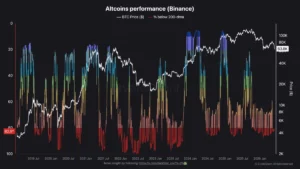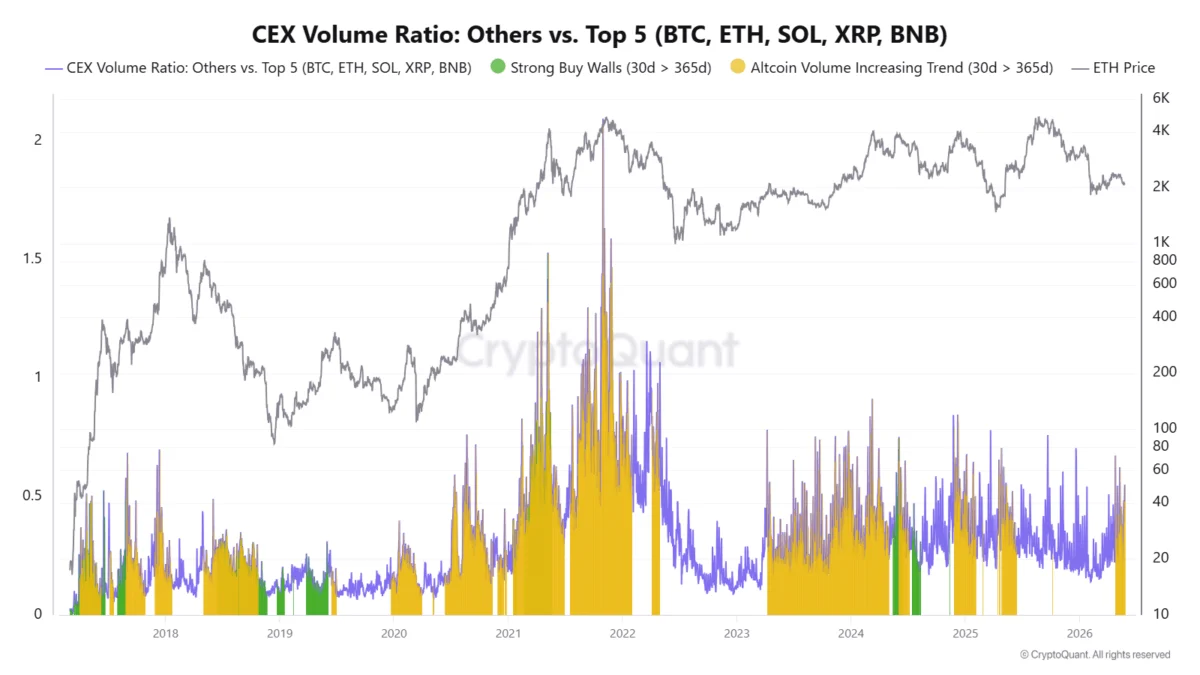
The contemporary cryptocurrency market is characterized by a profound sense of exhaustion. Following months of unrelenting selling pressure, macroeconomic uncertainties, and a failure of the broader altcoin sector to stage the anticipated multi-token rally, retail engagement has plummeted. General market sentiment sits firmly in negative territory, underscored by stagnant weekly price action and a distinct scarcity of the speculative euphoria that defined earlier cycles. Yet, beneath this veneer of market-wide apathy, on-chain intelligence reveals a fascinating divergence. According to recent telemetry compiled by analytics platform CryptoQuant, trading volumes for altcoins outside the top five tier assets—specifically excluding Bitcoin, Ethereum, Solana, XRP, and BNB—are actually on the rise. This quiet expansion of exchange volume during a period of generalized disengagement points toward deliberate, strategic accumulation by sophisticated market participants rather than random retail noise.
The Anatomy of Market Fatigue and Low-Engagement Accumulation
To understand the weight of the current altcoin volume anomaly, one must examine the broader macroeconomic and structural backdrop that has weighed on digital assets over the past several cycles. The market structure of the 2024-2026 era has been notably bifurcated. Capital has continuously funneled into institutional vehicles, treasury reserve assets, and the undisputed heavyweights of the ecosystem, leaving smaller-cap altcoins starved of organic liquidity.
For many retail investors and casual traders, this cycle has proven uniquely punishing. Previous historical benchmarks led market participants to expect a widespread "altcoin season"—a period where capital cascades down the risk curve from Bitcoin into micro-cap and mid-cap tokens, generating exponential returns across the board. When that broad-based rally failed to materialize at historical scales, enthusiasm curdled into skepticism and, eventually, profound disengagement.
However, market history consistently demonstrates that major structural shifts rarely occur amidst deafening fanfare. Instead, accumulation phases frequently coincide with periods of maximum boredom, widespread disillusionment, and low overall participation. The CryptoQuant data isolating exchange volumes for smaller-cap assets indicates that while the speculative masses have departed, a resilient cohort of capital allocators is quietly positioning themselves. Rather than chasing short-term pumps, these actors are methodically building inventory during sessions of low volatility, treating depressed valuations as long-term asymmetry rather than permanent terminal decline.

Chronology of the Altcoin Downtrend: From 2024 to 2026
The trajectory of the altcoin market over the past two and a half years provides crucial context for the current volume divergence. Tracing this timeline highlights how market participants have adapted to prolonged underperformance:
- Early to Mid-2024: Following initial macroeconomic rate-cut speculations and the successful approval of spot Bitcoin ETFs, capital concentrated almost entirely in Bitcoin and select institutional favorites. While Bitcoin pushed toward new highs, the broader altcoin market experienced a delayed and muted response.
- Late 2024 to Early 2025: Hopes for a traditional post-halving altcoin surge were largely frustrated. While fleeting narrative-driven rallies (such as localized surges in meme coins or artificial intelligence tokens) captured brief attention, the macro index for smaller-cap assets continued a steady downward bleed against Bitcoin.
- February 2025 Recovery Attempt: A brief market-wide relief rally injected temporary optimism into the sector, prompting retail participants to re-enter positions. However, persistent macroeconomic headwinds and a lack of follow-through volume quickly erased these gains, plunging market sentiment into deeper stagnation.
- Late 2025 to Mid-2026: Trading volumes across major centralized exchanges compressed significantly. It is within this window of prolonged consolidation and exhaustion that CryptoQuant began detecting the anomalous uptick in exchange volumes for altcoins outside the top tier, signaling a transition from reactive capitulation to quiet accumulation.
Analyzing the OTHERS/BTC Ratio: Signs of Macro Stabilization
The behavior of individual altcoins finds a macro counterpart in the OTHERS/BTC index, a vital charting metric that tracks the total market capitalization of all crypto assets excluding the top 10 relative to Bitcoin. For over two years, this ratio has mapped a relentless downward trend, graphically illustrating how capital has continually drained from the broader altcoin economy to feed the dominance of Bitcoin and primary layer-1 assets.
From a technical standpoint, the multi-year macro structure of the OTHERS/BTC index remains decidedly fragile. The ratio continues to trade comfortably below its major moving averages—including the closely watched 50-week, 100-week, and 200-week simple moving averages. This alignment confirms that Bitcoin’s structural dominance over the broader ecosystem remains unbroken on higher timeframes.
Nevertheless, beneath the surface weakness, the character of the price action has shifted. The aggressive, unyielding waterfall decline that characterized the market throughout 2024 and early 2025 has given way to a prolonged sideways consolidation phase, finding a localized floor near the 0.12 region. In technical analysis, protracted horizontal consolidation following a severe multi-year downtrend often serves as the foundational base for a cyclical trend reversal.
Market technicians note that the defense of this range is occurring simultaneously with subtle volume expansions during minor relief attempts. This confluence suggests that sellers are progressively exhausting their inventory, even in the absence of a confirmed bullish breakout. Should the OTHERS/BTC ratio manage to reclaim its declining 50-week moving average and print a sequence of higher local highs, it would provide the first empirical confirmation that institutional and high-net-worth capital is systematically rotating back down the risk curve.

Analyst Insights and Institutional Perspectives
While retail sentiment forums reflect deep frustration, institutional analysts and on-chain researchers view these phases through a lens of cyclical mechanics. Market structure experts point out that liquidity is rarely destroyed in crypto; rather, it rotates across risk tiers in accordance with macro liquidity cycles and investor risk appetites.
Several senior market strategists emphasize that the current divergence between declining sentiment and rising altcoin exchange volume is a textbook indicator of smart money positioning. "Retail traders buy when the narrative is loud, prices are green, and media attention is ubiquitous," notes one independent market structure researcher. "Conversely, seasoned allocators accumulate when liquidity is thin, volatility is compressed, and the broader narrative is written off as dead. The data showing rising altcoin volume amidst low general participation tells us that informed actors are taking the other side of the retail exit."
Furthermore, venture capital deployments and early-stage protocol metrics suggest that underlying development has not slowed down despite token price stagnation. Layer-2 scaling solutions, modular infrastructure projects, decentralized finance (DeFi) primitives, and real-world asset (RWA) tokenization networks continue to ship code and secure integrations. This fundamental disconnect between price depression and developer output historically creates asymmetric risk-reward setups for those willing to accumulate during periods of peak market apathy.
Broader Implications for the Next Market Cycle
The implications of this quiet accumulation phase extend far beyond short-term exchange statistics. If historical market cycles offer any reliable template, the current phase of low-engagement accumulation serves as the crucible for the next generation of market leaders.
When capital eventually begins to rotate out of primary reserve assets like Bitcoin and Ethereum—typically driven by macro liquidity injections, falling interest rate environments, or the maturation of secondary market infrastructures—it rarely floods the entire altcoin market uniformly. Instead, capital selectively targets sectors and tokens that have undergone the most rigorous cleansing processes during the preceding bear market or prolonged consolidation window.

The fact that exchange volumes are concentrating in non-top-five assets during a period of market-wide malaise suggests that capital is being filtered through a lens of deliberate selection. Rather than speculative money chasing any green candle, the current volume is being driven by deliberate positioning in specific niches of the digital asset economy.
As the market navigates the remainder of 2026, the critical metrics to monitor will not be social media sentiment indices or broad retail engagement metrics, but rather the structural defense of multi-year consolidation bases like the OTHERS/BTC range and the persistence of on-chain accumulation trends. If these technical floors hold and volume expansion broadens out of its current localized pockets, the quiet accumulation witnessed today may well be recognized in hindsight as the foundational floor of the next major altcoin market cycle.