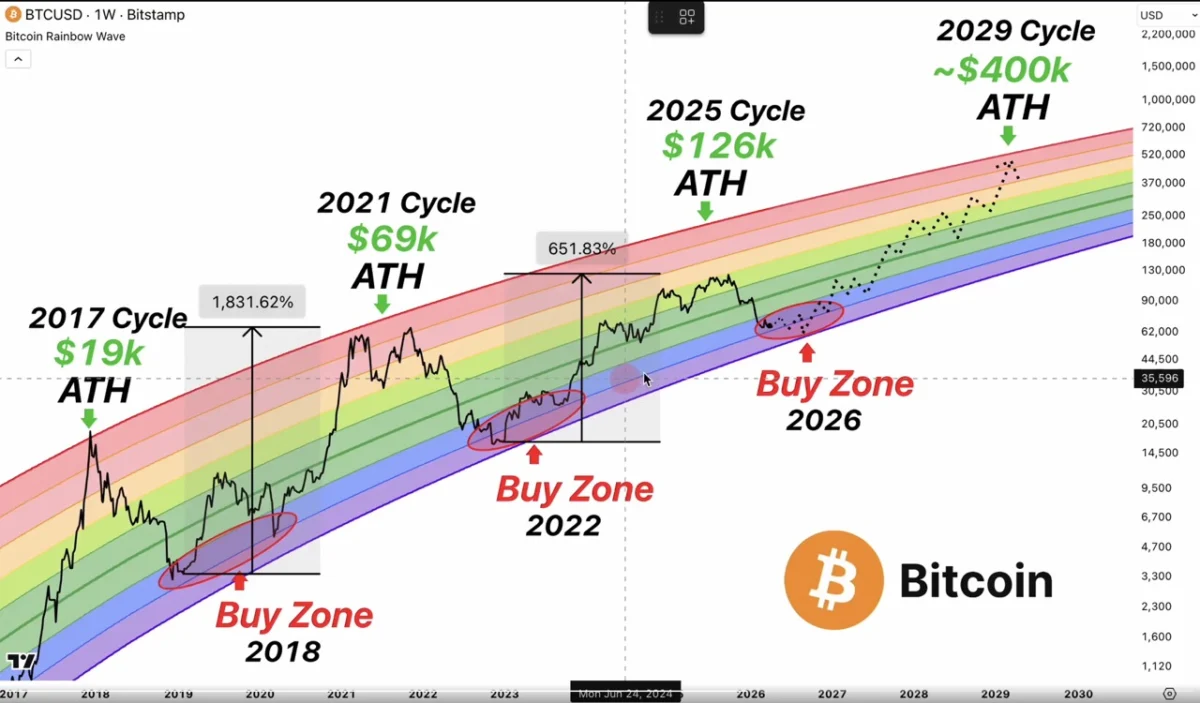
The recent volatility in the cryptocurrency markets, characterized by a sharp correction that saw Bitcoin (BTC) dip toward the $59,000 threshold, has reignited intense debate regarding the asset’s cyclical behavior. While retail sentiment has been dominated by extreme fear and uncertainty, institutional analysts and market technicians are interpreting these fluctuations through the lens of historical market cycles. Among these observers, crypto analyst Alex Mason has posited that the current price action is not a sign of systemic failure, but rather a predictable, albeit painful, stage of a maturing market cycle. According to this perspective, Bitcoin is navigating the final phases of a prolonged bear market, setting the stage for what many long-term investors anticipate will be a significant upward trajectory.
The Chronology of Recent Market Pressure
To understand the current state of Bitcoin, one must examine the timeline of the recent downturn. The market has been under sustained bearish pressure for over a year, a period defined by fluctuating macroeconomic conditions, rising interest rates, and a general cooling of investor appetite for risk-on assets. The recent drop to $59,000, followed by a modest recovery to approximately $61,000, is viewed by proponents of cycle theory as a necessary "clearing" of the market.
Historically, Bitcoin bear markets reach their nadir through a series of lower lows that shake out short-term speculators. The price action witnessed in recent weeks appears to align with this pattern. The initial decline triggered a surge in volatility, causing significant liquidations across derivatives exchanges. However, the subsequent stabilization above $60,000 suggests that a baseline level of demand remains active. Analysts like Mason argue that this specific technical formation—a sharp crash followed by a fragile recovery—is characteristic of the final accumulation phase before a broader structural change in trend.

Technical Analysis and the Path Toward the Bottom
The prevailing theory among market technicians suggests that Bitcoin is currently transitioning into the final stage of its bear market cycle. In this framework, the $59,000 to $61,000 range serves as a testing ground for support. While market participants may feel discouraged by the lack of immediate upward momentum, technical indicators often require these periods of consolidation to build the necessary volume for a sustainable reversal.
The projected roadmap for Bitcoin’s price, as outlined in recent technical reports, suggests a period of "re-testing." While a potential short-term bounce toward $65,000 is considered possible, many analysts believe this would likely be a "bull trap"—a deceptive rally designed to lure in liquidity before a final, deeper decline. This subsequent leg down could see the asset testing the $57,000 support level, and if that fails to hold, a potential capitulation event into the $40,000 price range.
While a drop to the $40,000s may seem catastrophic to the casual observer, market veterans often characterize these levels as a "value zone." The logic here is that the lower the price goes during the final stages of a cycle, the more attractive the asset becomes to long-term institutional buyers and retail investors who missed previous entry opportunities. Once the price establishes a firm floor—potentially around the $47,000 mark—the technical groundwork would be laid for a sustained, multi-year bull run.
Comparative Historical Data and Cycle Theory
The use of predictive models, such as the Bitcoin Rainbow Chart, has become a staple in assessing the asset’s long-term valuation. These models rely on the historical premise that Bitcoin’s price growth is not linear but logarithmic, following a series of "halving" events that reduce the supply of new coins entering the market. By mapping the current price against historical growth curves, analysts attempt to strip away the noise of short-term volatility to reveal the underlying trend.

If current projections hold, the move from the $47,000 floor would represent the beginning of the next major cycle, potentially pushing Bitcoin back into the six-figure range. Some models even extend these projections, suggesting that if the asset continues to follow its historical growth curve, the cycle peak could reach as high as $200,000 to $400,000 by 2029. Such figures are, of course, contingent on external variables, including global liquidity, regulatory developments, and the continued adoption of Bitcoin as a digital store of value.
Broader Market Implications and Institutional Sentiment
The implications of these price movements extend far beyond the portfolios of individual traders. For institutional investors, the current volatility is a test of Bitcoin’s resilience. As more traditional financial institutions incorporate Bitcoin into their product offerings, the asset is increasingly treated as a macro-hedge against inflation and currency debasement.
The fear observed in the market—often measured by the "Fear and Greed Index"—is frequently viewed by contrarian investors as a lagging indicator. When fear is at its peak, it often coincides with the moment of maximum opportunity. However, this is tempered by the reality of the current economic environment. The Federal Reserve’s stance on interest rates and the overall health of the global financial system remain the primary drivers of risk-on assets. Any shift in monetary policy that increases liquidity could accelerate the timeline for a recovery, whereas continued restrictive conditions may prolong the accumulation phase.
Managing Risk in a High-Volatility Environment
For those navigating the current climate, the consensus among financial experts is to focus on risk management rather than price speculation. The volatility inherent in the cryptocurrency space means that short-term price predictions are notoriously difficult to time with precision. The "final stage" of a bear market is often the most difficult to endure, as it is defined by boredom, frustration, and the desire to exit the market just before a reversal occurs.
Investors are often advised to look at the "on-chain" metrics—data that tracks the movement of coins on the blockchain. Currently, data suggests that long-term holders, often referred to as "HODLers," are not moving their assets to exchanges, which indicates a high degree of conviction in the long-term outlook despite short-term price fluctuations. When the supply of Bitcoin held by long-term investors remains stable during a price crash, it is generally interpreted as a bullish signal, as it suggests that the "smart money" is not interested in selling at these levels.
Conclusion: Looking Ahead to 2026 and Beyond
As the market continues to grapple with the aftermath of the $59,000 crash, the path forward appears to be one of cautious consolidation. While the potential for a deeper correction into the $40,000 range remains a focal point for risk-averse investors, the long-term thesis for Bitcoin remains fundamentally anchored in its scarcity and decentralized architecture.
The upcoming years will be critical in determining whether Bitcoin can successfully transition from its current speculative phase into a more stable asset class. For now, the market remains in a state of flux, waiting for a definitive catalyst to break the current cycle of fear. Whether the bottom is at $47,000 or elsewhere, the current period serves as a stark reminder that in the world of digital assets, volatility is the price of admission for potential long-term gains. As market participants look toward the next cycle, the focus remains on the structural integrity of the network and the continued expansion of the Bitcoin ecosystem, both of which continue to grow despite the noise of the daily price charts.