, and Technical Outlook Following Recent Dips
The cryptocurrency market experienced a synchronized downward correction mid-week, with Gram [GRAM] registering a notable 5.28% decline on Wednesday, October 18. This correction did not occur in a vacuum; it coincided with broader macroeconomic and sector-wide pressures that dragged down major digital assets. Bitcoin [BTC], the undisputed bellwether of the cryptocurrency ecosystem, faced a 2.89% slide during the same 24-hour window, while the cumulative altcoin market capitalization contracted by 1.62%. For traders and investors holding or monitoring GRAM, this recent wave of volatility has reignited a critical debate: Does the current price dip represent a lucrative accumulation opportunity, or are market participants walking into a bearish trap that warrants strict risk management and a defensive stance?

To understand GRAM’s current trajectory, one must examine the events that preceded this week’s sell-off. Earlier in the month, GRAM captured significant market attention and capital inflows following an aggressive price rally that pushed the token to a local high of $1.27. This bullish momentum was largely catalyzed by public endorsements from Telegram founder Pavel Durov, who explicitly characterized the token as "ridiculously undervalued." Durov’s commentary historically carries considerable weight within the broader Telegram-adjacent ecosystem, driving speculative fervor and retail participation. However, sharp rallies fueled by social sentiment and high-profile endorsements frequently leave behind structural vulnerabilities, particularly in the derivatives and futures markets.
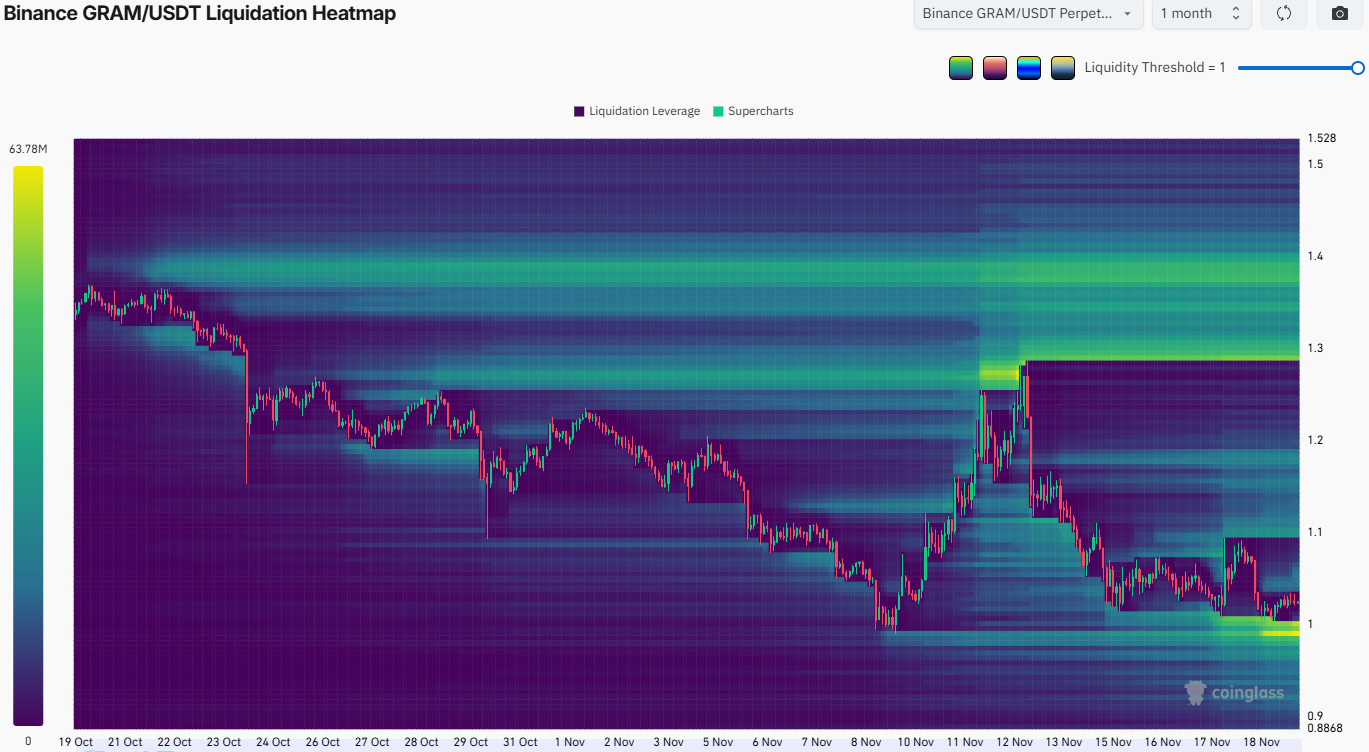
An analysis of the one-month liquidation heatmap for GRAM reveals a complex landscape characterized by dense clusters of liquidity both above and below the current market price. The rapid ascent to $1.27 created significant magnetic zones—areas where leveraged positions are concentrated and prone to liquidation. Crucially, the $1.00 threshold has emerged as a psychologically and technically vital level. This integer milestone holds strong technical confluence with the foundational floor of the earlier October rally. Market mechanics dictate that liquidity pooling just beneath such psychological barriers often acts as a magnet, systematically pulling prices lower to flush out late longs before any genuine reversal can materialize. Consequently, while a sweep of this lower liquidity zone could theoretically pave the way for a relief rally back toward the $1.27 to $1.30 resistance range, the prevailing macroeconomic and technical trend suggests that attempting a swing-buy trade carries an exceptionally high degree of risk.
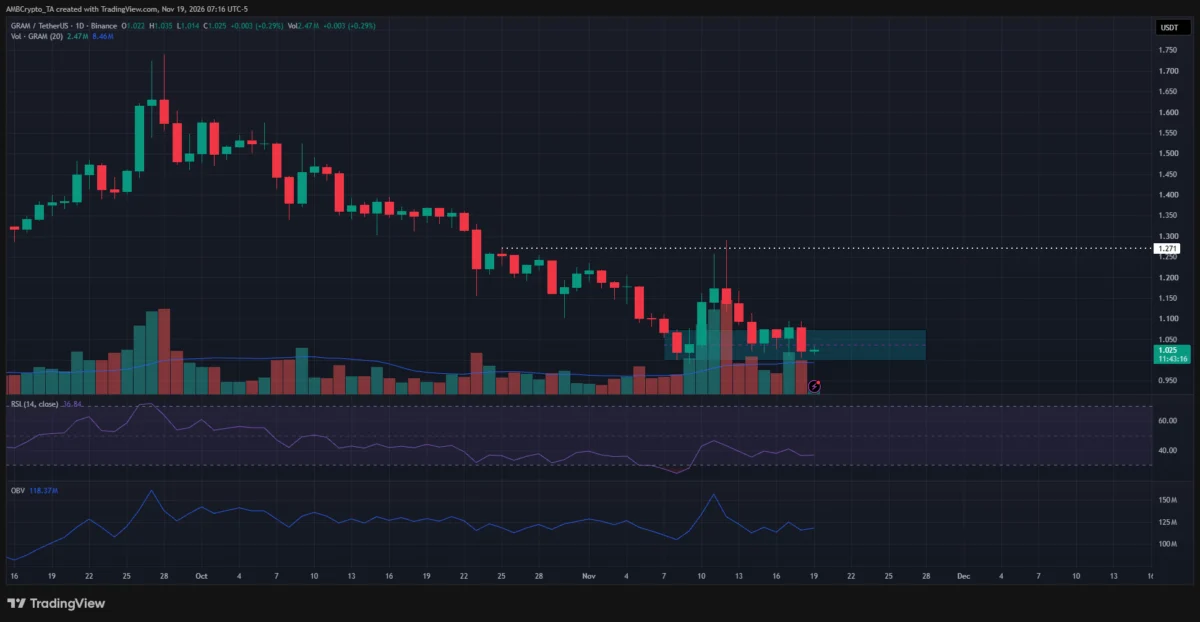
A granular inspection of the daily timeframe chart further validates the cautious sentiment currently held by institutional and seasoned retail traders. The forceful rejection witnessed after GRAM swept its October high of $1.27 clearly demonstrates that sell-side participants retain the upper hand in the medium term. Momentum indicators corroborate this bearish dominance; the daily Relative Strength Index (RSI) has lingered stubbornly below the neutral 50 threshold for over a month. In technical analysis terms, a prolonged RSI reading below 50 signifies sustained underlying selling pressure and an absence of robust accumulation. For market participants tracking the daily chart, the $1.00 to $1.07 zone serves as a critical local demand area. Observers are also closely monitoring the On-Balance-Volume (OBV) metric, as its upcoming trends are expected to provide definitive clues regarding whether institutional capital is quietly distributing tokens or preparing for a sustained defense of key structural supports.
Zooming into the intraday price action, the 1-hour chart highlights a defined short-term trading range fluctuating between $1.00 and $1.09, with the mid-range equilibrium sitting precisely at $1.045. At the time of reporting, GRAM’s spot price was hovering near the lower bounds of this established range. This positioning presents a precarious scenario for aggressive bulls. While tactical traders might eye the $1.00 mark as an entry point for a quick bounce toward the $1.045 to $1.09 resistance band, a decisive breach below the $0.978 level would invalidate the thesis entirely. Such a breakdown would signal that bears have successfully forced a structural collapse, rendering the short-term range-low buying strategy obsolete and exposing the asset to deeper corrections in alignment with the broader higher-timeframe downtrend. For aggressive sellers, waiting for either a confirmed breakdown below $0.98 or a rejection at higher range resistance offers a statistically sounder entry framework than attempting to catch a falling knife in a weak market structure.
The broader implications of GRAM’s recent price action extend beyond immediate chart patterns, offering a case study in the lifecycle of sentiment-driven altcoin rallies. When high-profile figures publicize valuations, the resultant influx of retail capital frequently outpaces organic network growth and liquidity depth. This dynamic creates fragile market structures where sudden macro-driven pullbacks—such as Bitcoin’s 2.89% slide—can trigger cascade liquidations. As the broader altcoin market continues to navigate macroeconomic headwinds and shifting regulatory landscapes, tokens closely tied to messaging ecosystems and community-driven narratives must prove their utility beyond speculative cycles.
Market analysts emphasize that risk management remains paramount for anyone engaging with GRAM at this juncture. The convergence of a sub-50 daily RSI, a clear loss of momentum following the October peak, and vulnerability at the $1.00 psychological support level suggests that patience is the most prudent strategy. Whether traders choose to maintain a bearish bias or wait for concrete signs of trend reversal at foundational demand zones, navigating GRAM requires strict adherence to stop-loss protocols and an acute awareness of broader cryptocurrency market correlations. As the weekly close approaches, the ability of bulls to defend the psychological $1.00 floor will ultimately dictate whether GRAM stabilizes into a healthy consolidation phase or succumbs to a deeper bearish continuation.