France is currently navigating a period of profound socioeconomic and political turbulence. The intersection of escalating living costs, a tightening national budget, sweeping public sector austerity measures, and intense nationwide demonstrations has fundamentally altered the political landscape. As the country looks ahead to the crucial presidential election scheduled for April 2027, prediction markets like Polymarket are tracking a seismic shift in voter sentiment. Traders are closely evaluating how ongoing civil unrest, global geopolitical conflicts, and domestic economic pressures will reshape the race for the Élysée Palace.
The backdrop of this political volatility is defined by widespread dissatisfaction among French citizens. On Saturday, October 17, the country witnessed yet another wave of mass mobilization. Official police figures recorded approximately 550,000 marchers taking to the streets across France, while independent organizers placed the turnout closer to 800,000. These demonstrations, aimed at protesting the escalating cost of living and stringent government austerity, resulted in heightened tensions. Law enforcement reported at least 1,800 arrests nationwide, highlighting the severe friction between frustrated citizens and state authorities.
This deep-seated public anger has placed immense pressure on an already embattled government. President Emmanuel Macron’s administration is currently attempting to push through aggressive spending cuts to address a widening national deficit. However, as households grapple with surging inflation, high fuel prices, and struggling public services, the political fallout has been swift. Prediction markets and political analysts alike are now asking a pivotal question: Which political figures stand to gain the most as disillusioned French voters prepare to head to the ballot boxes in April 2027?
Chronology of Unrest: From Educational Boycotts to Nationwide Demonstrations
The roots of the current social unrest can be traced back to September 21, when the movement first materialized in the form of student-led school boycotts in the deprived suburbs of Paris. Initially, the grievances were centered on structural issues within the public education system. Students and parents protested against unreplaced absent teachers, dilapidated school buildings, and severely overcrowded classrooms.
What began as localized educational protests rapidly escalated into a nationwide movement encompassing broader socioeconomic grievances. By early October, the demonstrations had transformed into a collective outcry against the soaring cost of living, energy price hikes, and declining household purchasing power.
As the protests swelled in size, incidents of civil disobedience and property damage began to surface, particularly during weekend demonstrations. While authorities and independent observers noted that looting and arson were largely driven by masked fringe groups rather than the peaceful majority of marchers, the policing response has become a focal point of public controversy.
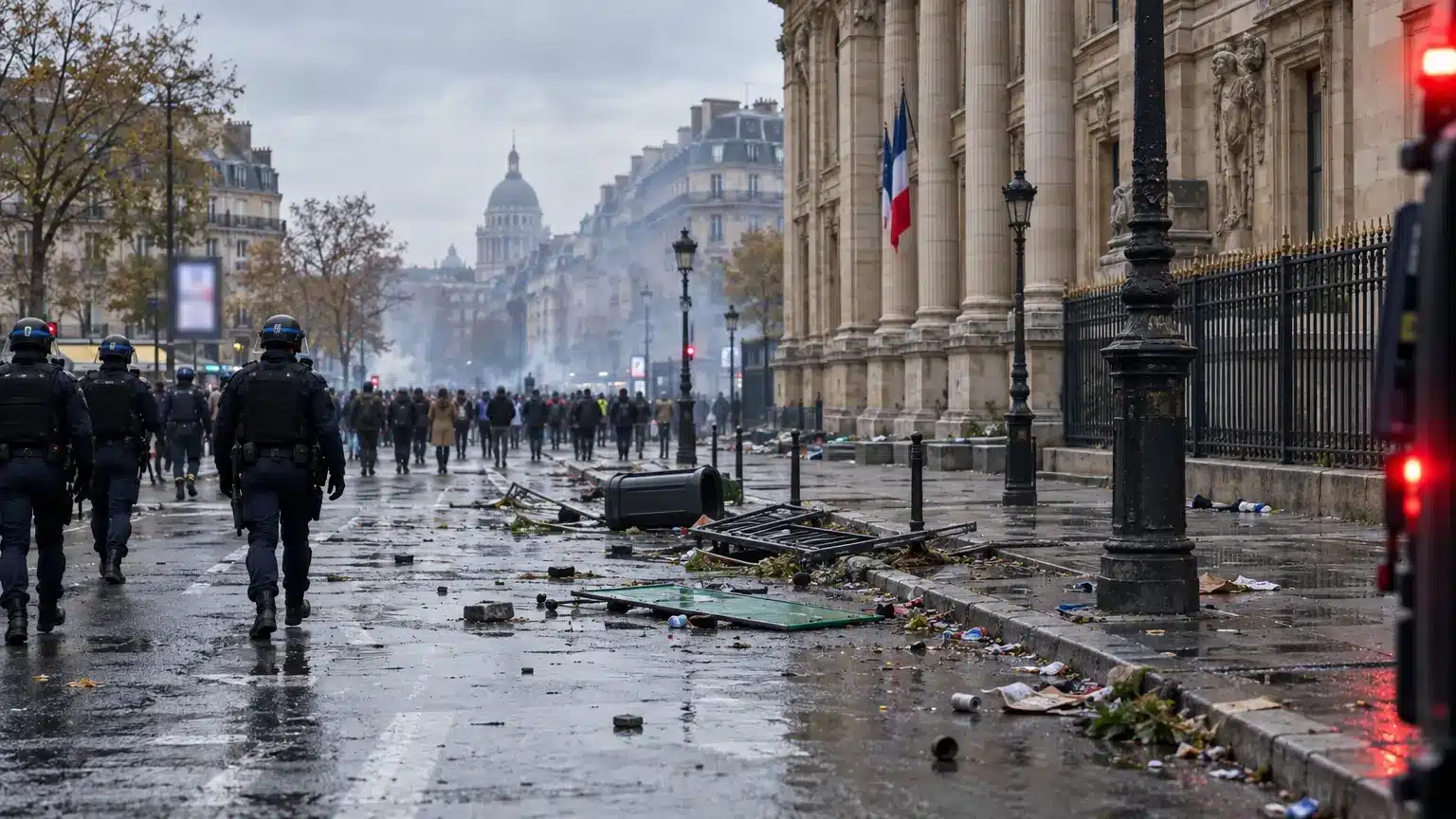
Tensions reached a boiling point following aggressive interventions by law enforcement. According to reports by Al Jazeera, more than 6,100 people had been arrested by early October, a significant portion of whom were minors. Furthermore, the human cost of the clashes has drawn widespread condemnation; a tragic incident in Lens left a 15-year-old student with a severed hand after a police stun grenade exploded, prompting an immediate official investigation into the use of force by law enforcement agencies.
Economic Pressures: Energy Crises, Inflation, and Austerity Measures
To fully understand the shifting political dynamics in France, one must examine the severe economic headwinds facing average households. The most immediate pressure point for consumers has been the cost of energy. Following the outbreak of war involving the United States, Israel, and Iran in February, global oil markets experienced severe disruptions. Consequently, French diesel prices surged to a record €2.41 per liter on September 21. At the height of this supply crunch, approximately 16% of petrol stations across France reported shortages of at least one fuel type, crippling daily commutes and commercial logistics.
Macroeconomic indicators have compounded this distress. Inflation climbed to 3.0% in September, up from 2.4% in August. The French national statistics institute, Insee, projected that overall household purchasing power would contract by 0.4% over the course of the year, driven primarily by wage growth lagging behind persistently high consumer prices.
Compounding these consumer struggles, the French government introduced a highly controversial 2027 budget proposal designed to shave €54 billion from the national deficit. Among the most contentious elements of this fiscal package is a €2 billion public-sector pay freeze. While government officials defend the austerity measures as a vital and unavoidable step to stabilize public finances and comply with European Union fiscal rules, critics argue that the cuts disproportionately punish middle-income and low-income families. Opposition lawmakers and labor unions point out that reductions in state spending directly impact public pensions, healthcare systems, and educational institutions, exacerbating the vulnerability of ordinary citizens.
Polymarket Odds and the 2027 Presidential Race
The convergence of economic hardship and social unrest has radically transformed the calculus for the upcoming French presidential election. Prediction markets, which aggregate real-time trader sentiment and capital allocation, have reacted decisively to the shifting political winds.
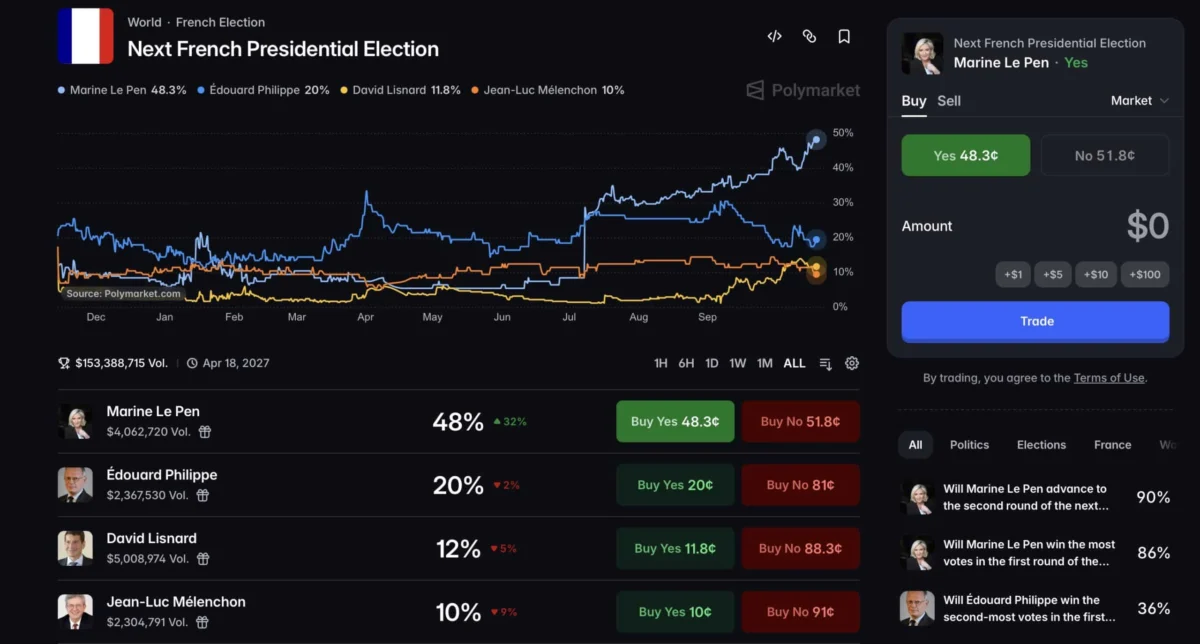
Polymarket data highlights a commanding lead for National Rally leader Marine Le Pen. Traders currently assign Le Pen a 48.3% probability of winning the presidential runoff scheduled for April 18, 2027. Furthermore, prediction markets price her chances of advancing to the second round of voting at an overwhelming 90%.

Behind Le Pen, former Prime Minister Édouard Philippe trails significantly with a 20% probability of securing the presidency. Local government leader David Lisnard holds 11.8%, while left-wing figurehead Jean-Luc Mélenchon sits at 10%. Despite intense speculation surrounding domestic political stability, markets remain largely confident in the institutional continuity of the current executive branch in the near term; Polymarket data indicates only a 4% chance that President Emmanuel Macron will leave office before December 31, 2026.
It is important to note that prediction market odds reflect crowd-sourced sentiment and trader positioning rather than definitive statistical forecasts. Nonetheless, these platforms offer valuable market intelligence regarding how financial and political observers perceive the trajectory of European governance.
Broader Impact, Implications, and Expert Analysis
The ongoing turmoil in France carries significant implications not only for domestic stability but also for the broader European Union. France remains a core pillar of the Eurozone’s economic and political architecture. Prolonged civil unrest, coupled with a growing populist political momentum, threatens to disrupt EU-level policy coordination, particularly regarding fiscal integration, defense, and green transition mandates.
Political analysts suggest that the current government finds itself in an unenviable policy trap. On one hand, failing to implement fiscal consolidation risks triggering a loss of confidence among bond markets and European regulators. On the other hand, pursuing aggressive austerity in the face of rampant inflation and declining purchasing power acts as a powerful catalyst for civil disobedience, ultimately bolstering anti-establishment and populist political parties.
As France moves closer to the April 2027 presidential contest, the trajectory of the nation will largely depend on the government’s ability to appease a frustrated populace without compromising its fiscal targets. Whether through strategic concessions on the national budget, reforms to policing tactics, or targeted relief for energy consumers, the administration must navigate a narrow path to restore social cohesion. Until then, the volatility observed in both the streets of Paris and prediction markets like Polymarket serves as a clear indicator of a nation deeply at a crossroads.