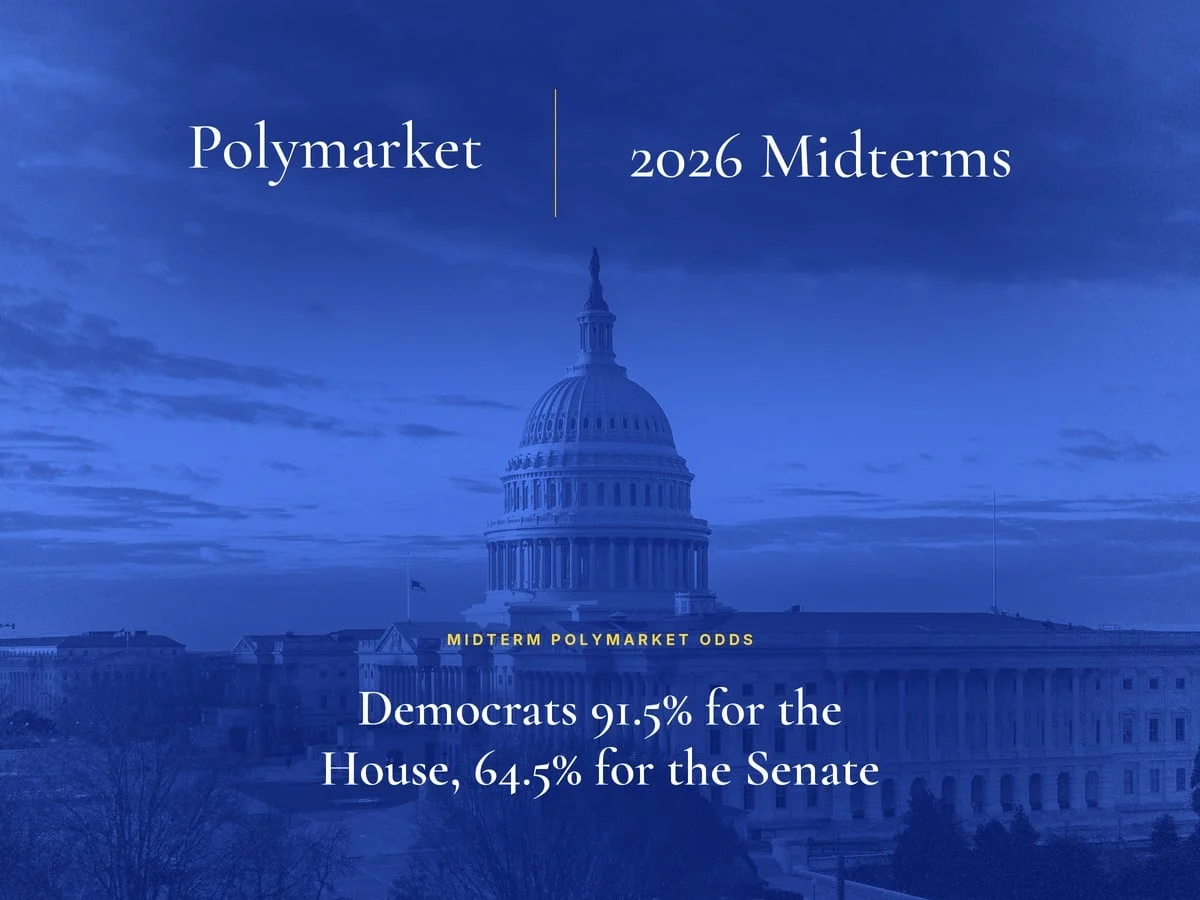
With the 2026 midterm elections drawing closer, prediction markets are increasingly pricing in a significant political shift that could profoundly reshape the regulatory landscape for digital assets in the United States. According to data from Polymarket, decentralized finance traders currently assign Democrats a commanding 91.5% probability of capturing the House of Representatives. Meanwhile, the likelihood of a Democratic takeover in the Senate stands at 64.5%. These projections, reflecting market sentiment as of late October, highlight a growing consensus that Washington may soon see a unified Democratic majority, a development that carries direct consequences for upcoming cryptocurrency legislation.
The broader implications of these odds extend far beyond traditional partisan politics. Because the U.S. Congress is responsible for drafting, debating, and passing comprehensive digital asset laws, the composition of the legislative branch next year will determine which lawmakers hold committee gavels, set the legislative calendar, and dictate the trajectory of federal oversight for blockchain technology. As billions of dollars in prediction market volume flow through these contracts, industry stakeholders, lobbyists, and investors are closely monitoring every percentage shift to gauge the future of crypto policy.
Shifting Odds: House All But Decided While Senate Contracts Drive Market Volatility
A granular examination of Polymarket’s primary election contracts reveals distinct behavioral patterns among traders. The House of Representatives market, which has accumulated a substantial trading volume of $18.78 million, treats a Democratic victory as a near-certainty. Over the preceding month, the odds for a Democratic House hovered between 91.5% and 92.5%, indicating that market participants see very little room for a Republican defense of the chamber.
In contrast, the Senate market—with a total trading volume of $7.23 million—remains the primary battleground for speculative capital. Because the Senate contract is significantly thinner in liquidity, it is more susceptible to movement from large-scale trades. Over a four-week period, the probability of a Democratic Senate climbed from 60.5% to 64.5%.
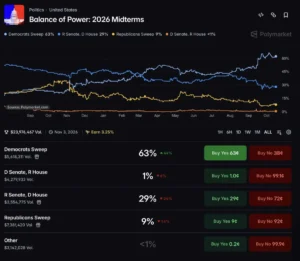
A third contract, focusing on the overall balance of power in Washington, further clarifies these dynamics. Polymarket’s balance-of-power market, which has drawn $25.54 million in volume, prices a complete Democratic sweep of both chambers at 62.5%. Meanwhile, a divided government consisting of a Democratic House and a Republican Senate sits at 27.5%, down from 30.5% a month prior. A Republican sweep of both chambers is considered a long shot by market participants, currently priced at just 8.5%.
Political figures have taken notice of the growing reliance on prediction markets as alternative polling indicators. The debate over the accuracy and integrity of modern forecasting tools intensified after former President Donald Trump publicly declared that contemporary midterm polls are "rigged," prompting heightened discourse across financial and political circles regarding the reliability of sentiment-driven data versus traditional polling methodologies.
The Legislative Fate of the CLARITY Act
The outcome of these midterm races carries immediate urgency for key legislative initiatives, most notably the Digital Asset Market Structure and Investor Protection Act—widely known as the CLARITY Act. Designed to establish a comprehensive federal regulatory framework for digital commodities and securities, the bill represents one
of the most anticipated legislative efforts in the history of the cryptocurrency industry.

The path of the CLARITY Act has been marked by high-stakes legislative battles. In July 2025, the bill achieved a significant bipartisan milestone by passing the House of Representatives with a decisive 294–134 vote. However, momentum stalled when the legislation moved to the upper chamber. On September 15, the bill failed a critical Senate procedural vote by a narrow 49–50 margin, leaving its future hanging in the balance.
To keep the legislation alive, Senator Thom Tillis entered a motion to reconsider, preserving the possibility of floor action during the lame-duck session following the midterm elections. Industry analysts note that if the CLARITY Act fails to secure passage before the current Congress expires in January, the legislative process will have to restart from scratch in the next congressional session. Under a newly convened Congress—particularly one potentially led by a Democratic House—the bill would likely face a completely different political calculus, potentially altering key provisions related to the jurisdiction of the Securities and Exchange Commission (SEC) and the Commodity Futures Trading Commission (CFTC).
Leadership Shifts and Congressional Oversight
A Democratic takeover of the House of Representatives would trigger immediate leadership changes within vital congressional committees, directly altering how the federal government interacts with the Web3 sector. The most consequential shift would occur at the helm of the House Financial Services Committee, the primary body responsible for banking, housing, and financial technology oversight.
Representative Maxine Waters, the ranking Democratic member of the committee, is positioned to reclaim the gavel from Republican Chair French Hill should Democrats secure the chamber. Waters, who previously chaired the committee from 2019 until Republicans regained the House majority in January 2023, has historically advocated for rigorous consumer protection, stringent anti-money laundering compliance, and heightened regulatory scrutiny of digital asset firms. Her return to the chairmanship would fundamentally change the tone of congressional hearings, shifting the focus toward consumer safeguards and systemic financial risk.
However, Waters may face an intra-party challenge for the leadership role. Representative Sean Casten has emerged as a potential contender for the top Democratic spot on the committee. While party leadership, including House Minority Leader Hakeem Jeffries, has maintained a neutral stance on the potential contest, the internal dynamics of the Democratic caucus could influence the committee’s specific policy priorities regarding decentralized finance and stablecoin regulation.
Broader Implications for the U.S. Digital Asset Economy
The convergence of prediction market sentiment, congressional leadership battles, and stalled legislative vehicles underscores the high-stakes environment surrounding U.S. crypto policy. For years, industry participants have criticized what they term "regulation by enforcement," arguing that the absence of clear statutory guidelines from Congress stifles innovation and drives blockchain startups overseas.
The potential realization of a Democratic-controlled Congress under current market projections suggests that future regulation will likely emphasize investor protection, systemic risk mitigation, and formal integration of digital assets into the traditional banking sector. While some market participants worry that Democratic leadership may favor more restrictive compliance mandates, others argue that any clear statutory framework—even one requiring rigorous oversight—is preferable to the legal ambiguity that has characterized the market in recent years.
As the final weeks of the election cycle tick down, prediction market participants will continue to scrutinize Senate polls and funding flows. Whether the odds solidify into a definitive Democratic sweep or fluctuate back toward a divided government, the decisions made in Washington over the coming months will set the regulatory boundaries for the U.S. digital asset economy for the foreseeable future.