The broader digital asset market has experienced heightened volatility over the past week, with the decentralized finance and derivatives sector facing unique pressures. At the center of this market correction is Hyperliquid [HYPE], which has registered a notable 17 percent price decline over the trailing seven-day period. Trading at approximately $72.49 at the time of publication, the altcoin has found itself unable to recapture its previous upward momentum, failing to reclaim the critical $87 to $89 psychological price band.
Despite recent high-profile exchange listings designed to expand retail market access and liquidity across major Asian trading hubs, heavy selling pressure has dominated the asset’s order books. Market analysts note that a combination of large-scale whale liquidations, macroeconomic regulatory developments, and exchange-specific operational changes have converged to create a challenging environment for HYPE holders. As technical indicators point toward sustained bearish momentum, the digital asset is currently testing critical macro and micro support levels that could dictate its price trajectory for the remainder of the fourth quarter.
Chronology of Market Pressure: Whale Activity and Exchange Developments
The downward pressure currently impacting Hyperliquid did not materialize in a vacuum; rather, it is the result of a sequence of structural events that began unfolding in late October. On October 31, the market witnessed significant whale-tier distribution when two prominent HYPE holders collectively liquidated $109 million worth of tokens. This mass offloading coincided with a pivotal regulatory announcement from the Intercontinental Exchange (ICE), which released a more relaxed and accommodating regulatory stance regarding perpetual futures contracts. While institutional clarity is generally viewed as a positive long-term development for derivatives platforms, the immediate market reaction involved large stakeholders de-risking and realizing profits following months of substantial gains.
Compounding this supply shock, exchange operational updates further influenced market liquidity. Following a security breach experienced by Binance in October—which temporarily restricted asset mobility—the platform officially reopened HYPE withdrawals on November 8. This operational milestone unexpectedly injected fresh liquidity back into the open market, as long-term holders and arbitrageurs who had been locked out of their accounts finally gained the ability to transfer and liquidate their assets. The sudden influx of withdrawable tokens added immediate downward pressure to spot markets, overwhelming the existing buy-side liquidity and triggering consecutive sessions of red candles.
International Exchange Listings Fail to Stem the Tide
In an effort to counter the mounting selling pressure, Hyperliquid secured significant structural catalysts through listings on two of South Korea’s premier centralized cryptocurrency exchanges, Upbit and Bithumb, on November 10. South Korean retail markets have historically demonstrated a strong capacity to drive localized volume and short-term price appreciation for mid-to-large-cap altcoins.

However, even the usually potent "Upbit effect" proved insufficient to reverse the prevailing macro downtrend. While the listings generated initial trading volume and temporary spikes in market attention, the broader distribution trend spearheaded by whales and unlocked exchange balances completely offset the localized buying demand. Consequently, HYPE failed to break back above its primary resistance zones, slipping steadily away from the $87-$89 threshold and descending deeper into bearish technical territory.
Technical Analysis: The Weekly and Daily Retracement Zones
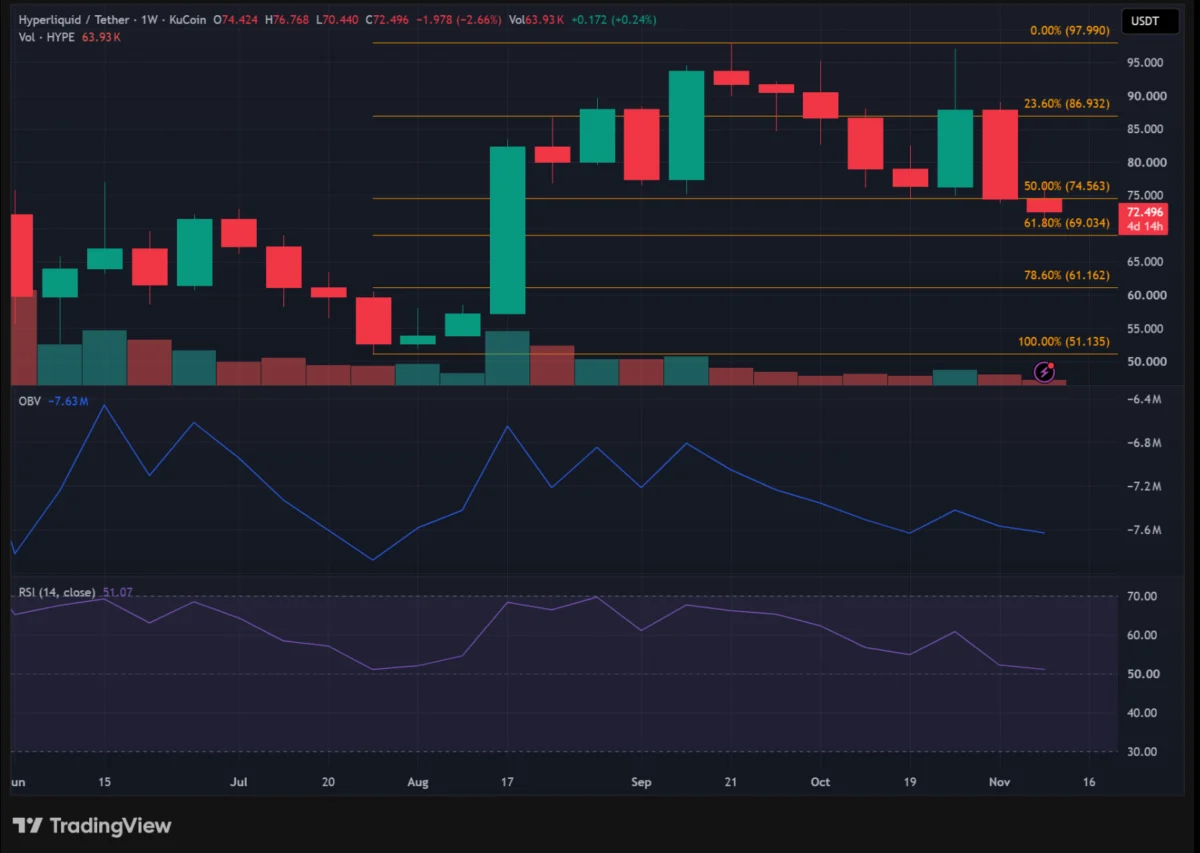
An examination of the weekly technical charts reveals that HYPE has decisively broken below the 50 percent Fibonacci retracement level, sinking deeper into the 61.8 percent retracement zone. In technical analysis, this specific region is frequently referred to as the "golden pocket," a critical threshold where institutional and swing buyers often attempt to establish macro bottoms. At $72.49, HYPE is currently testing the resilience of this zone.
Momentum indicators corroborate the cooling market sentiment. The weekly Relative Strength Index (RSI) stands at 51.07 and continues to slope downward. This reading indicates that the robust bullish momentum that characterized the asset’s performance through the late summer months has effectively evaporated, leaving the market in a neutral-to-bearish equilibrium. Furthermore, the On-Balance-Volume (OBV) indicator has displayed a noticeable decline from the peaks recorded between August and September. This divergence illustrates that buyers have struggled profoundly to match the high trading volumes associated with the recent waves of selling.
On the daily timeframe, the outlook remains similarly cautious. HYPE is trading directly beneath the 23.6 percent Fibonacci retracement line and hovering perilously close to its most recent swing low of $70.44. The daily RSI prints a subdued 35.35, signaling that sellers maintain firm short-term control over price action. Although a minor uptick in the daily OBV suggests fleeting flickers of buyer interest, analysts emphasize that this interest lacks the sustained volume required to engineer a genuine trend reversal.
Downside Targets and Critical Support Levels
As HYPE continues to test the patience of market participants, traders are closely monitoring a specific cluster of support levels to determine the next major price movement.
The immediate line of defense lies at the recent swing low of $70.44. Should persistent selling pressure breach this threshold, market attention will instantly pivot toward the weekly Fibonacci retracement support at $69.03. Market analysts suggest that if buyers can successfully defend the $69 region, the asset could establish a localized double bottom, potentially generating enough relief space for a measured technical recovery.
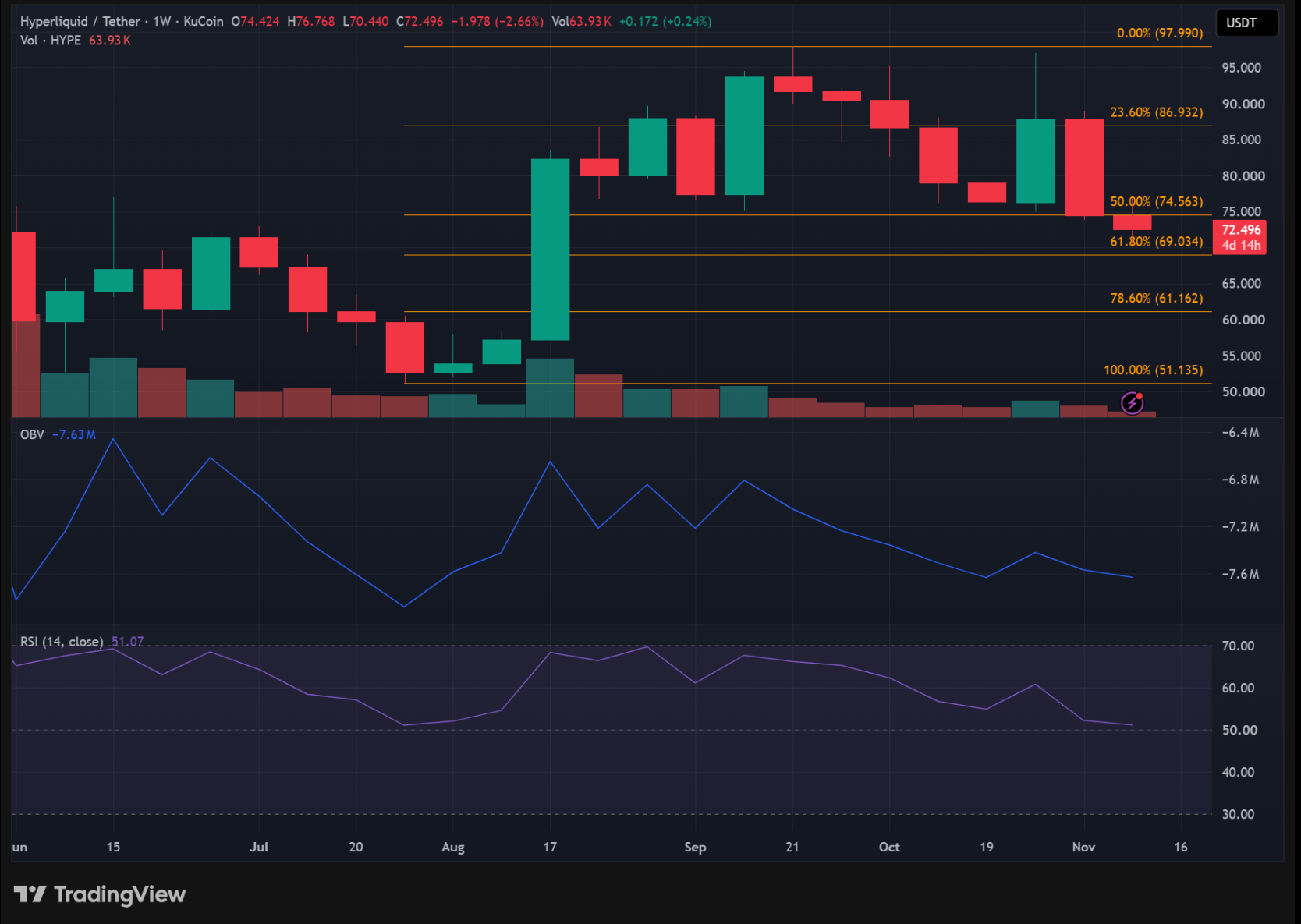
Conversely, if the $69 support level collapses under bearish weight, the next primary structural target sits significantly lower at the weekly Fibonacci level of $61.16. Such a move would represent an extension of the current correction phase, wiping out a larger portion of the mid-year gains and forcing market participants to re-evaluate the asset’s near-term valuation baseline.
Broader Implications for the Derivatives and DeFi Ecosystem
The recent price action of Hyperliquid offers broader insights into the delicate mechanics governing high-performance derivatives protocols and their native utility tokens. As decentralized finance increasingly intersects with traditional regulatory frameworks—evidenced by ICE’s shifting stances on perpetual futures—native tokens associated with derivatives platforms face unique market sensitivities.
Furthermore, the events surrounding the HYPE token highlight the systemic risks associated with exchange-level security incidents and liquidity bottlenecks. When large volumes of assets are temporarily sequestered due to platform maintenance or security protocols, a pent-up liquidation risk is frequently created. Once those restrictions are lifted, the resulting wave of supply can profoundly disrupt market equilibrium, overriding even traditionally bullish catalysts such as Tier-1 international exchange listings.
Moving forward, the ability of Hyperliquid to stabilize above its current golden pocket retracement zone will serve as a key bellwether for market sentiment regarding decentralized derivatives tokens. Whether daily buyers can marshal sufficient capital to defend the $69 floor—or whether macroeconomic and whale-driven distribution will force a deeper test of the $61 level—remains the central question for market participants as the fourth-quarter trading cycle progresses.