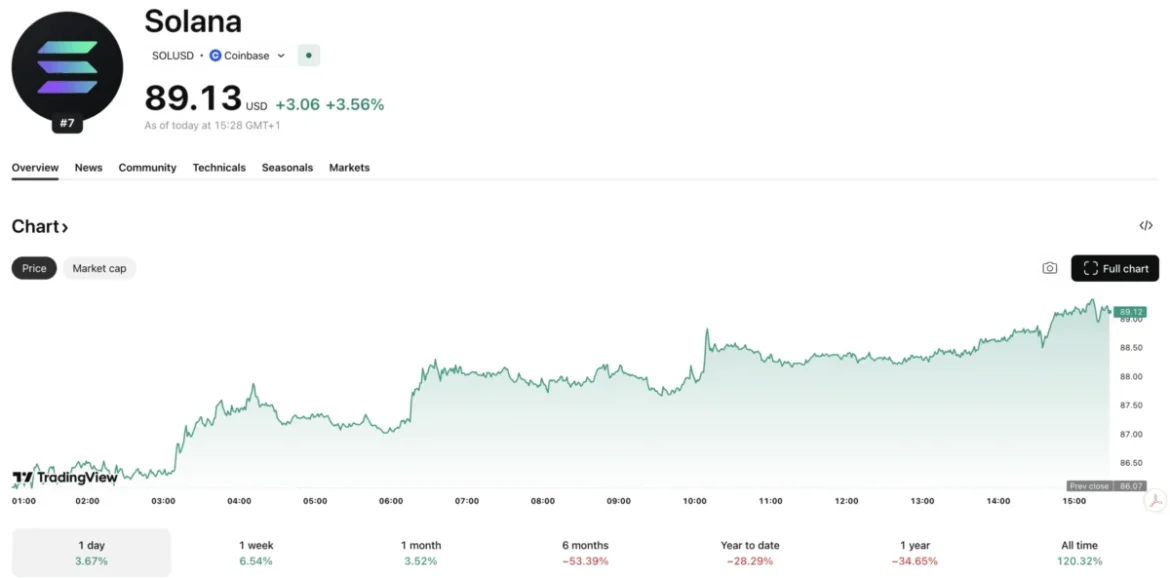
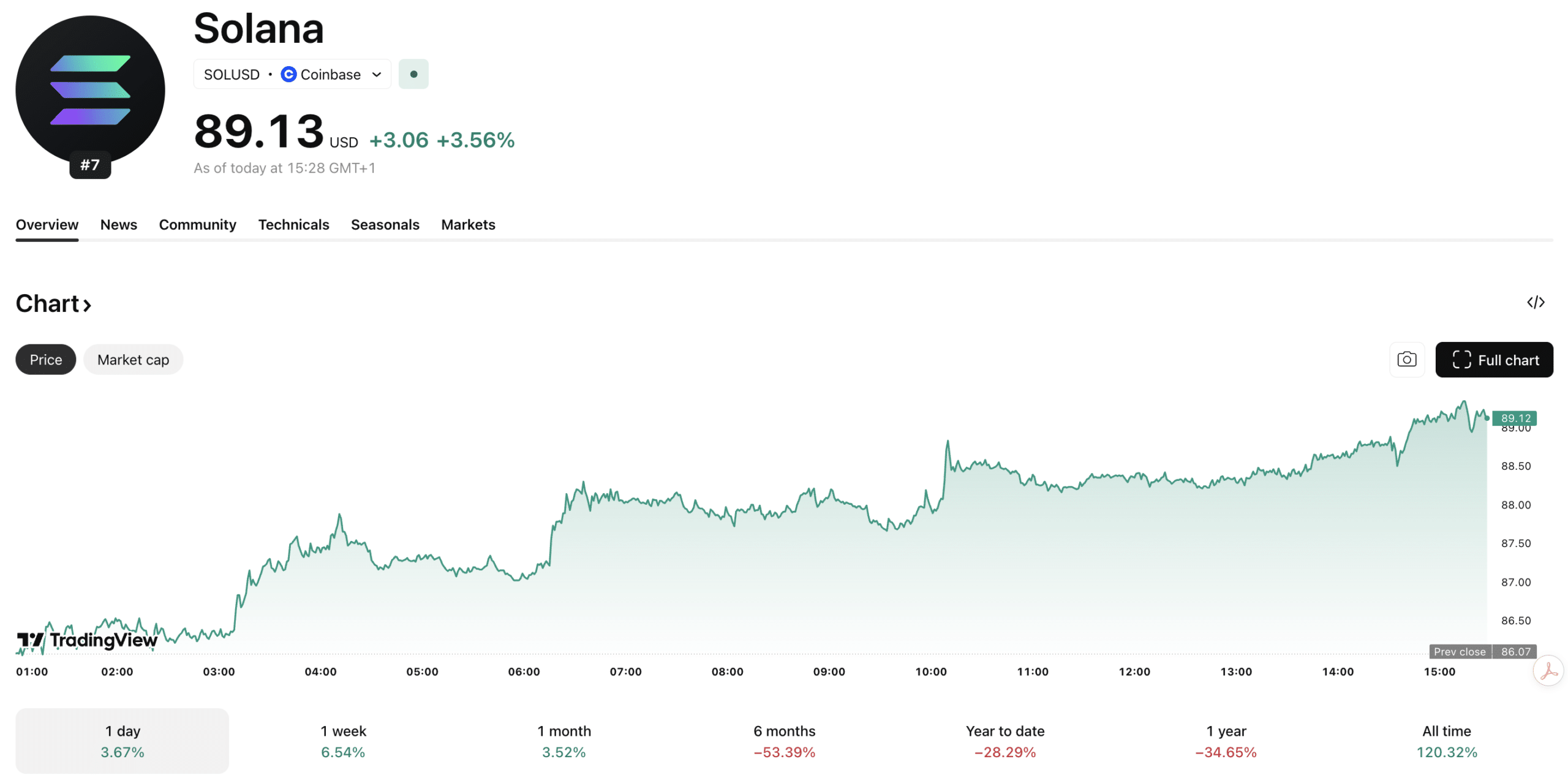
Solana USD is trading near $85.59–$86 on major exchanges, reflecting a notable 3.5% increase over the past 24 hours. However, the most significant indicator of Solana’s current trajectory may not be its spot price alone. The burgeoning U.S. spot Solana Exchange-Traded Fund (ETF) market has collectively surpassed $1 billion in Assets Under Management (AUM), a landmark achievement underscoring substantial institutional interest. This influx of capital, particularly highlighted by Goldman Sachs disclosing $108 million in SOL ETF holdings as of April 2026, signals a potential paradigm shift in how the market perceives and values Solana, moving beyond speculative trading to a more fundamentally driven narrative. The critical question now is whether this institutional validation will catalyze a sustained breakout in price or lead to another period of consolidation and potential rejection.
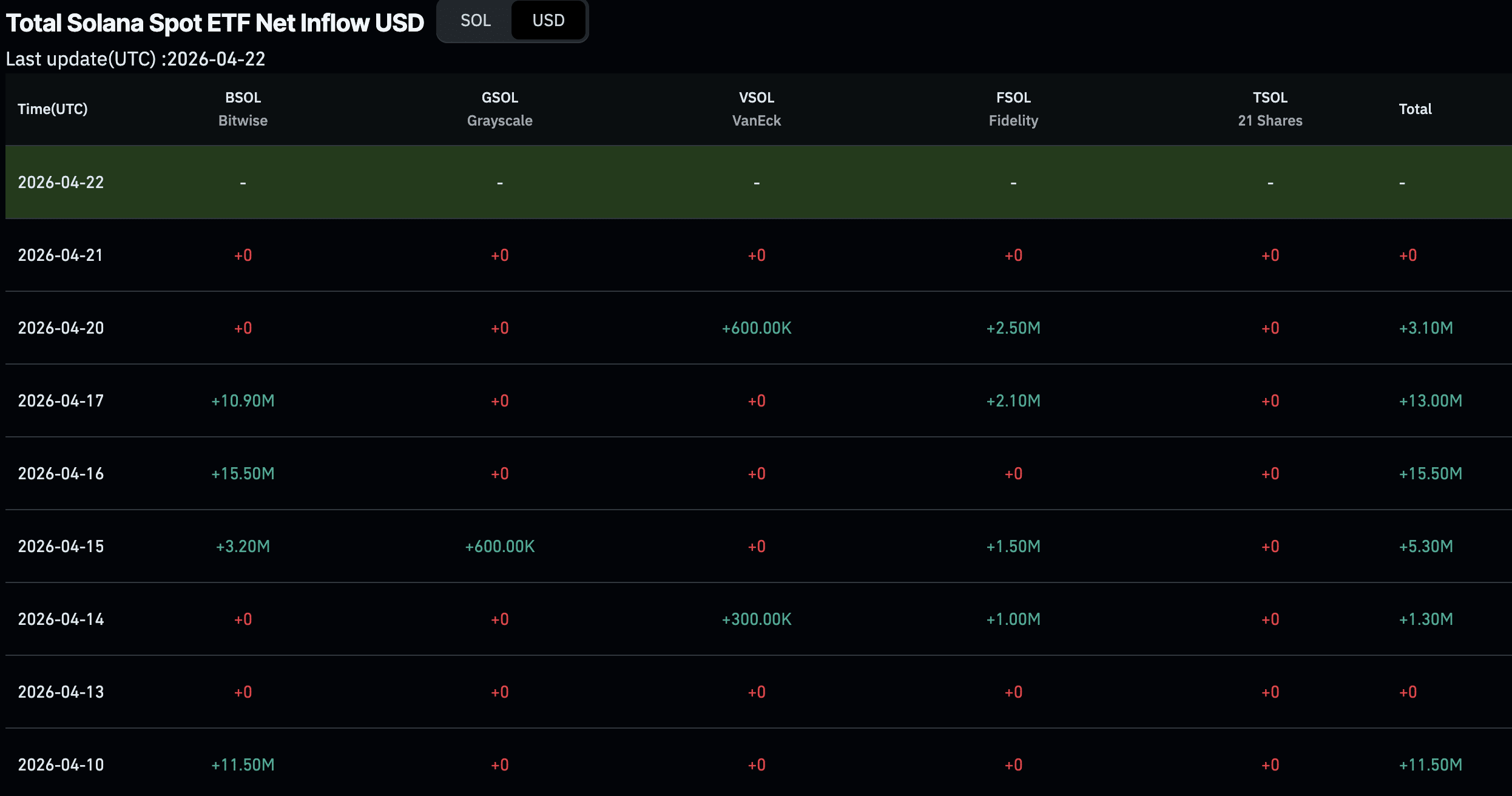
The landscape of U.S. SOL ETFs is currently dominated by Bitwise’s BSOL, which commands an impressive approximately 62% share of the market. On April 17 alone, BSOL witnessed inflows of $15.5 million in a single trading session, according to data compiled by CoinGlass. This substantial inflow from a single ETF highlights the concentrated demand from institutional investors seeking exposure to Solana through regulated financial products.
Simultaneously, the market is also navigating the implications of other significant events. Arkham Intelligence has tracked Alameda Research unstaking $16 million in SOL, a move anticipated to be for potential creditor distribution within the ongoing FTX bankruptcy proceedings. This development introduces a layer of potential sell-side pressure, as these funds could eventually enter the market. While this presents a counteracting force to the bullish ETF inflows, the overall market sentiment and the capacity of the ETF demand to absorb such distributions remain key factors.
Despite these headwinds, Solana is currently experiencing significant positive momentum. The broader cryptocurrency market, particularly Bitcoin (BTC), is showing strength, with BTC pushing towards a re-test of the $80,000 mark. This broader market strength often acts as a catalyst for major-cap altcoins, and Solana is no exception. SOL has recently climbed to just below $90, registering a near 7% gain over the past week. This upward trend, coupled with the increasing institutional adoption via ETFs, suggests a potentially robust foundation for future price appreciation.
The $1 Billion Milestone: A New Era for Solana ETFs
The crossing of the $1 billion AUM threshold for U.S. spot Solana ETFs is a watershed moment for the digital asset. This milestone is not merely a quantitative achievement but a qualitative indicator of evolving investor sentiment and regulatory acceptance. The introduction of regulated investment vehicles like ETFs has historically been a critical step in bringing digital assets into the mainstream financial ecosystem, attracting capital that might otherwise be hesitant due to regulatory uncertainties or the complexities of direct digital asset ownership.
Goldman Sachs’ significant allocation of $108 million in SOL ETF holdings is particularly noteworthy. As a globally recognized financial institution, Goldman Sachs’ investment reflects a calculated decision based on thorough due diligence and a strategic outlook on the long-term potential of Solana. This type of institutional endorsement can have a cascading effect, encouraging other asset managers and family offices to consider similar allocations. It signals a transition from niche speculative interest to a more integrated role within diversified investment portfolios.
The dominance of Bitwise’s BSOL ETF, capturing over 60% of the U.S. SOL ETF market, underscores the effectiveness of its strategy and its appeal to institutional investors. The substantial single-day inflow of $15.5 million on April 17th demonstrates a strong, immediate demand, likely driven by conviction in Solana’s underlying technology and its growth prospects. This concentrated demand can create significant buying pressure, potentially outstripping immediate supply and contributing to price appreciation.
Navigating Market Dynamics: Inflows vs. FTX Distributions
The narrative surrounding Solana’s price action is currently a complex interplay of bullish institutional inflows and potential sell-side overhang from the FTX bankruptcy proceedings. The $16 million unstaking by Alameda Research, while a concern, needs to be viewed within the broader context of the total market capitalization and the daily trading volumes. If the ETF inflows continue at their current pace, they could absorb or even surpass the volume of SOL tokens potentially entering the market from the FTX estate.

The FTX bankruptcy process itself has been a protracted affair, with distributions occurring over an extended period. This gradual release of assets can mitigate the immediate impact of large sell-offs. Furthermore, the creditors receiving these distributions may not necessarily liquidate their holdings immediately. Some may choose to hold SOL, believing in its future potential, especially given the positive developments in the ETF market.
The "cautious tape" mentioned in the original reporting refers to the prevailing market sentiment, where traders and investors are weighing these competing factors. The presence of both strong buying interest from institutions and the potential for selling pressure creates a scenario of price discovery, where the market actively seeks equilibrium.
Technical Analysis and Price Outlook
From a technical standpoint, Solana USD is currently trading within a narrow range, oscillating between $85 support and $87.10 resistance. The 4-hour chart indicates an attempted channel breakout near $85.87, which has yet to see significant follow-through. This consolidation suggests a period of indecision, with neither buyers nor sellers establishing decisive control.
The 24-hour trading volume for SOL varies significantly across different trading pairs, ranging from $3.31 billion to $9.91 billion. This wide spread can be interpreted as mixed conviction among market participants. The Relative Strength Index (RSI) for a 6-period window stands at 48.87, a reading that is essentially flat and confirms the lack of a dominant trend, neither bullish nor bearish.
Potential Scenarios for Solana’s Price Trajectory
Three plausible scenarios are emerging from the current technical and fundamental setup:
1. The Bull Case: A Breakout Towards $100 and Beyond
The most optimistic scenario hinges on Solana clearing the critical psychological and technical resistance level of $90. Community analysts, particularly those active on Binance Square, view a sustained close above $90 as a potent trigger for a run towards $100 and potentially higher. This upward momentum would be further bolstered if Bitcoin successfully reclaims and holds the $80,000 level, providing a strong tailwind for the broader altcoin market. The sustained inflow of capital into SOL ETFs, coupled with positive macroeconomic indicators or favorable regulatory news, could fuel such a rally. A successful push above $90 would likely signal strong institutional conviction and could attract further retail interest, creating a virtuous cycle of buying pressure.
2. The Base Case: Consolidation and Market Digestion
A more moderate outcome involves Solana continuing to trade within its current range, oscillating between approximately $83.66 and $87. This scenario suggests that the market will take time to digest the significant ETF inflows against the backdrop of potential FTX distributions. During this period, price action might be characterized by choppiness and volatility as traders react to news flow and attempt to gauge the true strength of demand. This phase of consolidation is not necessarily negative; it can allow the market to build a stronger foundation for a future upward move by absorbing existing supply and creating a more stable base for accumulation.
3. The Bear Case: A Reversal and Test of Lower Levels
The bearish scenario is triggered if Solana fails to hold its current support levels. The invalidation level for the current bullish structure is identified between $83 and $84. A daily close below this range would suggest that the market is rejecting the current price action and could lead to a re-test of lower support levels, potentially including $80.53. This outcome might be influenced by broader market downturns, negative regulatory developments, or a significant acceleration of sell-side pressure from the FTX distributions that overwhelms ETF demand. Such a move would indicate that the fundamental support from ETF inflows was not sufficient to overcome prevailing bearish sentiment or significant selling pressure.
The Fundamental Strength of ETF Inflows
The enduring bullish argument for Solana is significantly strengthened by the genuine fundamental support provided by ETF inflows. Unlike previous periods of consolidation, which were often driven by retail speculation or hype, the current inflows represent calculated allocations by sophisticated financial entities. Goldman Sachs’ substantial investment is not a fleeting speculative bet but a strategic portfolio decision, reflecting a belief in Solana’s long-term viability and its potential to capture market share in the digital asset space.
This institutional confidence is a powerful validator for Solana’s technology, its ecosystem growth, and its future potential. It suggests that established financial players see Solana as a mature and investable asset class, capable of delivering returns commensurate with other traditional asset classes. The presence of such large, informed capital injections can significantly alter the risk-reward profile for the asset, making it more attractive to a wider range of investors.
Previous analyses of Solana’s price action, including those conducted by Coinspeaker, have identified the current price range as pivotal. The technical setup has remained consistent, with key support and resistance levels providing crucial reference points for traders. The potential for SOL to test $87 within days, contingent on easing macroeconomic headwinds, remains a tangible possibility. The ultimate question, however, is not whether it can reach these levels, but whether it can sustain them, a feat that the current ETF inflows are significantly bolstering.
Solana’s Market Cap and the Search for Asymmetric Upside
While Solana’s recent achievements are undeniably positive, its substantial market capitalization presents a different investment dynamic compared to earlier stages of its growth. A market cap exceeding $50 billion, while a testament to its success, inherently compresses the potential for exponential, short-term returns. For investors seeking the kind of massive, multi-fold gains that Solana experienced in its early days, the current environment necessitates a different strategy.
The prospect of a 5.8x increase to reach a $500 billion market cap over a full market cycle is a realistic long-term target. However, this is not a trade expected to materialize within a 30-day timeframe. As large-cap assets mature, their growth trajectories tend to moderate. This reality is prompting a segment of the market to seek out investments with higher potential for asymmetric upside, often found in earlier-stage projects.
The Rise of Early-Stage Presales: A New Frontier for Returns
Traders who are rotating out of large-cap holding patterns are increasingly turning their attention to early-stage presales. These opportunities, while carrying higher risk, offer the potential to replicate the explosive growth seen from projects like Solana in their nascent stages. The appeal lies in the ability to acquire tokens at significantly discounted prices before they are widely available on public exchanges, with the hope of capturing substantial gains during listing events and subsequent market adoption.
One such presale project garnering attention is Maxi Doge ($MAXI). Built on the Ethereum blockchain as an ERC-20 meme token, Maxi Doge has reportedly raised $4.7 million at a current price of $0.0002814. The project leans heavily into a "leverage king" culture, symbolized by a mascot embodying a 1000x trading mentality. It features holder-exclusive trading competitions with leaderboard rewards and a dedicated Maxi Fund treasury intended for liquidity provision and strategic partnerships. This approach aims to foster a community of engaged and incentivized holders, mirroring the network effects that have propelled many successful cryptocurrency projects.
The project’s traction has been noted alongside other notable presale movers in the current market cycle, suggesting a broader trend of capital flowing into these early-stage opportunities. Maxi Doge’s dynamic staking APY aims to compound holder positions, while its presale rounds continue to fill, offering a structured path for early investors to participate. This strategy is designed to reward early adopters and build momentum leading up to its public launch.
Broader Implications for the Digital Asset Market
Solana’s journey, from its inception to becoming a significant player in the digital asset ecosystem, is a compelling case study in innovation and market adoption. The successful launch and rapid growth of its U.S. spot ETFs signify a maturing market that is increasingly integrating digital assets into traditional financial frameworks. This integration not only provides liquidity and accessibility but also lends legitimacy to the underlying technologies and their potential applications.
The $1 billion AUM milestone for SOL ETFs is a clear indicator that institutional investors are actively seeking exposure to high-potential blockchain ecosystems. This trend is likely to continue, with other major altcoins potentially following suit with their own ETF offerings, provided regulatory pathways remain favorable. The increased institutional involvement can lead to greater price stability, reduced volatility, and a more predictable growth trajectory for these digital assets.
However, the dual forces of institutional demand and potential sell-side pressure highlight the inherent complexities and risks within the cryptocurrency market. The ability of the market to absorb significant capital inflows while simultaneously managing the distribution of assets from distressed entities like FTX will be a crucial determinant of Solana’s near-term price action.
The emergence of projects like Maxi Doge in the presale space further illustrates the diverse investment strategies at play within the digital asset landscape. While institutional investors focus on established, regulated assets, a significant segment of the market continues to seek out high-risk, high-reward opportunities in nascent projects. This dichotomy is a defining characteristic of the cryptocurrency market, driving innovation and capital formation across different tiers of the ecosystem.
Ultimately, Solana’s current position, bolstered by significant institutional backing via ETFs, presents a promising outlook. The interplay of technical indicators, market sentiment, and the evolving regulatory landscape will shape its path forward. The $1 billion ETF AUM is more than just a number; it’s a powerful signal of confidence that could redefine Solana’s role in the digital economy and pave the way for further mainstream adoption of cryptocurrencies. The coming weeks and months will be critical in observing whether this confidence translates into sustained price appreciation and a breakout above key resistance levels, solidifying Solana’s position as a leading digital asset.
Disclaimer: This article is for informational purposes only and does not constitute financial or investment advice. The cryptocurrency market is highly volatile, and investors should conduct their own research and consult with a qualified financial advisor before making any investment decisions.