BNB has firmly re-established its footing in the upper echelons of the global cryptocurrency market capitalization rankings, notably outpacing XRP earlier in the year to secure its spot as one of the industry’s dominant digital assets. However, as the digital asset navigates through ongoing market consolidation and shifting macroeconomic currents, analysts and investors are casting their gaze toward a much larger horizon. While a return to its previous all-time highs and a push toward the $2,000 threshold remain plausible targets under favorable market conditions, sweeping projections of a $10,000 or $20,000 BNB valuation require a foundational expansion of the entire global cryptocurrency economy that simply does not exist in the current landscape.
The Mathematical Reality Behind Extreme Price Targets
To understand the feasibility of extraordinary price milestones, market analysts frequently rely on market capitalization math rather than isolated token pricing. A recent comprehensive breakdown shared by prominent crypto market analyst Crypto Patel on social media platform X highlights the stark mathematical realities governing BNB’s potential price ceilings.
At the time of analysis, BNB maintains a robust market capitalization hovering around $80.6 billion, firmly securing the fourth position among global digital assets, trailing only Bitcoin, Ethereum, and the stablecoin USDT. The token previously achieved a milestone all-time high of approximately $1,370 in October 2025, a peak that propelled its total market valuation to roughly $185 billion.

While reaching past records demonstrates the asset’s capacity to command substantial market value, scaling toward a $10,000 valuation represents an entirely unprecedented tier of financial growth. Factoring in BNB’s long-term supply deflation trajectory—which targets a reduction down to 100 million tokens via systematic coin burns—a $10,000 price point would require a market capitalization of $1 trillion. To put this into perspective, a $1 trillion valuation for BNB alone would equal the total market capitalization of Bitcoin during several historical market cycles and represent a significant fraction of today’s entire crypto asset class.
Extrapolating further, a theoretical $20,000 BNB token would necessitate a staggering $2 trillion valuation for a single altcoin. Such a figure would exceed the combined market capitalization of the entire cryptocurrency ecosystem as it stands in the current economic climate. Consequently, industry experts caution against near-term speculative targets in that extreme range, noting that such figures belong to distant macroeconomic possibilities rather than immediate trading horizons.
BNB’s Competitive Standing and the Challenge to Overtake Ethereum
The broader narrative surrounding BNB’s market position involves not only maintaining its lead over competitors like XRP but also closing the valuation gap with the industry’s premier smart contract platform, Ethereum. Following its resurgence in market rankings, BNB has steadily widened the gap between itself and XRP, prompting market participants to evaluate the feasibility of challenging Ethereum for the coveted second-place spot among cryptocurrencies.
Achieving parity with Ethereum requires a clear understanding of comparative market valuations. Based on static comparisons using prevailing market metrics, BNB would need to trade at approximately $1,500 to match Ethereum’s market capitalization baseline. While this price level is closely aligned with BNB’s previous all-time high zone, a direct flip in the rankings would require BNB to sustain record-breaking momentum while Ethereum’s valuation remains stagnant or experiences a relative downturn. In a realistic market recovery scenario, however, a rising tide typically lifts all major assets, meaning Ethereum would likely experience upward price pressure concurrently.

Structural Risks and the Binance Ecosystem Concentration
Beyond raw mathematics and competitive market dynamics, structural considerations play a pivotal role in shaping BNB’s long-term outlook. One of the most frequently cited challenges is the inherent concentration risk associated with the broader Binance ecosystem.
Unlike decentralized protocols whose value propositions are distributed across independent validators and diverse developer communities, a significant portion of BNB’s fundamental utility is tied directly to Binance. Key value drivers—including the automated quarterly token burn mechanism, exchange trading fee discounts, robust on-chain transaction activity within the BNB Chain ecosystem, and widespread institutional custody solutions—are deeply interconnected with the operations and regulatory standing of the Binance exchange.
Financial analysts emphasize that any significant regulatory headwinds, legal challenges, or negative public sentiment directed toward Binance invariably create cascading effects on BNB’s price action and market liquidity. Consequently, risk management models must factor in this ecosystem dependency when projecting long-term valuation models.
Realistic Bull Case Projections and Long-Term Horizons
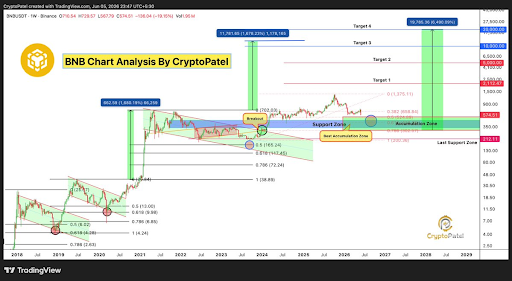
While hyper-inflated price targets require monumental shifts in global liquidity, measured and credible bullish scenarios point toward more attainable milestones. Current technical analysis suggests that a successful breakout from ongoing consolidation phases could see BNB reclaim its previous historical highs and make a sustained push toward the $3,000 threshold.
Longer-term cyclical projections, such as those outlined in extended chart analyses, map out potential trajectories toward elevated price brackets, though these macro models frequently position such occurrences toward the end of the decade, specifically targeting the 2029 timeframe under optimal conditions of global liquidity expansion and institutional adoption.
Ultimately, BNB’s journey forward will depend on a combination of continued utility expansion within decentralized finance (DeFi), real-world asset (RWA) tokenization milestones on the BNB Chain, ongoing supply deflation through regular token burns, and the broader maturation of the digital asset regulatory landscape. Market participants are advised to balance optimism regarding the asset’s proven resilience with a grounded understanding of macroeconomic scale and valuation math.