The launch of U.S.-based spot Solana exchange-traded funds (ETFs), once heralded as the definitive "holy grail" for the asset’s mainstream adoption, has failed to stem a significant tide of capital flight. As the crypto market navigates the volatile landscape of early 2026, Solana (SOL) finds itself in a precarious position, struggling to maintain its valuation against a backdrop of macroeconomic uncertainty and internal network challenges. Despite high-profile predictions of a $1,000 valuation, the current reality paints a more sobering picture of cooling institutional interest and a market recalibrating its expectations for the high-performance blockchain.
A Chronology of the 2026 Capital Contraction
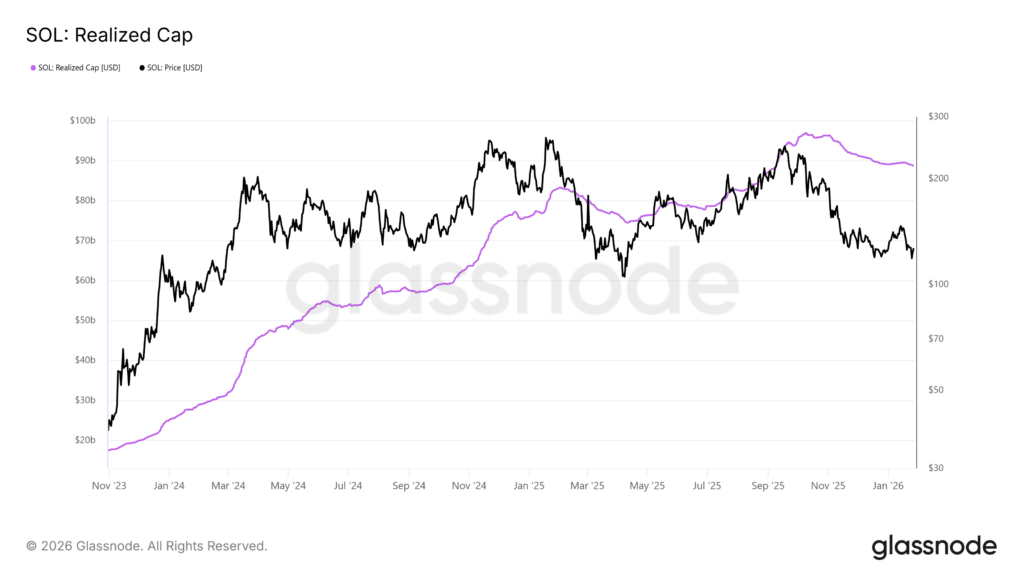
The narrative surrounding Solana in late 2025 and early 2026 was defined by the transition from speculative euphoria to fundamental scrutiny. Throughout the latter half of 2025, Solana’s Realized Cap—a metric tracking the total value of assets at the time they last moved on-chain—reached a peak of nearly $97 billion. This surge was largely driven by anticipation surrounding the regulatory approval of spot ETFs, which proponents argued would provide a reliable on-ramp for institutional capital.

However, the reality of the post-launch environment has been starkly different. As the broader cryptocurrency market entered a correction phase in late 2025, Solana’s Realized Cap retreated to approximately $88.8 billion. This $8 billion drawdown, occurring precisely as these investment products became available, suggests that the expected influx of new capital has been offset by existing holders choosing to de-risk or rotate their assets.
The price action mirrors this sentiment. From a peak of $253 in late 2025, the SOL token has experienced a correction of roughly 50%, trading in the $127 range as of early 2026. This downward pressure has forced analysts and investors to re-examine the feasibility of the $1,000 price target that circulated among industry insiders during the height of the bull run.
The Breakdown of Bullish Expectations
The disparity between market sentiment and price performance has sparked a heated debate regarding the "four-year cycle" hypothesis. Many market participants argue that the crypto industry is currently adhering to a rigid cyclical pattern, which, if historically consistent, suggests that 2026 may be a year characterized by consolidation or bearish trends rather than aggressive growth.

Platforms such as Kalshi have provided data that highlights this growing pessimism. Market consensus, as reflected in predictive betting markets, suggests a strong probability that SOL will conclude 2026 in the $100 to $149 range. The likelihood of the asset reaching the $450 milestone—a prerequisite for any realistic path to $1,000—is currently priced at a mere 11%. This starkly contrasts with the aggressive, long-term forecasts issued by institutions like VanEck, which has previously suggested that the combination of ETF inflows and network utility could propel the asset toward $3,200 by 2029. Standard Chartered, offering a more moderate outlook, has projected a $500 price point within that same three-year window.
Technical and Operational Challenges: The Firedancer Factor
Beyond the macroeconomic factors, the technical roadmap for Solana has hit several roadblocks that have dampened investor enthusiasm. Central to the bullish thesis for Solana was the "Firedancer" client, a high-performance validator software designed to increase the network’s throughput and reliability significantly.
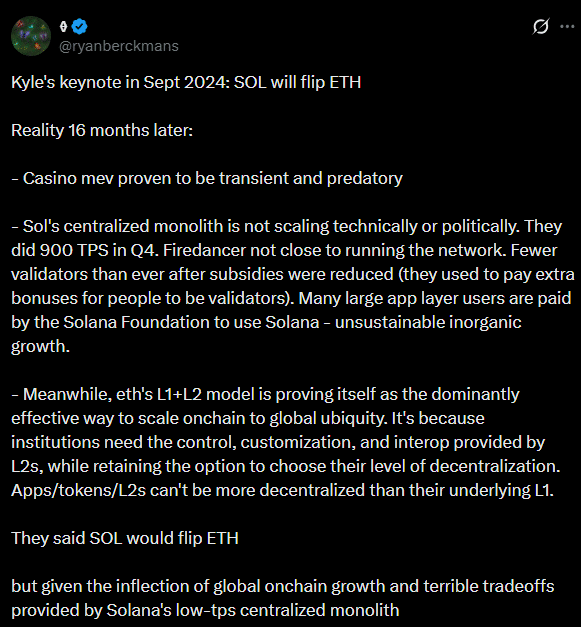
Industry analysts, including Ryan Berckmans, have noted that the delay in the full-scale materialization of these technical milestones has weakened the "speed and efficiency" argument that previously attracted developers and venture capital. When a blockchain promises radical performance upgrades, the failure to deliver on those promises within a specified window often leads to a decline in trust, particularly among the institutional validator class.

Furthermore, the recent "validator crisis"—characterized by a period of increased node exits—has sparked concerns regarding the chain’s decentralization profile. Critics argue that if the validator set becomes too concentrated or if the barriers to entry for running a node increase, the network’s value proposition as a secure, decentralized financial layer becomes compromised. Berckmans has suggested that these operational frictions could potentially allow competitors, most notably Ethereum, to outperform Solana in the medium-to-long term as they continue to iterate on their own scaling solutions.
Options Market Sentiment: A Tale of Two Timeframes
The derivatives market offers a nuanced view of how professional traders are positioning themselves in light of this uncertainty. Data from the options market at Deribit reveals a split sentiment based on duration.
In the near term, there is evidence of a slight recovery in the 25-Delta Skew for one-week and one-month expiries. This indicates that some traders are betting on a tactical bounce, seeking upside exposure to capitalize on potential short-term volatility or a mean-reversion trade. This "neutral-to-bullish" outlook suggests that while the long-term thesis is under pressure, the market has not yet abandoned the prospect of short-term price discovery.
Conversely, the medium-term outlook, represented by three-month and six-month tenors, remains decidedly bearish. The negative 25-Delta Skew in these longer durations points to a higher demand for "put" options, which are essentially insurance contracts against further price declines. This suggests that while professional traders may be willing to gamble on a short-term rally, they are simultaneously hedging against the risk that the current $127 support level might fail.
Implications for the Broader Crypto Ecosystem
The current state of the Solana market serves as a vital case study for the maturation of the digital asset industry. The "ETF effect" has historically been viewed as a panacea for liquidity issues, but the Solana experience demonstrates that even with regulated financial products, asset performance remains tied to broader market liquidity and fundamental project execution.
The implications for the ecosystem are twofold:
- Institutional Maturity: Institutional investors are demonstrating a more discerning approach. They are no longer buying the "narrative" of a blockchain; they are assessing the concrete progress of network updates, the stability of the validator set, and the actual volume of capital flowing into the ecosystem.
- Re-calibration of Valuation Models: The move away from the $1,000 price target indicates a healthy, albeit painful, recalibration of market expectations. By moving toward more grounded projections, such as those provided by Standard Chartered, the market may be setting a more sustainable foundation for long-term growth.
Conclusion: A Critical Juncture
As Solana enters the next phase of its development, the narrative will likely shift from pure speculation to a focus on execution. The network is no longer in its infancy, and the grace period typically afforded to "high-potential" chains is narrowing. To recapture the momentum of 2025, the Solana foundation and its developer community must address the concerns regarding validator attrition and deliver the long-promised performance upgrades associated with the Firedancer client.
While the spot ETF provides a necessary bridge to institutional capital, it is not a substitute for robust, reliable network performance. In the near term, the potential for a price recovery remains contingent on a broader reversal of the capital outflows that have characterized the early months of 2026. Whether Solana can overcome its current hurdles and validate the long-term institutional price targets will depend on its ability to prove that its underlying technology can reliably support the next generation of decentralized finance, regardless of the broader market’s cyclical volatility. For now, the $1,000 dream remains on hold, replaced by a cautious, data-driven approach to one of the most closely watched assets in the crypto market.