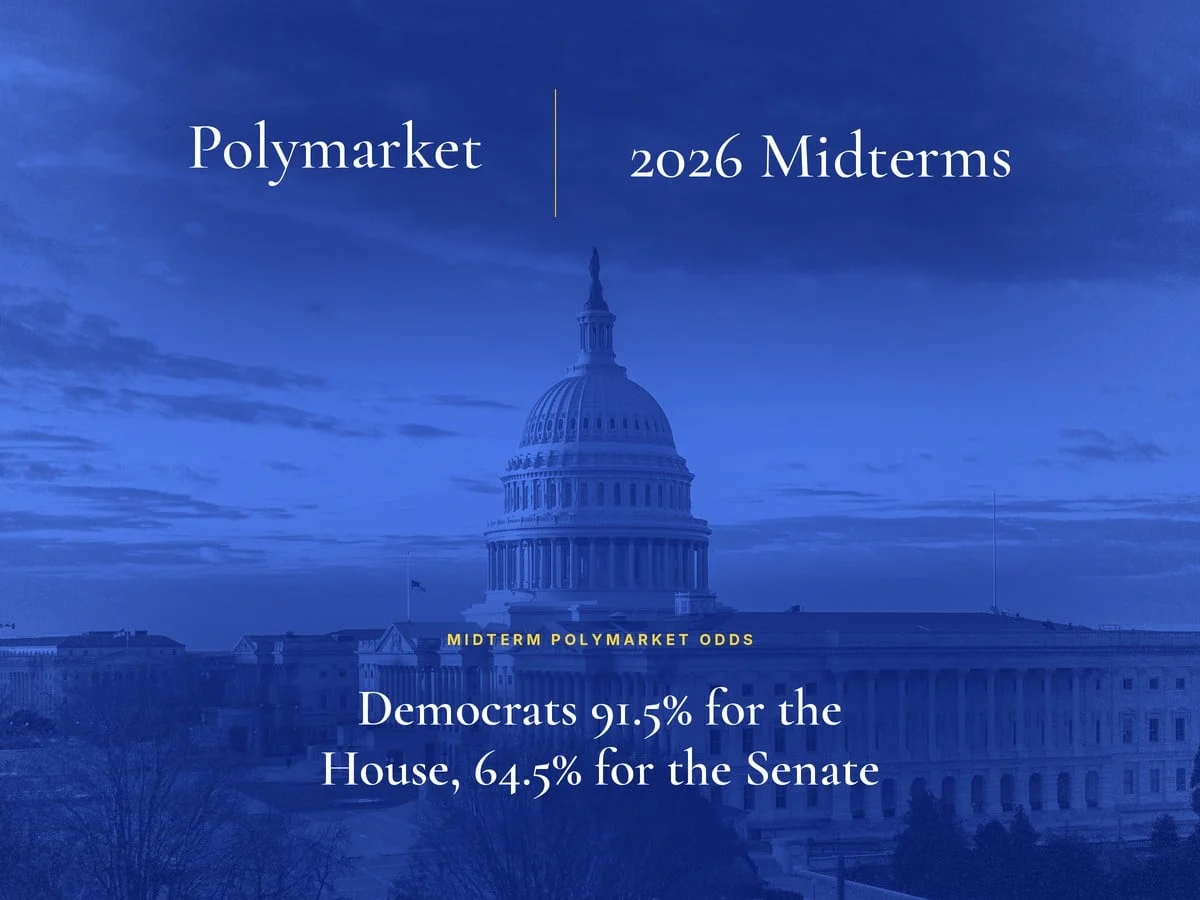
As the United States approaches the November 3, 2026 midterm elections, prediction markets are painting a clear picture of the shifting political landscape, with significant implications for the future of digital asset oversight. According to data from Polymarket as of Tuesday, October 20, traders are overwhelmingly favoring the Democratic Party to capture both chambers of Congress. The latest odds give Democrats a 91.5% probability of maintaining or expanding their presence to win the House of Representatives, alongside a 64.5% chance of taking control of the Senate.
This widening political gap is serving as a primary indicator for institutional investors, fintech leaders, and Web3 advocates trying to decipher who will write the rules governing cryptocurrencies next year. While the House of Representatives is increasingly viewed by forecasters as a settled contest, the Senate remains the primary battleground where capital is actively moving, liquidity is shifting, and the ultimate balance of legislative power hangs in the balance.
Decoding the Prediction Markets: House Certainty vs. Senate Volatility
The stark division between the two legislative chambers is further highlighted by Polymarket’s comprehensive balance-of-power contract. Current market pricing places a Democratic sweep—capturing both the House and the Senate—at a 62.5% probability. Meanwhile, a split Congress featuring a Democratic House paired with a Republican Senate is priced at 27.5%. Conversely, a total Republican sweep of both legislative bodies sits firmly in the minority at just 8.5%.
A closer examination of the market data over the preceding month reveals a distinct trend favoring Democratic gains in the upper chamber. Between September 21 and October 20, the Democratic contract within Polymarket’s dedicated Senate market climbed from 60.5% to 64.5%. Over the same timeframe, the House contract experienced a minor downward adjustment, slipping slightly from 92.5% to 91.5%. Concurrently, the likelihood of a split government—a Democratic House working alongside a Republican Senate—contracted from 30.5% to 27.5%.
Trading volumes across these specific contracts offer additional context regarding market conviction. The House market has attracted significant participation, boasting a total trading volume of $18.78 million. The balance-of-power market stands as the most liquid contract, drawing $25.54 million in trades. In contrast, the Senate market remains comparatively thin, with $7.23 million in traded volume. Because the Senate contract holds less liquidity, it remains more sensitive to large-scale capital inflows and individual high-value trades, making it the critical metric to watch in the final weeks leading up to the election.
The Legislative Stakes: The CLARITY Act and Capitol Hill Leadership
The outcome of these midterm elections carries profound consequences for the digital asset industry, particularly concerning the regulatory framework governing blockchain technology, decentralized finance (DeFi), and tokenized assets in the United States. At the center of this legislative debate is the highly anticipated CLARITY Act, a comprehensive market structure bill designed to establish clear jurisdictional boundaries between the Securities and Exchange Commission (SEC) and the Commodity Futures Trading Commission (CFTC).

The legislative trajectory of the CLARITY Act has been marked by high drama and sharp partisan divides. The bill initially demonstrated strong bipartisan momentum in the House of Representatives, successfully passing by a comfortable 294–134 margin in July 2025. However, the legislation encountered a severe roadblock in the upper chamber. On September 15, the CLARITY Act narrowly failed a crucial procedural vote in the Senate, stalling at a 49–50 tally.
To prevent the bill from dying entirely, Senator Thom Tillis subsequently entered a motion to reconsider, successfully keeping the legislation alive for the ongoing lame-duck session following the election cycle. Industry analysts note that if the bill fails to secure passage during this narrow window, it will officially expire with the current Congress in January 2027. Should that occur, the legislative process would need to restart from scratch during the next congressional session, introducing a brand-new dynamic shaped by whichever party controls the House and Senate.
Leadership Shifts and Committee Dynamics
A Democratic victory in the House of Representatives would instantly trigger significant leadership changes within the key congressional committees responsible for drafting financial and technological policy. Most notably, a Democratic majority would install a new chair atop the influential House Financial Services Committee, replacing the current Republican leadership under Chairman French Hill.
Rep. Maxine Waters, the senior Democrat on the committee, is positioned to reclaim the gavel should her party retain the chamber. Waters, who previously chaired the committee from 2019 until Republicans secured the majority in 2023, has historically advocated for heightened consumer protection, stringent oversight of financial institutions, and rigorous examination of emerging digital asset products. Under her leadership, the committee’s hearing calendar would likely pivot toward aggressive oversight of regulatory agencies and increased scrutiny of major crypto enterprises.
However, a potential leadership battle looms within the Democratic caucus. Representative Sean Casten has emerged to challenge Waters for the top Democratic position on the committee. As party leadership, including House Minority Leader Hakeem Jeffries, has maintained a neutral stance on the internal contest, the eventual outcome of this leadership race could significantly influence the tone and pacing of future crypto-related legislation.
Broader Implications and Market Reactions
As prediction markets continue to aggregate sentiment, political figures have begun responding to the polls and forecasting tools shaping the national discourse. Recently, political figures have sparred over the reliability of pre-election polling data, with former President Donald Trump publicly declaring via social media and platform commentary that midterm polling metrics "are rigged." Despite political pushback, institutional participants increasingly treat platforms like Polymarket as valuable proxies for real-time sentiment analysis, given that participants put financial capital behind their predictions.
With the election just days away, market analysts emphasize that the trajectory of the Senate contract will dictate the final narrative. If the Senate probability continues its upward trajectory to align closely with the dominant House odds, traders will have fully priced in a complete political sweep, effectively altering the legislative roadmap for fintech and digital assets. Conversely, if the Senate odds recede below the 60% threshold, market participants will prepare for a divided Washington, forcing lawmakers from both parties to forge bipartisan compromises on crucial technology and financial market reform in the 110th Congress.