The long-awaited arrival of U.S. spot Solana (SOL) exchange-traded funds (ETFs) was widely heralded by industry analysts as a definitive catalyst for the asset’s next leg upward. Market participants anticipated that institutional access would mirror the success seen by Bitcoin and Ethereum products, driving massive inflows and potentially pushing the token toward triple-digit growth. However, the reality of the post-launch landscape has proven sobering. Despite the regulatory green light and the subsequent trading availability of these investment vehicles, Solana has experienced significant capital flight during the broader crypto market downturn of late 2025 and early 2026.
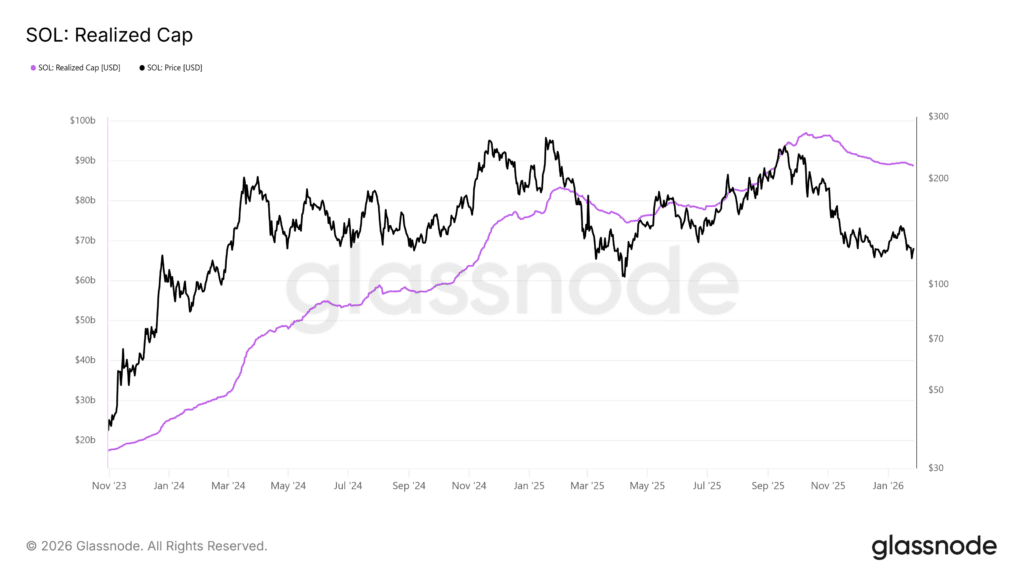
Data from on-chain analytics firm Glassnode reveals a stark contraction in market liquidity. The Realized Cap of the Solana network—a metric representing the total capital invested in the asset—has plummeted from a peak of nearly $97 billion to approximately $88.8 billion. This $8.2 billion evaporation of capital underscores a fundamental disconnect between institutional product availability and investor appetite during periods of macroeconomic volatility.

A Chronology of the 2025-2026 Correction
The current bearish phase for Solana stands in sharp contrast to the optimism that defined the third and fourth quarters of 2025. Following the regulatory approval of the spot Solana ETF, the asset briefly surged, reaching a local high of $253. At that time, bullish narratives surrounding the "Solana Supercycle" dominated discourse, with some industry insiders suggesting a psychological price target of $1,000 was well within reach for the high-performance blockchain.
However, the momentum stalled as the fourth quarter of 2025 progressed. A confluence of factors, ranging from macroeconomic shifts to technical stagnation, began to weigh on the price. By the onset of 2026, the asset had shed 50% of its value, trading at $127. This rapid decline has forced analysts to reconsider the four-year cycle hypothesis, which suggests that after the parabolic growth phases seen in previous iterations of the crypto market, 2026 is structurally positioned as a consolidation or "bearish" year.
The Disparity Between Institutional Forecasts and Market Reality
The discrepancy between analyst price targets and actual market performance has become a point of contention among institutional researchers. While some firms, such as VanEck, have maintained highly optimistic long-term projections—suggesting that the influx of institutional capital via ETFs could eventually propel SOL toward a $3,200 valuation by 2029—the current market sentiment tells a more cautious story.

Prediction markets have become a primary gauge for this shift in sentiment. According to data from the prediction platform Kalshi, market participants are currently pricing in a much more modest trajectory for the remainder of 2026. Data indicates an 11% probability that the token will break the $450 threshold, while the likelihood of it sustaining a price between $100 and $149 is significantly higher, at roughly 75%. Even more conservative institutions, such as Standard Chartered, have issued reports suggesting that the $500 milestone is more realistic for the 2029 horizon, effectively pushing back the timeline for a "mega-rally" by several years.
Structural Challenges and the Firedancer Factor
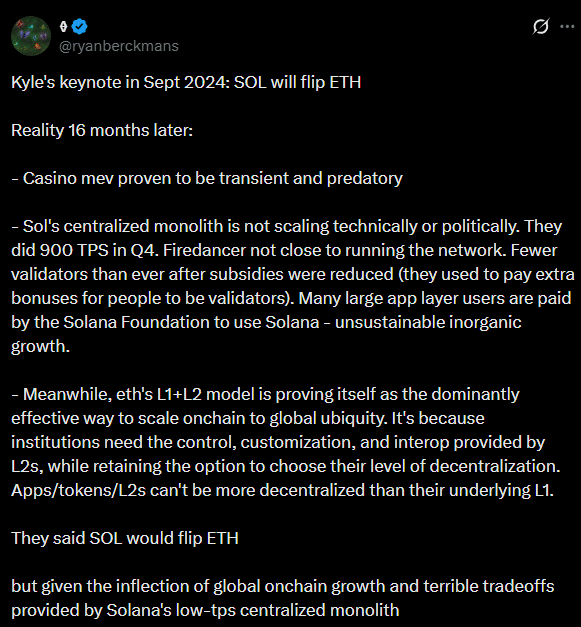
The optimism surrounding Solana was historically anchored to its technological roadmap, most notably the implementation of Firedancer, the network’s second independent validator client. Firedancer was envisioned as the solution to Solana’s historical downtime issues and a pathway to unprecedented throughput speeds. However, the anticipated impact of this upgrade has not manifested as quickly as the developer community had hoped.
Market analysts, including Ryan Berckmans, have pointed to this delay as a primary contributor to the waning institutional confidence in the chain. When high-profile technological catalysts fail to meet their projected deployment timelines, it creates an opening for competitors to capture market share. Furthermore, the ecosystem is grappling with a "validator crisis." Increasing concern regarding the decentralization of the network and the departure of key validators has led to questions about the network’s long-term resilience.

Berckmans noted in recent communications that these structural vulnerabilities could shift the competitive balance in favor of Ethereum in the mid-to-long term. While Ethereum has faced its own challenges regarding Layer-2 fragmentation, its status as a battle-tested, decentralized ledger continues to offer a different risk profile compared to the high-throughput, high-risk architecture of Solana.
Derivatives Market Analysis: A House Divided
The options market, which often serves as a window into the professional trading community’s collective psyche, presents a fragmented outlook for Solana. Current data from Deribit, aggregated via Laevitas, shows a distinct bifurcation between near-term expectations and medium-term hedging strategies.
For short-dated expiries (1-week to 1-month), there has been a slight recovery in the 25-Delta Skew. This indicates that traders are cautiously seeking upside exposure, betting on a potential technical bounce or short-term mean reversion. This sentiment is best described as "neutral-to-bullish," reflecting a belief that the asset is currently oversold.
However, when looking at the 3-month and 6-month tenors, the outlook shifts dramatically. The negative 25-Delta Skew observed in these timeframes demonstrates that institutional and professional traders are heavily prioritizing the purchase of "put" options over "calls." This strategy is a clear signal of demand for downside protection, suggesting that market participants are bracing for the possibility of further volatility or an extended period of sideways price action throughout the remainder of the year.
Broader Implications for the Crypto Asset Class
The failure of the Solana ETF to serve as a "magic bullet" for price appreciation highlights a maturing, yet fragile, digital asset market. For years, the crypto industry has operated under the assumption that the "ETF Effect"—the process of opening up crypto assets to the traditional financial (TradFi) world—would act as a perpetual price support.
The events of 2026 suggest that macro conditions—including interest rate environments, liquidity availability, and central bank policies—still exert more influence on price than the mere existence of a regulated investment vehicle. When capital is fleeing risky assets in favor of yield-bearing debt or cash, even the most efficient blockchain technology can struggle to retain its value.
Furthermore, the Solana experience serves as a case study for the risks inherent in "catalyst-driven" investing. Many investors entered the SOL market specifically because they believed in a linear progression of events: approval of the ETF leads to inflows, which leads to price discovery, which triggers a bull market. The interruption of this chain by external economic forces has left many retail investors holding depreciating assets, potentially dampening interest in future ecosystem developments.
Conclusion and Outlook
As 2026 progresses, the path forward for Solana remains complex. The $1,000 price target, once a rallying cry for proponents of the network, now appears increasingly detached from current market realities. While the technology underlying the chain remains robust, the ecosystem must contend with the dual pressures of a cooling macroeconomic climate and a requirement to demonstrate sustained, decentralized growth.
For the near term, the potential for a recovery remains tethered to the broader crypto market’s ability to stem the tide of capital outflows. Unless there is a fundamental shift in global liquidity that encourages risk-on sentiment, Solana—and by extension, the broader altcoin sector—will likely continue to face a challenging environment. The focus for investors, therefore, has shifted from speculative "moon" targets to fundamental metrics: network usage, validator health, and the successful, stable deployment of long-awaited infrastructure upgrades. Until these milestones are achieved, the market is likely to remain in a "wait-and-see" holding pattern, wary of the risks that have defined the current cycle.