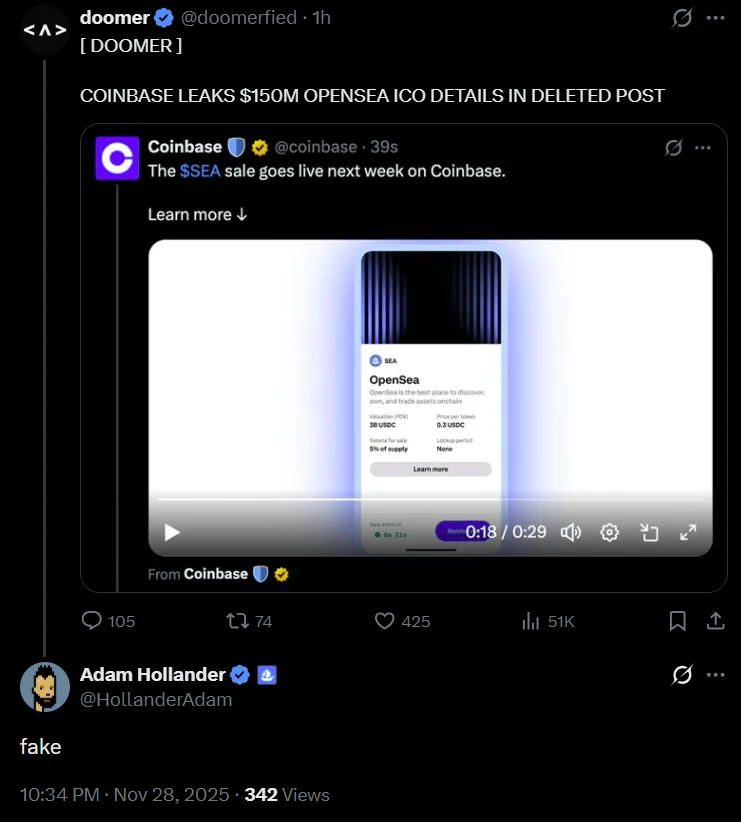
The digital asset ecosystem was briefly sent into a state of heightened speculation this week following the emergence of viral social media reports alleging that OpenSea, the world’s leading non-fungible token (NFT) marketplace, was preparing for an imminent $150 million token sale on the Coinbase exchange. The rumors, which gained significant traction across platforms including X (formerly Twitter) and various Telegram channels, were swiftly addressed and categorically denied by OpenSea’s executive leadership. Adam Hollander, the Chief Marketing Officer at OpenSea, intervened to stabilize market sentiment, characterizing the circulating reports as entirely fabricated.
The incident underscores the extreme sensitivity of the cryptocurrency market to potential liquidity events, particularly regarding long-anticipated utility tokens from major industry incumbents. While OpenSea has confirmed its intent to enter the tokenized economy, the discrepancy between the rumored timeline and the official roadmap highlights the ongoing challenges of information verification in the era of decentralized social media.
Anatomy of a Viral Misinformation Event
The speculation originated from a parody account on X, which posted a sophisticated fabrication claiming that Coinbase had briefly published—and subsequently deleted—a social media post teasing a $150 million "SEA" token offering. Given the historical volatility of the crypto market and the high expectations surrounding OpenSea’s eventual token launch, the rumor spread rapidly. Traders and retail investors, eager to front-run what they perceived as a major liquidity event, began discussing potential entry points and the impact on the broader NFT ecosystem.
The dissemination of this information was accelerated by the automated nature of modern crypto-news aggregators and the high-frequency trading environment of Telegram groups. By the time the claim reached mainstream crypto news cycles, it had gained the appearance of a credible industry leak. The speed at which this narrative traveled highlights the susceptibility of the sector to "rage-bait" and speculative misinformation, a persistent issue that often necessitates rapid intervention from company leadership.
Official Clarification and Corporate Stance
Adam Hollander’s rebuttal was direct and decisive. By labeling the posts as "fake," the CMO effectively halted the speculative rally that had begun to form around the non-existent sale. For stakeholders, this was a critical clarification. OpenSea has historically maintained a guarded approach to its internal development timelines, and an unverified $150 million raise would have represented a significant departure from the platform’s stated operational strategy.
This incident serves as a case study for corporate communication in the Web3 space. As platforms grow in influence, the necessity for robust, authenticated communication channels becomes paramount. OpenSea’s swift response likely prevented significant financial loss for traders who might have attempted to capitalize on the rumored token sale, reinforcing the importance of relying solely on official company disclosures and verified executive channels.
The Official Roadmap: What We Know About SEA
Despite the false report, it remains factually accurate that OpenSea is actively working toward the launch of its native "SEA" token. According to the company’s official communications, the token is currently scheduled for an official debut in the first quarter of 2026. This timeline is critical, as it provides a clear window for investors and community members to distinguish between authentic progress and manufactured market noise.
CEO Devin Finzer has provided a transparent framework regarding the token’s distribution model. Unlike many projects that focus exclusively on venture capital allocation, OpenSea has emphasized a community-centric approach. According to Finzer, 50% of the total SEA supply is earmarked specifically for the community. This allocation strategy is designed to reward historical platform users—those who have engaged with the marketplace throughout its growth—and participants in various rewards programs. By prioritizing long-term users, OpenSea aims to align the token’s utility with its most loyal customer base, potentially mitigating the "pump-and-dump" dynamics that often plague new token launches.
Tokenomics and Long-Term Value Proposition
The structural integrity of the SEA token is predicated on its integration into the core OpenSea marketplace. Beyond the initial distribution, the token is intended to function as an engine for platform sustainability. OpenSea has explicitly stated its intention to implement a buyback program, utilizing 50% of the platform’s revenue at launch to repurchase SEA tokens from the open market.
This economic model, often referred to as a "buyback and burn" or "buyback and distribution" mechanism, is designed to create consistent buy-side pressure. By tying the token’s value directly to the marketplace’s revenue, OpenSea is attempting to create a self-sustaining loop where the success of the NFT marketplace inherently benefits SEA token holders. This mechanism is a departure from simple governance tokens and signals an intent to provide tangible value to the ecosystem.
Market Context: The State of the NFT Marketplace
The rumor of a $150 million sale is not entirely coincidental; it arrives at a time when the NFT market is undergoing a period of intense re-evaluation. Following the massive boom of 2021-2022, the NFT sector has faced significant headwinds, including declining floor prices, reduced trading volumes, and shifting investor interest toward AI and decentralized finance (DeFi).
OpenSea’s decision to launch a token in 2026 is, in many ways, a strategic pivot. By introducing a native asset, the platform is looking to incentivize retention in a competitive landscape where rivals like Blur have successfully used token-based rewards to capture market share. The token launch represents a maturation phase for OpenSea, moving from a pure marketplace model to a decentralized finance-integrated ecosystem.
Implications for Regulatory Compliance and Market Transparency
The false rumor regarding the Coinbase listing brings to light the broader concerns regarding market manipulation and the regulatory oversight of token launches. Coinbase, as a publicly traded company on the NASDAQ, maintains strict protocols regarding the listing of assets. The mere suggestion that a major exchange would inadvertently announce a multi-million dollar sale and then delete it is inherently implausible to seasoned industry observers, yet the rumor persisted.
This event highlights the ongoing need for clearer guidelines regarding how digital assets are marketed and traded. As institutional participation in the crypto sector grows, the tolerance for speculative misinformation is decreasing. Investors are increasingly demanding verified information, and the role of the "official announcement" is becoming the gold standard for market stability.
The Role of Historical Data in Token Distribution
A key aspect of the upcoming SEA launch is the reliance on historical platform data to determine eligibility. This "airdrop" style distribution is a common tactic, but one that requires immense technical and data-security rigor. OpenSea’s challenge will be to execute this in a way that is equitable, transparent, and resistant to "Sybil attacks"—where users create multiple accounts to game the distribution system.
By clearly communicating the plan early, OpenSea is allowing its user base to digest the logic behind the distribution. The focus on historical activity acts as a reward for users who weathered the marketplace’s evolution, effectively creating a "proof-of-loyalty" cohort.
Navigating Future Speculation
As the 2026 launch date approaches, it is highly probable that the crypto community will see further attempts to manipulate market sentiment through misinformation. The "SEA" token name, while simple, is easily searchable and highly susceptible to SEO-based social media exploitation.
For participants in the Web3 space, the lesson from this episode is twofold:
- Source Verification is Mandatory: Any information regarding major financial events, such as token sales or exchange listings, should be cross-referenced with the company’s official blog or verified executive accounts.
- Understand the Tokenomics: By studying the disclosed plans for the SEA token—such as the 50% community allocation and the revenue-based buyback program—users can better identify when a rumor aligns with the project’s actual trajectory versus when it is a fabrication designed to cause panic or FOMO (Fear of Missing Out).
Conclusion: A Maturing Ecosystem
The incident surrounding the fabricated SEA token sale is a testament to the high stakes of the modern digital economy. OpenSea remains a dominant force in the NFT space, and its transition into a tokenized marketplace is a significant event that warrants close, objective observation.
While the rumor was indeed "fake," the underlying reality is that OpenSea is preparing for a significant evolution in its operational structure. The community and the broader market would do well to focus on the official documentation provided by Devin Finzer and the OpenSea team, rather than the transient, unverified noise that characterizes the daily cycles of social media. As we look toward the first quarter of 2026, the success of the SEA token will likely depend less on viral rumors and more on the utility, transparency, and economic soundness of the system OpenSea is currently building.
The marketplace has proven resilient in the past, and as it moves to integrate its own native asset, the company’s commitment to clear communication—as demonstrated by the CMO’s prompt response—will be a vital asset in maintaining investor confidence and ensuring a successful launch. The industry continues to evolve, and with it, the necessity for a more rigorous approach to information consumption and market analysis.