The landscape of decentralized finance (DeFi) is continuously evolving, transitioning from speculative trading primitives toward sophisticated, yield-generating infrastructure that mirrors traditional financial markets. Among the latest innovations capturing institutional interest are on-chain lending and yield strategies, commonly referred to as "vaults." According to recent analysis by Grayscale’s Head of Research, Zach Pandl, these automated yield-generating vehicles could represent the next major sector of crypto technology primed for mass public adoption.
Pandl places on-chain vaults in the same evolutionary trajectory as stablecoins, tokenized real-world assets (RWAs), and perpetual futures. These products began as experimental, niche use cases within the digital asset ecosystem before eventually catching the attention of traditional finance (TradFi) institutions. As capital efficiency and yield optimization become paramount for both retail and institutional investors, on-chain vaults are emerging as a bridge connecting decentralized liquidity pools with structured, real-world credit markets.
Understanding the Mechanics of On-Chain Vaults
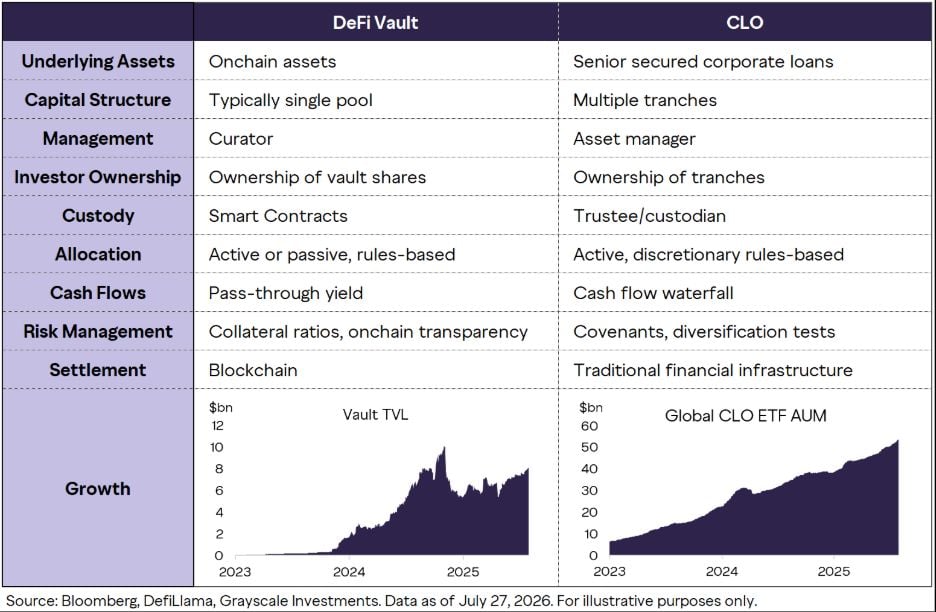
To comprehend the significance of on-chain vaults, it is essential to examine their structural framework. On-chain vaults function as automated asset management tools that pool user capital and deploy it into various yield-generating strategies, primarily focused on crypto-backed or real-world credit.
In traditional financial markets, similar structures are widely prevalent, most notably Collateralized Loan Obligations (CLOs). CLOs pool a diverse selection of individual corporate loans, which are then managed by professional asset managers, allowing investors to share in the generated interest payments. CLOs are historically recognized as one of the most liquid segments of structured finance, demonstrating remarkable resilience even during major economic downturns.
On-chain vaults eliminate the need for centralized intermediaries such as traditional asset managers, custodians, and manual loan administrators. Instead, they rely on transparent smart contracts and specialized decentralized finance curators—such as Steakhouse Financial, Gauntlet, and Sentora—to manage risk parameters, select credit pools, and optimize returns. This automation reduces overhead costs while increasing operational transparency, allowing investors to track asset health and yields in real-time on public ledgers.

The Current Market Landscape and Dominant Curators
The on-chain vault market has experienced rapid growth, reaching a total value locked (TVL) of approximately $7.3 billion. Despite the presence of numerous operators, the market exhibits a high degree of concentration. Data indicates that the top three curators—Steakhouse, Sentora, and Gauntlet—collectively control over 70% of the total market share. Across the ecosystem, there are currently 57 active curators managing more than 3,000 distinct vaults designed to maximize yield for participants.
This burgeoning market has already begun attracting attention from major crypto protocols seeking stability during volatile cycles. For instance, the decentralized stablecoin protocol Ethena notably integrated exposure to AAA-rated CLO funds to diversify its yield-generating mechanisms. By tapping into structured credit products, protocols can insulate themselves from the extreme price fluctuations typical of cryptocurrency bear markets, securing more consistent, predictable returns for their token holders.
Grayscale and S&P Global’s Outlook on TradFi Disruption
The potential ceiling for on-chain vaults is vast. Grayscale’s Zach Pandl has suggested that the on-chain vault market possesses the scale and utility required to eventually disrupt the multi-trillion-dollar traditional CLO market, which currently hovers around $1.5 trillion in global valuation.
This bullish assessment is echoed by legacy financial institutions. S&P Global recently published a comprehensive primer analyzing how vaults could reshape the capital markets of tomorrow. The ratings agency highlighted real-world asset tokenization and improving regulatory clarity as the primary catalysts that will unlock the next wave of exponential growth for the sector.
In its report, S&P Global noted that applications of vaults interacting with real-world assets are expanding rapidly and are projected to become the dominant use case for the technology over the long term. By merging the transparency of blockchain rails with tangible off-chain credit assets, vaults offer a compelling value proposition for institutional allocators seeking yield outside of traditional banking systems.
Regulatory Hurdles and Compliance Uncertainty
Despite the promising trajectory, the integration of on-chain vaults into mainstream finance faces notable hurdles, primarily concerning regulatory compliance. The intersection of decentralized software protocols and traditional credit instruments creates a complex legal gray area.
S&P Global pointed out that many institutional investors continue to avoid direct investment in vault tokens because of uncertainty regarding which regulatory frameworks apply to them. Specifically, questions persist across global jurisdictions regarding whether specific vault tokens constitute securities under federal laws, requiring registered offerings and strict compliance protocols.
In an effort to address these ambiguities, the U.S. Securities and Exchange Commission (SEC) has intensified its scrutiny of the decentralized finance and digital lending sectors. Earlier this year, the regulatory agency clarified that many on-chain lending vaults will indeed fall under the purview of federal securities laws. However, the SEC stopped short of issuing a blanket prohibition or classification, maintaining that each product will be evaluated on a case-by-case basis depending on its specific architectural design, governance structure, and operational mechanisms.
Broader Market Implications and Future Outlook
The evolving dialogue between regulators and crypto native developers signals a maturing industry. As institutions demand legal certainty, protocols are increasingly adopting compliance-first designs, incorporating features such as permissioned access, zero-knowledge identity verification, and transparent reporting.
Whether on-chain vaults will achieve the widespread mainstream adoption projected by analysts at Grayscale and S&P Global will largely depend on how regulatory frameworks crystallize in major jurisdictions like the United States. If regulators provide clear, navigable pathways for tokenized credit and automated asset management, the influx of traditional institutional capital could propel on-chain vaults from a $7.3 billion niche into an indispensable pillar of modern global finance.