of Congress Ahead of 2026 Midterms as Crypto Regulation Hangs in the Balance
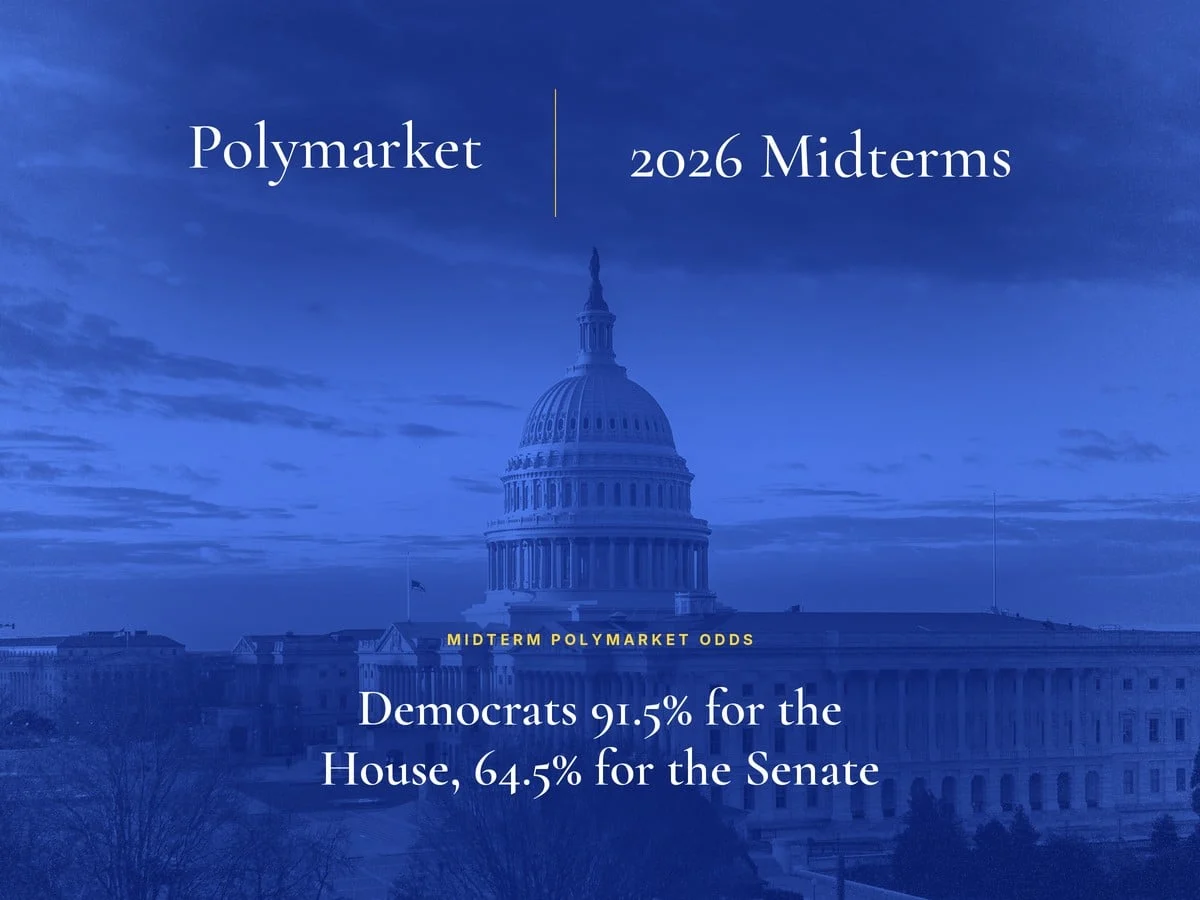
Prediction markets are signaling a potential shift in the American political landscape as the November 3, 2026, midterm elections approach. According to wagering data from Polymarket, decentralized finance traders heavily favor the Democratic Party to capture both chambers of Congress. As of Tuesday, October 20, bettors place the probability of a Democratic-controlled House of Representatives at 91.5%, while the odds for taking the Senate sit at 64.5%. These converging forecasts are establishing the framework for how federal digital asset policies, market structures, and compliance frameworks will be debated and legislated in the coming year.
While the odds for the House of Representatives have remained largely stable and treated as nearly settled by market participants, the Senate contracts continue to experience active capital inflows and shifting valuations. The ongoing movements in these prediction contracts carry profound implications for the cryptocurrency sector, particularly regarding pending legislation such as the CLARITY Act, committee leadership changes, and the future posture of regulatory oversight from Washington.
Shifting Odds and Market Dynamics Across Polymarket Contracts
The divergence and convergence of political fortunes are highlighted across three primary prediction markets hosted on Polymarket. The standalone House contract indicates a dominant 91.5% likelihood of a Democratic majority, slipping only marginally from 92.5% recorded on September 21. Conversely, the Senate contract has seen a notable upward trajectory, climbing from 60.5% a month prior to its current standing of 64.5%.
To understand the broader implications, a third contract measuring the balance of power provides a comprehensive breakdown of potential Washington outcomes. Polymarket’s balance-of-power market prices a total Democratic sweep of both chambers at 62.5%. Meanwhile, a split Congress featuring a Democratic House paired with a Republican Senate is priced at 27.5%, down from 30.5% over the same monthly tracking period. A Republican sweep of both legislative bodies sits firmly in the minority at 8.5%.
Trading volume across these markets highlights where participants are placing their financial conviction. The House market has accumulated a substantial $18.78 million in total traded volume, reflecting high confidence and deep liquidity. The balance-of-power market leads total activity with $25.54 million traded. In contrast, the Senate market remains the thinnest of the three, with $7.23 million in volume, making it more susceptible to price swings driven by large-scale trades.
Because each Polymarket share pays out one dollar if the prediction proves correct, current contract prices directly reflect implied probabilities. For instance, a contract priced at 64.5 cents signifies a 64.5% implied probability of that outcome occurring. As the election cycle enters its final fortnight, political developments continue to draw intense scrutiny from traditional finance and Web3 stakeholders alike. Amidst these shifting metrics, political figures have also weighed in on the reliability of polling and forecasting data; notably, former President Donald Trump recently declared via social media that midterm polling metrics are "rigged," prompting heightened engagement across prediction platforms.
Chronology and Legislative History of the CLARITY Act

The urgency behind these market movements stems from a stalled legislative agenda regarding digital asset regulation in the United States. The cornerstone of this debate is the Digital Asset Market Structure and Investor Protection framework, widely known as the CLARITY Act, which aims to establish clear jurisdictional boundaries between the Securities and Exchange Commission (SEC) and the Commodity Futures Trading Commission (CFTC).
The legislative timeline for the CLARITY Act highlights the high stakes of the upcoming congressional transition:
- July 2025: The CLARITY Act successfully passes the House of Representatives in a decisive 294–134 bipartisan vote, signaling strong initial momentum for comprehensive crypto legislation.
- September 15, 2025: The momentum halts abruptly in the upper chamber when the bill fails a critical Senate procedural vote by a razor-thin margin of 49–50.
- Late September 2025: Senator Thom Tillis files a motion to reconsider the vote, successfully keeping the legislative vehicle alive for the post-election lame-duck session.
- October 2026: With the midterm elections weeks away, industry observers warn that if the bill fails to pass during the lame-duck session, it will officially expire with the current Congress in January 2027, forcing lawmakers to restart the legislative process from the beginning.
Implications for House Leadership and Committee Oversight
A Democratic takeover of the House of Representatives would trigger significant shifts in key congressional committees, fundamentally altering how crypto legislation is drafted, negotiated, and prioritized. Under a Democratic majority, the House Financial Services Committee—the primary legislative body responsible for banking, monetary policy, and digital asset oversight—would experience a change in gavel leadership.
Representative Maxine Waters, the ranking Democratic member of the committee, is positioned to reclaim the chairmanship she held from 2019 until Republicans assumed the majority in 2023. Waters, who has long advocated for robust consumer protections, stringent anti-money laundering controls, and heightened regulatory scrutiny of decentralized finance and crypto issuers, would dictate the hearing calendar. Her leadership would likely prioritize rigorous oversight of regulatory agencies and digital asset firms, shaping the tone of federal policy.
However, a leadership contest could materialize within the Democratic caucus. Representative Sean Casten has emerged to challenge Waters for the top Democratic assignment on the committee. While party leadership, including House Minority Leader Hakeem Jeffries, has maintained a neutral stance on the internal contest, the eventual outcome will influence the legislative strategy applied to future fintech and crypto bills.
Broader Economic and Regulatory Impact on Web3 Markets
The intersection of prediction markets and federal elections underscores the growing maturation of the cryptocurrency sector as a political lobbying and voting bloc. Market participants are not merely wagering on political outcomes; they are pricing in regulatory certainty, compliance costs, and institutional capital deployment.
A unified Democratic government, as priced by Polymarket’s 62.5% balance-of-power projection, would likely pursue a regulatory agenda aligned with executive branch priorities, potentially emphasizing investor protection, systemic risk mitigation, and SEC enforcement authority. Conversely, a divided government—represented by the 27.5% probability of a Democratic House and Republican Senate—would necessitate bipartisan compromise, potentially resulting in more moderate or narrowly scoped legislative outcomes for digital assets.
As the remaining days of the 2026 midterm cycle tick down, institutional investors, crypto foundations, and compliance officers are monitoring the Senate contracts closely. Whether the probabilities converge toward a definitive sweep or retreat into divided-government territory will dictate the legislative strategy for digital assets as the nation looks toward the convening of the next Congress in January 2027.