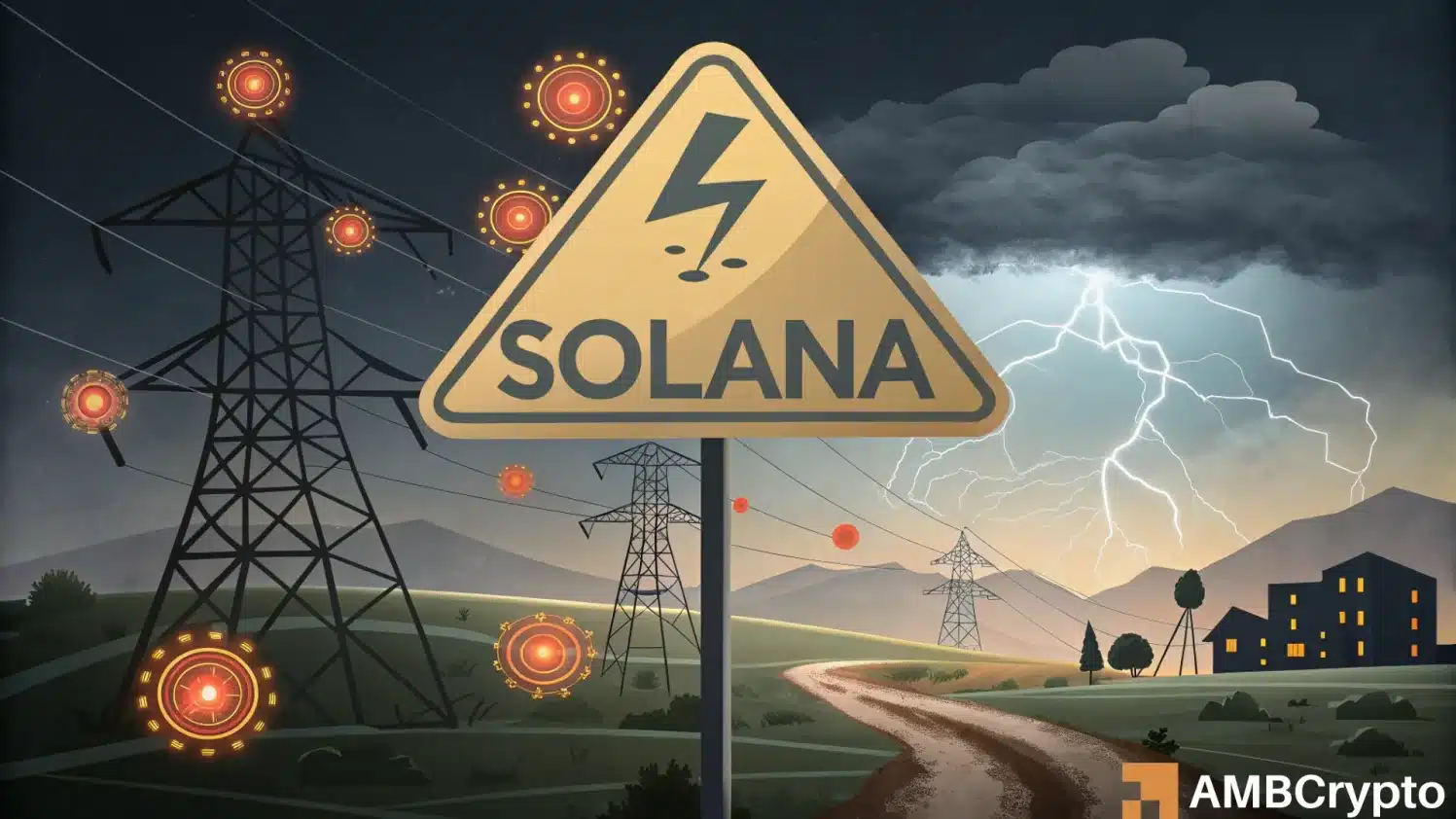
Solana enters February 2026 facing a period of intense scrutiny as market confidence falters amidst a significant price correction and emerging concerns regarding structural network integrity. Currently trading at approximately $105.03, the SOL token has reached its lowest valuation since April 2025, marking a challenging start to the month. This decline represents a 7.17% drop within a 24-hour window and contributes to a broader downward trend that has seen the asset lose over 54% of its market value over the preceding twelve months, according to data from CoinMarketCap.
As the token hovers precariously near the psychological support level of $100, the narrative surrounding the blockchain has shifted from one of high-speed innovation to one of institutional anxiety. This shift is compounded by the emergence of a persistent, if speculative, theory known among industry critics as the “Solana killer flaw.”
The Anatomy of the “Solana Killer Flaw”
The “Solana killer flaw” is a term gaining traction within technical forums and among bearish market analysts. Unlike the network outages that plagued the blockchain in its earlier years—which were often attributed to congestion or specific consensus bugs—this new discourse focuses on deeper, architectural vulnerabilities. Critics argue that the very mechanisms Solana employs to achieve its high throughput may harbor hidden systemic risks that, if triggered by specific transaction patterns or state bloat, could lead to severe, prolonged network disruption.
While developers associated with the Solana ecosystem have repeatedly emphasized that recent upgrades, such as the implementation of the Firedancer validator client and enhanced multi-client support, have significantly bolstered network resilience, the market remains unconvinced. The concern for investors is not necessarily the current functionality of the network, but the long-term viability of its governance and decentralization models. Validator concentration remains a central point of contention, with institutional stakeholders expressing hesitation over the degree to which a relatively small number of entities control the network’s consensus mechanism.
A Chronology of Declining Sentiment
To understand the current state of Solana, one must look at the trajectory of the last eighteen months. Throughout 2025, Solana solidified its reputation as the premier destination for retail DeFi, NFT trading, and stablecoin activity. Reports from 21Shares have consistently highlighted the network’s industry-leading metrics in terms of transaction volume and active user count. However, the disconnect between usage metrics and price action became increasingly apparent in late 2025.
In January 2026, the ecosystem hit a performance ceiling. DeFiLlama data indicates that Solana’s spot Decentralized Exchange (DEX) volumes plummeted from a monthly peak of $38.4 billion in January to a current localized level of $4.6 billion. This sharp contraction in speculative activity suggests that the "degen" interest that fueled Solana’s massive rallies in 2024 and early 2025 has evaporated.
The situation was exacerbated by the security breach confirmed by Step Finance, which impacted specific treasury wallets. While the breach was not a direct exploit of the Solana mainnet, it served as a catalyst for a broader loss of confidence in the security of the ecosystem’s surrounding infrastructure. Following these events, institutional sentiment took a downward turn, evidenced by the $11.3 million in net outflows recorded by Solana-linked Exchange Traded Products (ETPs), as reported by Farside Investors.
Market Metrics and Institutional Caution
The fundamental question currently facing the Solana ecosystem is whether its undeniable utility can be successfully converted into long-term value for token holders. For much of 2025, the debate centered on scalability. With the successful scaling of the network, that debate is now considered largely settled. The new, more difficult question is one of economic sustainability.
The cooling of on-chain metrics is a clear indicator that market participants are rotating capital away from high-leverage positions. When transaction volume on DEXs falls by nearly 90% in a single month, it signals a transition from a high-growth phase to a period of consolidation. For institutional investors, this transition is fraught with risk. The volatility inherent in SOL, combined with the "killer flaw" narrative, has led to a more cautious approach to capital allocation.
Furthermore, the influence of high leverage in the Solana ecosystem cannot be overstated. During periods of market stability, leverage allows for rapid appreciation. However, in the current climate of uncertainty, the same leverage creates a "liquidation cascade" risk. As prices move toward the $100 support level, traders who are over-leveraged face the prospect of forced selling, which in turn places further downward pressure on the token price.
Comparative Analysis and Future Implications
Despite the current bearish atmosphere, Solana maintains several distinct advantages over its competitors. It remains the dominant chain for stablecoin velocity and retail interaction. Unlike some competitors that struggle with low adoption, Solana’s problem is not a lack of users, but a lack of profit-capture mechanisms that benefit the average token holder.
The ongoing integration of Firedancer—the independent validator client designed to improve the network’s efficiency and fault tolerance—is widely seen as the most critical technological hurdle for the ecosystem to clear in 2026. If successfully deployed across the network, it could effectively neutralize the "killer flaw" arguments by ensuring that even if one client suffers an architectural failure, the network as a whole remains operational.
From an institutional perspective, the focus has shifted toward governance. Large-scale capital is rarely deployed into environments where centralization concerns are perceived as existential risks. If the Solana Foundation and the broader community can demonstrate a credible path toward increased validator decentralization, institutional interest may stabilize. Conversely, if governance remains perceived as being heavily influenced by a core group of early stakeholders, the "cautious" stance from institutional investors is likely to persist.
Conclusion: The Path Forward
The situation surrounding Solana in February 2026 is a microcosm of the broader challenges facing high-performance blockchains. The era of "growth at all costs" has been replaced by an era of "value extraction and security." For Solana, the next several months will be defined by its ability to resolve the technical and perceptual challenges that have stalled its momentum.
The $100 support level acts as a critical psychological and technical threshold. A sustained breakdown below this level could trigger a wider capitulation, while a bounce would suggest that the market still perceives intrinsic value in the network’s throughput and user base. As the industry watches, the "Solana killer flaw" narrative serves as a reminder that in the crypto space, technological maturity is only half the battle; building trust with a wary, institutionalized market is equally, if not more, demanding.
The blockchain’s resilience will be tested not just by the code, but by the market’s willingness to look past the current volatility and recognize the underlying demand that persists despite the broader downturn. Investors remain at a crossroads, waiting for either a concrete signal that the network’s structural risks have been mitigated or for a return to the liquidity conditions that previously allowed Solana to thrive as a top-tier asset.