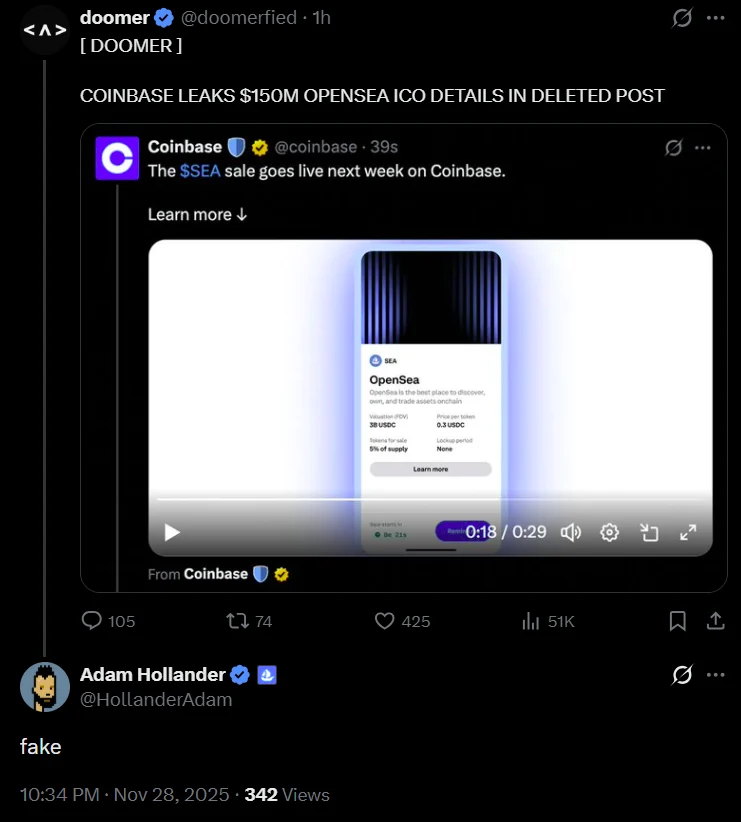
The landscape of digital asset marketplaces experienced a brief period of volatility this week following the rapid proliferation of unverified claims regarding a $150 million token sale for OpenSea’s upcoming native asset, SEA. Adam Hollander, the Chief Marketing Officer of the prominent NFT marketplace, issued a formal denial on social media, explicitly labeling reports of an imminent initial exchange offering (IEO) on Coinbase as entirely fabricated. The incident highlights the growing susceptibility of the decentralized finance (DeFi) and non-fungible token (NFT) sectors to sophisticated social engineering and misinformation campaigns conducted via high-traffic social media channels.
The Genesis of the Rumor and Its Rapid Proliferation
The false narrative originated from a parody account on X (formerly Twitter) that mimicked the aesthetic and tone of major industry news outlets. The account claimed that Coinbase had briefly published and subsequently retracted a social media post announcing a $150 million token sale for the SEA token, with a launch scheduled for the following week.
Within hours, the rumor transcended the platform of origin, infiltrating Telegram trading groups and crypto-focused news aggregators. The speed at which the misinformation spread underscores the heightened anticipation surrounding OpenSea’s long-awaited transition into a token-incentivized ecosystem. Because the market has been actively speculating on the utility and distribution mechanics of the SEA token since its initial announcement, the fake news was treated by many as a confirmation of existing rumors rather than a novel development, facilitating its rapid adoption by retail traders.
Chronology of the SEA Token Development
OpenSea’s trajectory toward a native token has been characterized by strategic deliberation and a focus on long-term platform sustainability. The official roadmap for the SEA token is outlined as follows:
- Early 2025: Initial discussions regarding platform evolution and the potential for a native governance and rewards token begin to surface within industry circles.
- Late 2025: OpenSea confirms the existence of the SEA token project, outlining its purpose to serve as the backbone for community rewards, staking mechanisms, and decentralized governance.
- November 2025: A wave of market speculation regarding specific launch dates and partnerships—including the false Coinbase claim—reaches a fever pitch, prompting an official response from OpenSea leadership.
- Q1 2026 (Projected): The official launch window for the SEA token, as confirmed by CEO Devin Finzer.
The clarity provided by CEO Devin Finzer regarding the token’s actual launch window—scheduled for the first quarter of 2026—stands in stark contrast to the urgency manufactured by the misinformation campaign.
Structural Details of the SEA Ecosystem
Unlike many speculative tokens that enter the market without clear utility, OpenSea has articulated a specific economic framework for SEA. According to internal disclosures, 50% of the total token supply is earmarked for the community. This allocation is designed to prioritize historical users who have contributed to the marketplace’s liquidity and growth during the NFT boom and subsequent market consolidation.
Furthermore, the integration of the token is not merely superficial. OpenSea intends to implement a robust buyback program, committing 50% of its platform revenue generated at the time of launch toward the periodic purchase of SEA tokens from the secondary market. This mechanism serves two primary functions: first, it provides consistent demand to support the token’s market valuation; second, it aligns the financial success of the platform with the interests of token holders, creating a cyclical relationship between marketplace activity and asset performance.
Analysis: Market Sentiment and the "Airdrop" Phenomenon
The intensity of the reaction to the fake Coinbase rumor is reflective of a broader cultural phenomenon within the crypto industry: the "airdrop frenzy." As historical users of decentralized protocols—such as Uniswap, Arbitrum, and Blur—have received significant capital injections through retroactive airdrops, the community has become hyper-vigilant for similar opportunities within the OpenSea ecosystem.
The prospect of an "OpenSea Airdrop" has been a staple of industry conversation for years. Because OpenSea remains one of the few dominant legacy platforms without a governance token, the market has primed itself to react to any news—real or fake—that suggests an impending distribution. The recent incident serves as a case study in how market participants, driven by the fear of missing out (FOMO), often bypass standard due diligence protocols, prioritizing speed over verification.
Official Responses and Industry Impact
In his response, CMO Adam Hollander maintained a firm, professional stance, emphasizing that the organization communicates all major developments through official channels. By characterizing the post as "fake," Hollander effectively stabilized the immediate market reaction, preventing what could have been a significant pump-and-dump cycle had investors continued to act on the fabricated information.
From a regulatory and security perspective, this event underscores the necessity for platforms to maintain clear lines of communication. Coinbase, the exchange falsely linked to the sale, did not issue a statement, as it is standard practice for major institutions to ignore parody-driven rumors unless they threaten significant reputational or legal harm. However, the incident has reignited discussions regarding the responsibility of social media platforms in curbing the spread of financial misinformation, particularly as it relates to nascent digital assets.
Broader Implications for the NFT Market
OpenSea’s shift toward a tokenized model is emblematic of the "Platform-as-a-Protocol" evolution. By moving beyond a simple brokerage model to a decentralized governance structure, OpenSea aims to recapture market share lost to incentive-driven competitors like Blur. The success of this transition hinges on the community’s trust in the tokenomics and the transparency of the distribution process.
Data from the broader NFT market shows a shift in user behavior; traders are increasingly migrating toward platforms that offer loyalty programs and native yield opportunities. If OpenSea successfully executes its Q1 2026 launch as planned, it could potentially redefine the standard for NFT marketplace engagement. However, the organization must navigate the complexities of managing user expectations while contending with a landscape prone to malicious misinformation.
Conclusion: Navigating the Future of Digital Assets
As OpenSea approaches its 2026 launch window, the company faces the dual challenge of building a sophisticated financial product and maintaining an unassailable reputation. The recent false rumor incident, while disruptive, provides a valuable lesson for both the developer and the user. For developers, it highlights the importance of preemptive communication. For users, it serves as a reminder that the high-stakes environment of the crypto markets requires a disciplined approach to information consumption.
The SEA token, once launched, will be tasked with integrating the fragmented interests of digital collectors, traders, and platform stakeholders. Its success will likely be measured not just by its price action, but by its ability to foster a sustainable, governance-driven community that outlasts the volatile cycles of the NFT industry. Until then, stakeholders are advised to rely exclusively on verified communications from the OpenSea executive team and official company domains, ignoring the noise of unverified social media narratives that seek to exploit market anticipation for short-term gain.
The incident serves as a critical checkpoint in the ongoing maturation of the Web3 ecosystem. As the industry moves toward more professionalized financial instruments, the ability for platforms to maintain control over their narratives will become as important as the code that powers their marketplaces. The market now turns its focus toward the official Q1 2026 rollout, with a heightened awareness of the risks inherent in the digital asset space.