The political landscape in France is undergoing a period of intense volatility, directly reflected in shifting prediction markets as citizens take to the streets over escalating living costs, soaring energy prices, and controversial government austerity measures. Polymarket odds for the upcoming 2027 French presidential election are increasingly capturing the deep economic anxiety gripping the nation, as mass demonstrations, nationwide strikes, and contentious state budgets redefine the country’s political trajectory.
As the April 2027 ballot approaches, traders on decentralized prediction platforms are aggressively repricing the odds for key political contenders. At the same time, the administration of President Emmanuel Macron faces unprecedented pressure from a populace grappling with persistent inflation, deteriorating public services, and the immediate fallout of geopolitical conflicts on domestic fuel prices.
Chronology of Unrest: From High School Boycott to Nationwide Protests
The current wave of civil unrest did not materialize overnight; it represents the culmination of mounting grievances that have steadily compounded throughout the year. The movement traces its roots back to September 21, when high school students in the deprived suburbs of Paris initiated coordinated class boycotts. These initial demonstrations were fueled by localized frustrations regarding unreplaced absent teachers, dilapidated school infrastructure, and severely overcrowded classrooms.
What began as a localized education protest rapidly metastasized into a broad nationwide movement encompassing broader economic grievances, including the escalating cost of living and soaring energy expenses. By early October, the demonstrations had drawn participation from diverse segments of French society, uniting students, working-class families, and labor unions in a shared expression of discontent.
As the scope of the protests widened, clashes between demonstrators and law enforcement intensified. By early October, international media outlets, including Al Jazeera, reported that over 6,100 individuals had been arrested, a significant portion of whom were minors. Furthermore, reports indicated that roughly 190 high school students had sustained injuries during the clashes. The severity of the police response became a central flashpoint when a 15-year-old student in Lens tragically lost a hand following the explosion of a police stun grenade, prompting an official government investigation that remains ongoing.
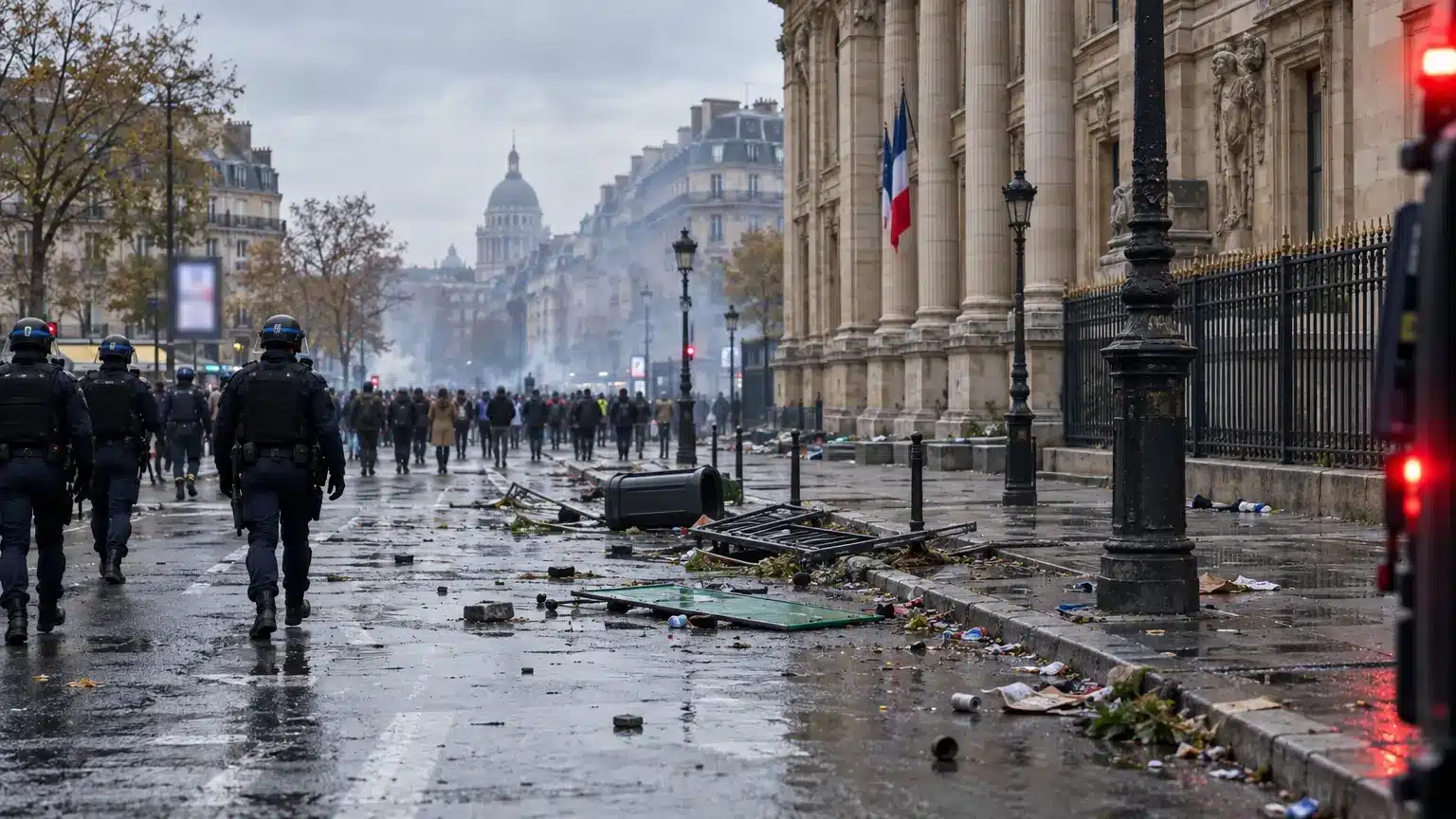
The unrest reached a dramatic peak on Saturday, October 17, when authorities recorded approximately 550,000 marchers across the country, while organizers claimed figures closer to 800,000. Despite the peaceful intentions of the vast majority of participants, the demonstrations were marred by incidents of looting, arson, and property damage. Law enforcement authorities attributed these violent episodes to masked agitators and fringe extremist groups who infiltrated the wider marches, though critics and civil liberties groups continued to voice sharp condemnation over the heavy-handed policing tactics employed during the events.
Economic Pressures: Energy Crises, Inflation, and Austerity Measures
The socio-political turmoil in France is inextricably linked to severe macroeconomic pressures that have severely compressed household purchasing power. The most immediate and acute pressure point has been the energy sector. Following the outbreak of the war involving the United States, Israel, and Iran in February, global oil markets experienced severe disruptions, driving crude prices upward and directly impacting European refiners and consumers.
In France, the consequences were acutely felt at the fuel pump. On September 21, the price of standard diesel surged to a record €2.41 per liter. This spike coincided with severe supply chain bottlenecks that left approximately 16% of the nation’s petrol stations entirely short of at least one essential fuel grade, paralyzing daily commutes and freight transport alike.
Beyond energy, general consumer price inflation accelerated to 3.0% in September, up from 2.4% in August. The national statistics institute, Insee, has projected that overall household purchasing power will contract by 0.4% over the course of the year, as wage growth consistently lags behind the pace of inflation.
Compounding these household struggles is the government’s aggressive fiscal consolidation agenda. Facing mounting public debt and pressure from European Union fiscal rules, the administration proposed a stringent 2027 budget aimed at achieving €54 billion in structural savings. Among the most contentious elements of this fiscal package is a proposed €2 billion public-sector pay freeze.
While government officials and fiscal conservatives argue that these deficit-reduction measures are indispensable for safeguarding the nation’s long-term economic stability, critics contend that the cuts disproportionately target essential public services. Reductions in funding for pensions, healthcare, and education have been fiercely condemned by labor unions and opposition politicians, who argue that the burden of fiscal adjustment is falling almost exclusively on middle-income earners and impoverished households.
Polymarket Odds and the 2027 Presidential Race
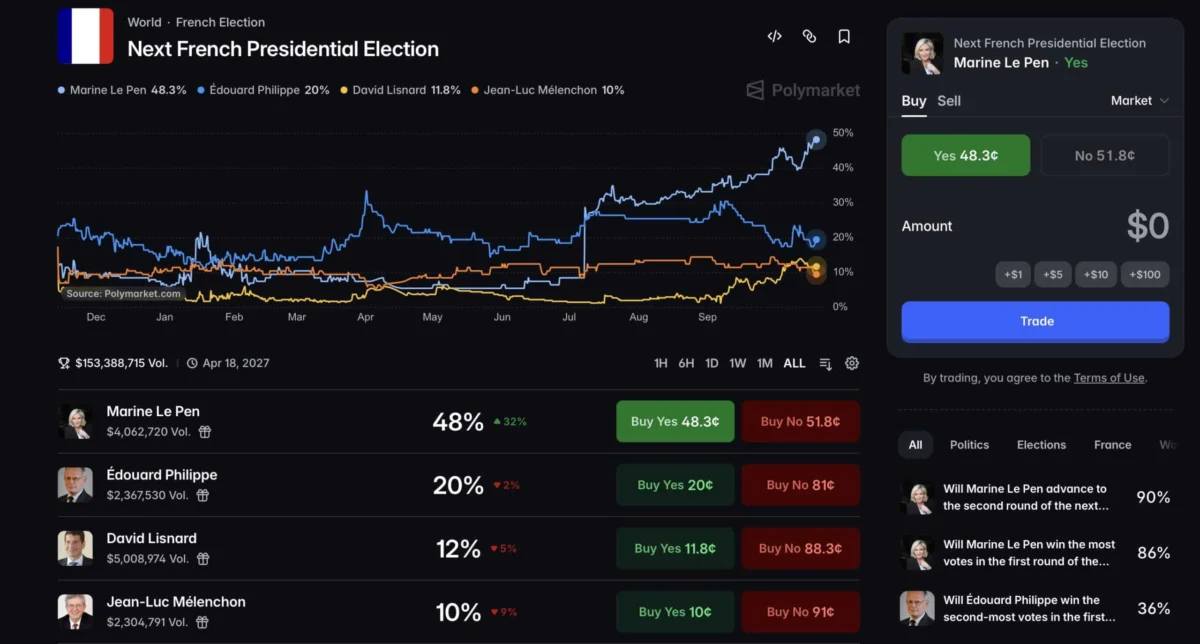
The convergence of economic hardship and social unrest has fundamentally altered the calculus for the upcoming presidential election scheduled for April 18, 2027. Prediction markets such as Polymarket have become barometers for shifting political sentiment, capturing how traders perceive the vulnerability of the current establishment and the rising fortunes of opposition figures.
According to current Polymarket data, Marine Le Pen, leader of the National Rally, holds a commanding position in the race, commanding a 48.3% probability of winning the presidency in the April 2027 run-off. Furthermore, traders price Le Pen at an overwhelming 90% likelihood of successfully advancing to the second round of voting.
Behind Le Pen, other prominent political figures are trailing significantly in the prediction markets. Edouard Philippe, the former Prime Minister, stands at 20% probability, while conservative figure David Lisnard is priced at 11.8%, and left-wing leader Jean-Luc Mélenchon captures 10% of the market sentiment.

Despite the intense domestic turbulence and the fragility of the ruling coalition, traders view an abrupt collapse of the executive branch as unlikely in the immediate term. Polymarket data indicates that the probability of President Emmanuel Macron departing office prior to December 31, 2026, sits at a modest 4%. Market analysts emphasize that while prediction markets provide a real-time reflection of crowd-sourced sentiment and trader positioning, they are speculative instruments and do not constitute formal deterministic forecasts of electoral outcomes.
Official Responses and Societal Implications
The French government has found itself caught between the competing imperatives of international fiscal discipline and domestic social cohesion. Administration officials have repeatedly defended the necessity of the proposed budget cuts, maintaining that failure to address the national deficit would expose France to severe sovereign debt pressures and loss of market confidence.
However, government representatives have also signaled a willingness to engage in dialogue with moderate labor representatives and local officials to mitigate the impact of rising living costs. Targeted energy subsidies and localized cost-of-living relief packages have been floated as potential stopgap measures, though skepticism remains high regarding whether these interventions will be sufficient to quell widespread public anger.
Opposition leaders have capitalized heavily on the unrest, framing the protests and strikes as a direct indictment of the administration’s economic policies. Right-wing and left-wing factions alike have utilized the momentum of the cost-of-living crisis to rally their respective bases, emphasizing themes of institutional neglect, the erosion of the French welfare state, and the necessity of sweeping political change.
Broader Implications for European Stability
The developments in France carry significant ramifications that extend well beyond national borders, holding substantial weight for the broader European Union. As the second-largest economy in the Eurozone, France’s fiscal health and political stability are critical pillars of the European monetary union. Persistent civil unrest, coupled with the potential ascendancy of eurosceptic political forces in the 2027 election, introduces a high degree of structural uncertainty into European policy coordination, trade relations, and defense integration.
Economists note that the ongoing friction between austerity mandates and popular resistance highlights a broader continental dilemma: how governments can successfully manage post-pandemic debt burdens without precipitating severe social fragmentation. As inflation continues to erode real incomes and public sector dissatisfaction deepens, the French government faces a delicate balancing act to restore economic equilibrium while preventing further escalation of social unrest ahead of the pivotal 2027 ballot.