The United States legislative effort to establish a comprehensive digital asset framework is encountering severe headwinds in the upper chamber of Congress, threatening to leave the cryptocurrency sector mired in regulatory ambiguity for the foreseeable future. According to a strategic market report published by investment banking giant Jefferies on June 30, 2026, the proposed CLARITY Act faces a rapidly narrowing window for Senate enactment. Led by analyst Andrew Moss, the Jefferies research team cautioned that institutional adoption, market stability, and crypto-linked equities could experience heightened volatility as the probability of the bill becoming law before the end of the year diminishes.
Prediction markets have adjusted rapidly to the shifting political climate. Data from Polymarket indicates that the odds of the CLARITY Act achieving full enactment by the conclusion of 2026 have tumbled to 48%, marking a sharp decline from the 70% probability recorded in mid-May. With roughly 20 legislative days remaining on the Congressional calendar before the traditional August recess, lawmakers are running out of time to reconcile deep partisan and inter-agency disagreements. The looming summer recess, followed closely by the heating up of the November midterm elections, has transformed what was once viewed as a near-certainty into a high-stakes legislative bottleneck.
Financial analysts emphasize that the current impasse is far more than a mere scheduling inconvenience. Instead, market participants view the legislative struggle as a critical structural inflection point for the global digital asset economy. A statutory framework passed by Congress represents the dividing line between permanent, durable regulatory clarity and a fragile patchwork of agency enforcement actions and guidance documents. While formal legislation would provide a permanent foundation for institutional capital deployment, the alternative—a prolonged regulatory vacuum—leaves market participants exposed to the shifting priorities of successive presidential administrations and reactionary enforcement regimes.
Chronology of the CLARITY Act and the Legislative Bottleneck
The journey of the CLARITY Act through the halls of the United States Congress has been characterized by protracted negotiations, jurisdictional turf wars, and intense lobbying from both traditional financial institutions and digital asset enterprises. The legislative vehicle first gained significant momentum when it successfully cleared the House of Representatives on July 17, 2025, passing by a robust bipartisan margin of 294 to 134. This decisive House vote signaled a growing congressional appetite for establishing clear boundaries between America’s primary financial regulators.
Following its progression through the lower house, the bill moved to the Senate, where it languished in committee negotiations for months before securing approval from the Senate Banking Committee on May 14, 2026, by a bipartisan vote of 15 to 9. By June 1, 2026, the legislation was officially placed on the Senate floor calendar, setting the stage for what many proponents hoped would be a swift passage. However, the path to a full Senate vote requires overcoming the formidable 60-vote threshold, necessitating at least seven Democratic crossovers—a difficult task given the contentious policy debates surrounding the bill.
The core legislative sticking points involve complex policy provisions rather than broad philosophical disagreements over the need for regulation. Unresolved disputes persist regarding ethics requirements, stringent illicit finance language, and, most persistently, the regulatory treatment of stablecoin issuers. Specifically, lawmakers remain deeply divided over whether issuers of dollar-pegged stablecoins should be legally permitted to pay yield to token holders. These contentious issues have already forced Senate leadership to stall floor scheduling once. With the legislative calendar offering virtually no margin for error, a second delay could prove fatal to the bill’s prospects for the current session of Congress.
Broader Wall Street Assessment and Diminishing Expectations
Jefferies is not the only major financial institution raising alarms about the deteriorating legislative outlook. JPMorgan Chase issued a parallel warning earlier in June, characterizing the congressional calendar as severely constrained and highlighting the stablecoin yield debate as an intractable obstacle. Similarly, Galaxy Research has revised its internal probability metrics downward, pegging the likelihood of passage at roughly 50% to 55%.
Market observers note that the failure to advance the legislation before the August recess could effectively push the timeline into 2027 or beyond. This risk is amplified by the looming November midterm elections. Should the political balance of power shift in the Senate—particularly if Democrats recapture the majority—the delicate bipartisan compromises painstakingly constructed over the past two years could unravel entirely, forcing sponsors to restart the legislative process from square one.
What the Regulatory Framework Unlocks, or Forfeits
The economic implications of the CLARITY Act extend far beyond Capitol Hill politics, directly dictating the trajectory of institutional capital allocation within the United States. According to the Jefferies assessment, formal enactment would grant traditional financial powerhouses—including commercial banks, major asset managers, and institutional exchanges—the explicit statutory authority required to scale tokenization services, institutional custody arrangements, crypto staking, and lending products. Currently, financial institutions must rely on piecemeal, non-binding guidance issued by the Securities and Exchange Commission (SEC), the Commodity Futures Trading Commission (CFTC), and the Office of the Comptroller of the Currency (OCC). While these agency interpretations approximate legal permission, they lack the legal certainty of an act of Congress.
At the center of the legislative framework is the proposed decentralization test. This legal architecture is designed to determine the precise moment a network token transitions from being classified as a security under SEC jurisdiction to a commodity under the oversight of the CFTC. Spot crypto exchange-traded fund (ETF) attorneys have long argued that this statutory distinction is the missing link required to expand spot crypto ETF approvals beyond foundational assets like Bitcoin and Ether to encompass large-cap decentralized tokens such as Solana (SOL) and Avalanche (AVAX). The rapid product expansion witnessed following BlackRock’s recent rollouts of Bitcoin-linked ETF structures illustrates how swiftly institutional product development accelerates once a clear regulatory lane is established.
Furthermore, Jefferies identified the CLARITY Act as a mandatory prerequisite for reviving the dormant domestic cryptocurrency initial public offering (IPO) pipeline. The legislation aims to establish a bespoke disclosure regime tailored specifically for ancillary asset originators. This framework would be significantly lighter than traditional securities registration, enabling compliant token fundraising and secondary market trading on CFTC-registered digital commodity exchanges once specific decentralization thresholds are verified. Without this statutory relief, prospective issuers remain exposed to unpredictable, case-by-case enforcement scrutiny from the SEC.
Conversely, in a prolonged delay scenario, regulated financial institutions would remain tethered to reversible agency actions. Jefferies characterizes this regulatory limbo as a persistent structural drag on blockchain initiatives. Compliance teams across Wall Street would be forced to reassess legal risk under an enforcement-driven paradigm rather than a statute-based framework—a continuation of the exact hostile pattern that has governed the U.S. digital asset market structure since 2020.
Equities in Focus: Circle, Coinbase, and Bullish Navigational Risk
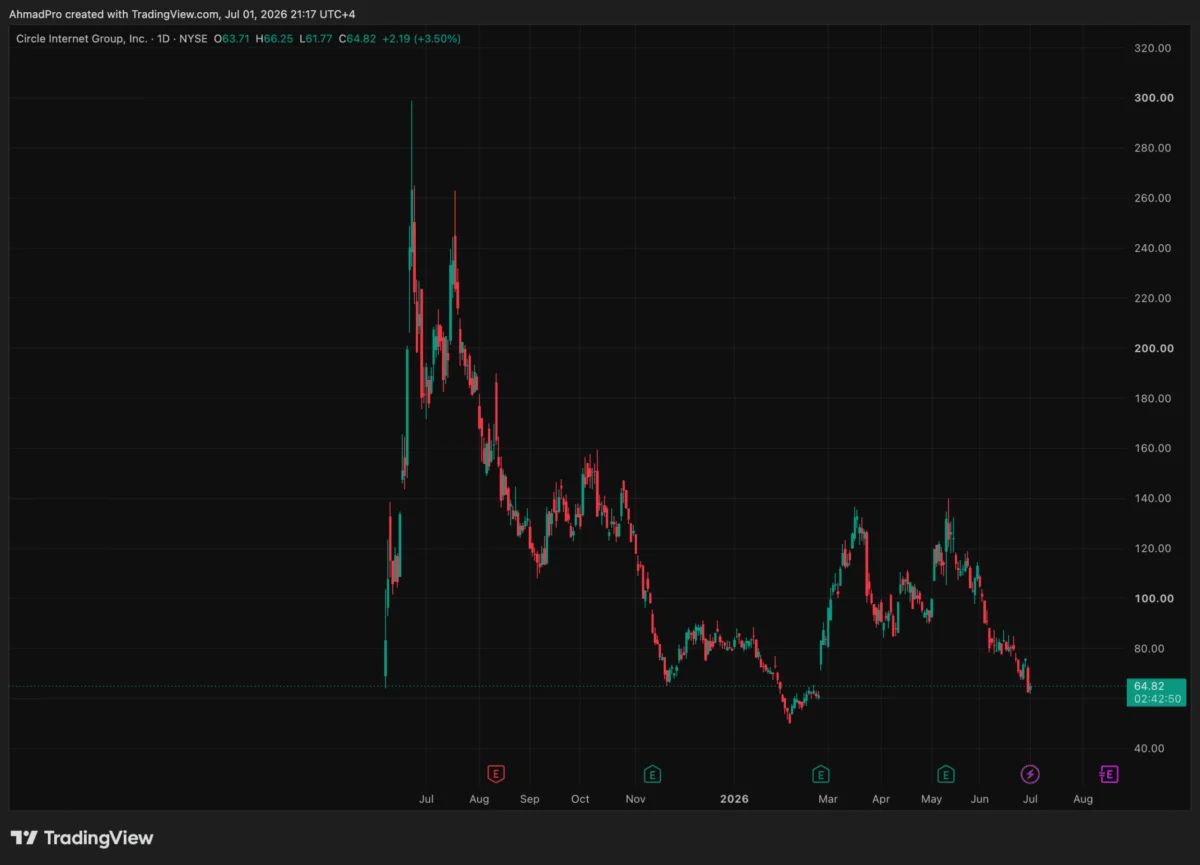
The legislative uncertainty is already manifesting in the public equities markets. Jefferies expects the ongoing legislative process to generate outsized volatility in crypto-linked equities, specifically flagging Circle (CRCL), Coinbase (COIN), and CoinDesk parent company Bullish (BLSH) as the primary publicly traded entities exposed to the outcome.
For stablecoin issuer Circle, the investment bank describes the legislative implications as a mixed bag. The current text of the CLARITY Act would close a regulatory loophole that currently enables third-party intermediaries, such as Coinbase, to offer financial rewards or yield on USDC holdings. While this provision could constrain the velocity of USDC circulation and growth in the near term, a legislative delay would paradoxically grant Circle additional operational runway to diversify its revenue streams and expand its global payments network independently. Over the long term, Jefferies suggests that intensifying commercial competition from traditional bank-issued stablecoins represents a far more significant structural risk to Circle’s business model—a challenge that federal legislation neither creates nor resolves.
Market observers emphasize a broader disconnect between macroeconomic realities and asset valuations. Prediction market odds have slumped into near-coin-flip territory, yet equities within the digital asset sector have largely failed to reprice commensurately to reflect the increasing likelihood of a prolonged regulatory vacuum. As the industry awaits the scheduled July text release and subsequent Senate floor maneuvers, these equity valuations remain vulnerable to sudden repricing events depending on whether the legislative gap closes positively or negatively.
Official Responses and Divergent Viewpoints
Despite mounting pessimism from Wall Street analysts and sliding prediction market odds, pockets of optimism persist among key regulatory figures and industry lobbyists. Speaking publicly on the matter, SEC Commissioner Hester Peirce offered a contrasting perspective on the legislative timeline, expressing confidence in the ultimate success of the initiative. "I’m still optimistic it will get done this summer," Peirce stated during a recent industry appearance. "I expect that we’ll see it pass soon."
Proponents of the legislation argue that the bipartisan foundation forged within the Senate Banking Committee demonstrates a durable consensus that transcends standard partisan divides. However, skeptics counter that optimistic agency commentary cannot override the harsh mathematical realities of a congested Senate floor calendar and deeply entrenched disputes over fiscal policy and consumer protection.
As the summer legislative session reaches its critical juncture, the divergence between regulatory optimism and institutional apprehension highlights the precarious state of U.S. digital asset policy. Whether Congress can overcome its internal divisions before the August recess will determine whether the American cryptocurrency market steps into a new era of institutional maturity or remains tethered to a cycle of regulatory friction.