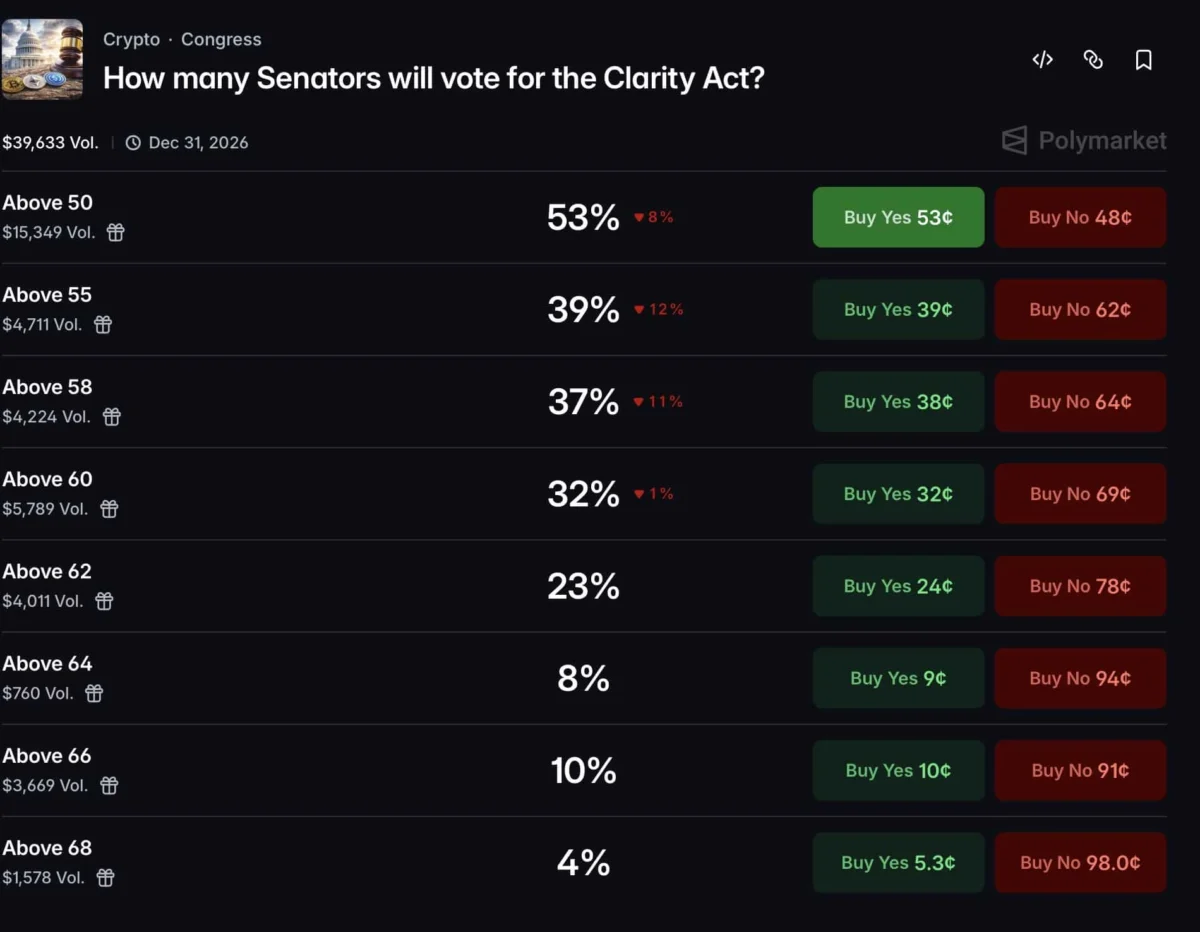
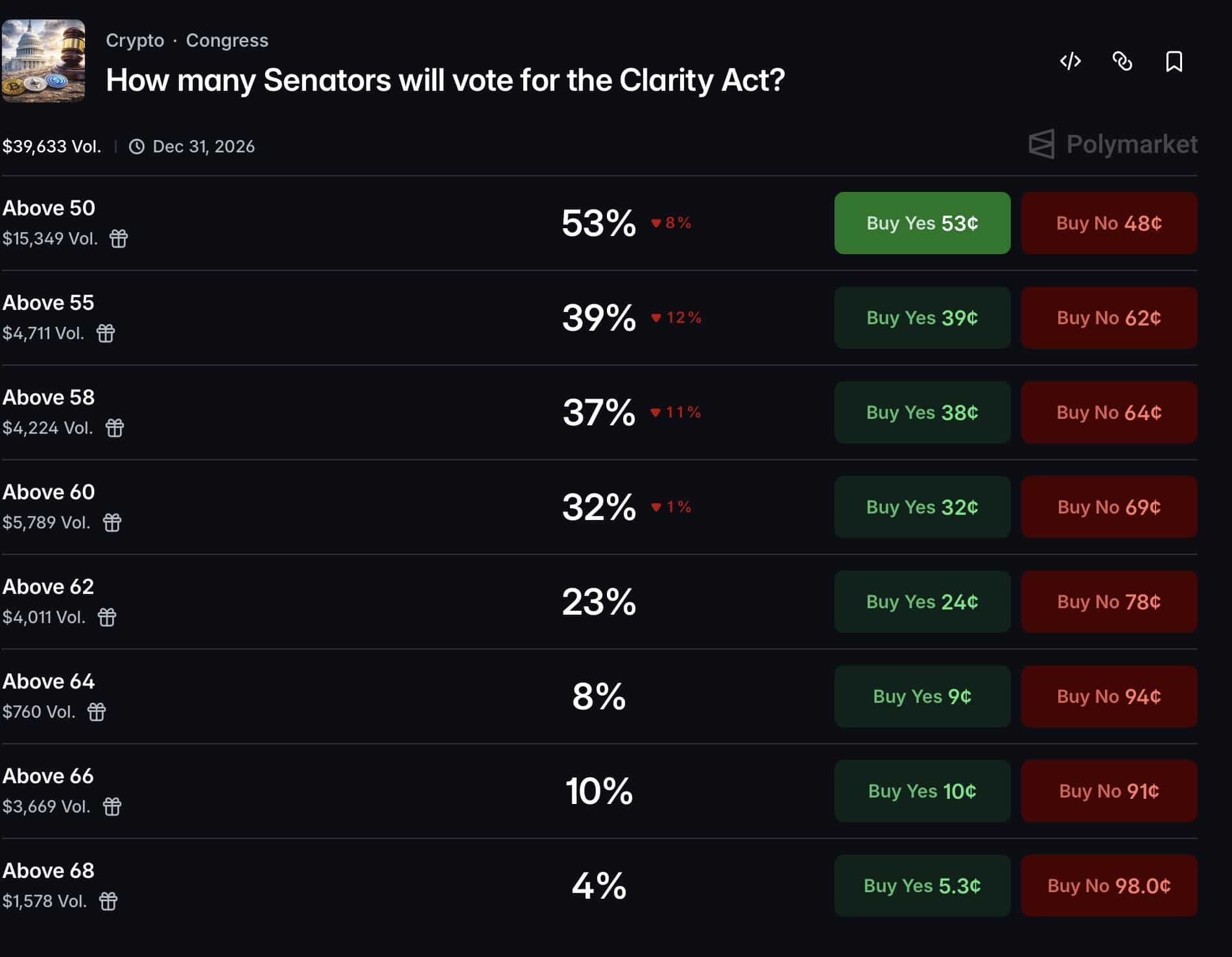
The legislative future of digital asset regulation in the United States faces renewed scrutiny as prediction markets adjust their outlook on the much-debated Clarity Act. Recent data from the decentralized prediction platform Polymarket indicates a notable dip in trader confidence regarding the scale of legislative support the bill will garner upon reaching the United States Senate floor. Specifically, traders currently price a 53% probability that more than 50 senators will cast a "Yes" vote during the chamber’s inaugural final-passage vote for the legislation. This figure represents an 8-percentage-point decline over a single week, reflecting growing uncertainties about whether the crypto market structure bill can command robust, cross-aisle momentum before the expiration of the market contract on December 31, 2026.
While a simple majority remains treated as a coin toss by market participants, expectations for a broader, filibuster-proof coalition have dropped far more sharply. The probability of the bill clearing a 60-vote threshold—a critical benchmark in the 100-seat Senate where most major legislation requires supermajority support to overcome procedural hurdles—sits significantly lower at 32%. Total trading volume on the active "How many Senators will vote for the Clarity Act?" market has reached $39,633, highlighting the niche yet highly analytical participation of financial and political speculators monitoring the intersection of Capitol Hill politics and Web3 market structures.
Understanding the Mechanics of Prediction Market Contracts
To properly contextualize these shifting metrics, financial analysts emphasize the precise wording and structural rules governing the Polymarket contract. The terminology employed by the platform dictates strict numerical definitions: "Above 50" requires a minimum tally of 51 senators, while "Above 60" demands at least 61 affirmative votes.
The decay in projected support accelerates substantially past the standard majority threshold. For instance, contracts predicting "Above 55" votes are priced at 39%, while those forecasting "Above 58" votes sit at 37%. Both categories have suffered contractions exceeding 10 percentage points week-over-week, marking the steepest declines observed across the entire market spectrum. Industry observers note that these downward revisions do not necessarily signal an outright abandonment of the regulatory framework by lawmakers. Rather, they reveal a pragmatic reassessment among traders who recognize the structural chasm separating a simple legislative majority from the formidable 60-vote barrier required to insulate a bill from partisan gridlock.
Crucially, the prediction market contract features strict resolution criteria. The contract resolves strictly on the basis of the first Senate vote concerning the final passage of qualifying crypto market-structure legislation occurring prior to January 1, 2027. Under these guidelines, preliminary milestones such as committee votes, motions to proceed, cloture motions, and legislative amendments are explicitly excluded from triggering a resolution. If the legislative vehicle ultimately clears the Senate via a voice vote or unanimous consent, the market automatically registers a "Yes" outcome, irrespective of raw numerical tallies. Conversely, if no qualifying final-passage vote takes place before the deadline, the contract defaults to a "No" resolution.

Legislative Background and Chronology of H.R. 3633
The journey of the Clarity Act through the halls of Congress has been marked by protracted debate, intense lobbying, and complex jurisdictional turf wars between federal financial regulators. The legislative roots of the current debate trace back to the House of Representatives, where the foundational measure, designated as H.R. 3633, successfully advanced on July 17, 2025. During that initial legislative test, the House demonstrated substantial bipartisan backing, passing the bill by a decisive 294-134 margin.
Following its transmission to the upper chamber, the bill underwent months of committee review and redrafting. On June 1, 2026, the Senate Banking Committee formally reported an amended substitute version of the legislation. This milestone established that the bill had successfully navigated early legislative committees, yet it left open the timeline and ultimate viability of securing a floor vote.
As the legislative calendar advanced into late summer 2026, political friction intensified. Reports surfaced indicating that Democratic lawmakers rejected the final negotiated version of the Clarity Act, subsequently putting forward a counteroffer that challenged key provisions of the Republican-backed framework. Compounding these headwinds, state-level regulatory officials entered the fray; notably, the New York Attorney General formally called upon Congress to block the enactment of the Crypto Clarity Act, arguing that federal preemption could undermine state-level consumer protections.
Amid these conflicting pressures, the Trump administration launched a coordinated administrative push in mid-September 2026, deploying executive branch officials to lobby wavering senators in an effort to secure the momentum necessary to advance the bill to the floor. Despite these high-level interventions, broader political skepticism caused independent market analysts to lower the odds of the Clarity Act officially becoming law within the calendar year to roughly 20%.
Implications for SEC and CFTC Jurisdictional Boundaries
While prediction markets focus heavily on the arithmetic of vote counts, the broader implications of the Clarity Act extend far beyond a single legislative tally on Capitol Hill. At its core, the legislation seeks to establish a comprehensive federal regulatory framework for digital assets, systematically defining the legal boundaries between the Securities and Exchange Commission (SEC) and the Commodity Futures Trading Commission (CFTC).
For years, the digital asset ecosystem has operated under a regime characterized by regulatory ambiguity and enforcement-driven oversight, a paradigm frequently criticized by industry participants as "regulation by enforcement." The Clarity Act aims to resolve these tensions by codifying explicit statutory definitions that determine when a digital token constitutes a security versus a digital commodity, thereby dictating whether oversight falls under the purview of the SEC or the CFTC.
The ongoing debate over the bill’s provisions highlights deep ideological divisions regarding investor protection, financial innovation, and systemic risk. Proponents within the decentralized finance (DeFi) and broader Web3 sectors argue that clear regulatory guardrails are essential to provide legal certainty, attract institutional capital, and retain blockchain development talent within the United States. Conversely, critics and consumer advocacy groups express concern that statutory exemptions or streamlined compliance pathways could dilute regulatory oversight, potentially leaving retail investors vulnerable to market volatility and fraudulent schemes.
Broader Market Context and Outlook
The shifting sentiment on Polymarket serves as a real-time barometer of the political realities facing financial innovation in Washington. Although the Trump administration’s legislative push underscores a high-level executive commitment to regulatory reform, the legislative process remains subject to the inherent friction of a deeply divided Congress.
Market participants tracking the Clarity Act must distinguish between the probability of a procedural floor vote and the ultimate enactment of statutory law. As the December 31, 2026 expiration date for the prediction market approaches, traders continue to weigh the competing pressures of executive branch advocacy, state-level resistance, and partisan negotiations. Ultimately, the trajectory of the Clarity Act will not only determine the legislative legacy of digital asset regulation for the decade but will also permanently reshape the jurisdictional mandates of the nation’s premier financial regulatory agencies.