Ether.fi, one of the foremost liquid restaking platforms in the decentralized finance (DeFi) ecosystem, has implemented a significant structural pivot concerning its flagship asset, weETH. The protocol officially announced that it has removed all direct restaking exposure from weETH, fundamentally transforming the asset into a pure liquid staking token (LST). As part of this strategic realignment, Ether.fi has transitioned its restaking operations to weETHs on Symbiotic while simultaneously exiting the EigenLayer ecosystem. According to project representatives, the core objective of this architectural overhaul is the mitigation of systemic vulnerabilities, specifically targeting the elimination of bundled risk within user portfolios.
The distinction between liquid staking tokens and liquid restaking tokens has become a focal point of discussion within the broader cryptocurrency community. Traditional liquid staking tokens, such as standard LSTs, allow participants to lock up their Ethereum to secure the consensus layer, earning baseline staking rewards while receiving a derivative token that unlocks liquidity for use across various DeFi applications. Liquid restaking tokens (LRTs), conversely, push capital efficiency further by taking that staked Ethereum—or its liquid derivative—and redeploying it into secondary yield-generating layers, such as Actively Validated Services (AVSs), to capture supplementary interest.
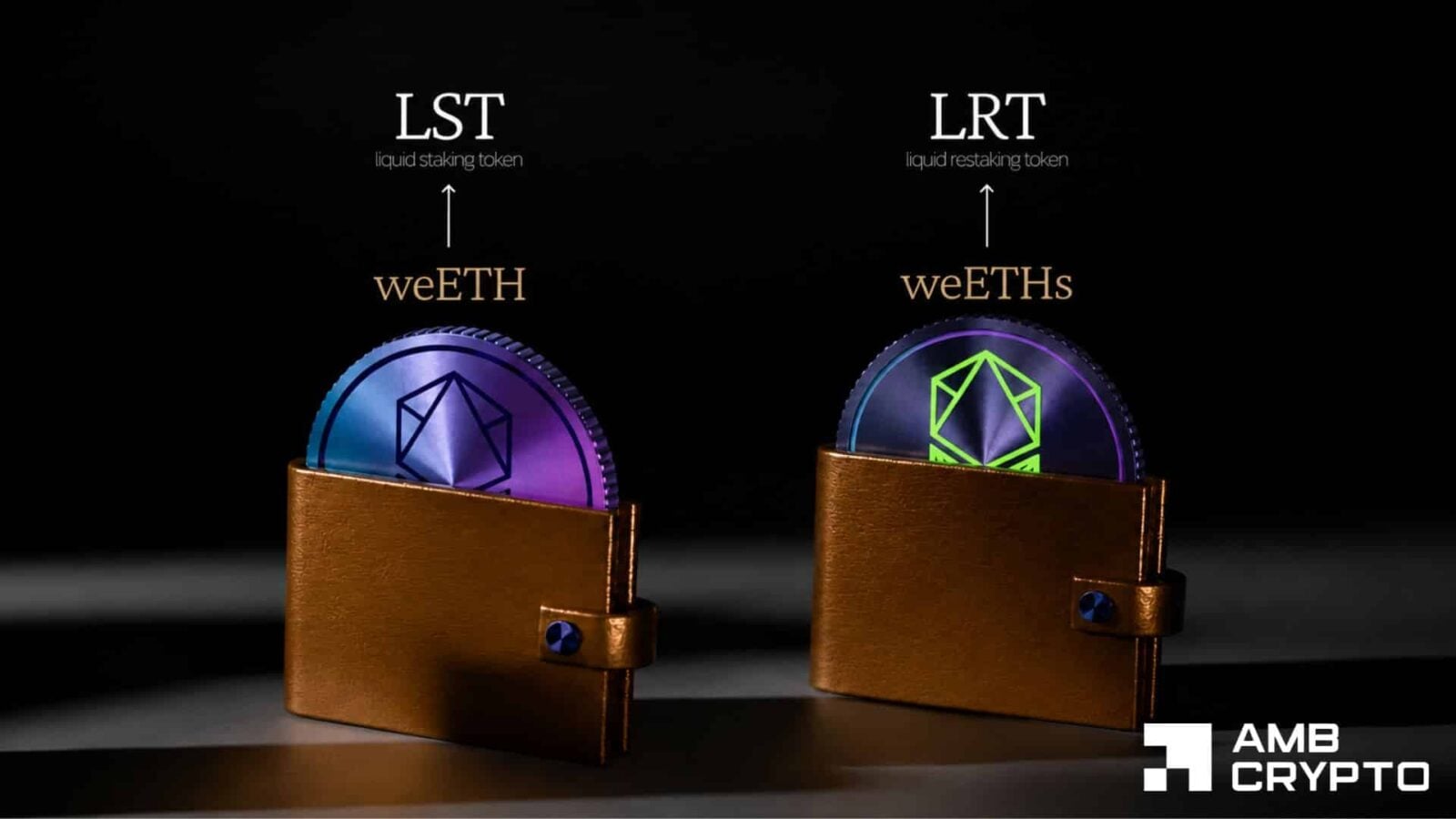
While the promise of compounded yields attracted billions of dollars in capital during the height of the restaking craze, these complex, multi-layered looping strategies introduced unprecedented systemic hazards. The intricate web of smart contract interactions required to chase marginal yield gains created attractive attack vectors for malicious actors. High-profile security incidents, most notably the $292 million exploit involving KelpDAO, laid bare the vulnerability of interconnected restaking architectures. These events forced a comprehensive reassessment of risk management paradigms across the entire decentralized finance landscape, prompting major liquidity hubs to reevaluate their asset listings and collateral frameworks.
Responding to these escalating security concerns, major lending protocols have begun aggressive clean-up campaigns. Aave, the leading decentralized lending market, recently adopted a stringent risk framework that resulted in the removal of over $98 million worth of risk-exposed assets characterized by low protocol adoption and high structural dependency. This aggressive pruning directly impacted various yield-looping mechanisms, including the Pendle Principal Token (PT) trades that heavily relied on Ether.fi and EigenLayer infrastructure. Industry analysts, including Tom Wan of Entropy Advisors, noted that Ether.fi and EigenLayer were instrumental in kickstarting the initial wave of ETH looping on Aave and Pendle, historically providing participants with an extra 50 to 100 basis points on top of baseline staking rates. With Aave deprecating these strategies, protocols built around them faced immediate indirect pressures to adapt or face liquidity contractions.
The broader liquid restaking market has experienced a notable cooling period over the past several months. Market data indicates that total value locked (TVL) within the liquid restaking sector contracted from a peak of approximately $29 billion down to roughly $22 billion. Despite this industry-wide contraction, Ether.fi has maintained a dominant market position, commanding roughly half of the total sector share with approximately $11.4 billion in total value locked. Nonetheless, the decision to strip restaking exposure from weETH is widely interpreted as a tactical retreat in response to changing macroeconomic and sector-specific conditions.
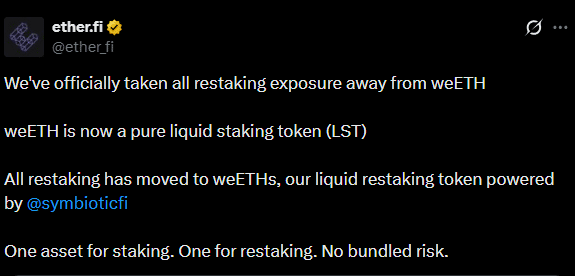
Ether.fi CEO Mike Silagadze reflected on the structural shift, describing the development as the conclusion of a distinct chapter for the protocol. Acknowledging the premature nature of early restaking models, Silagadze remarked that the era of aggressive restaking deployment has paused, though he expressed long-term optimism that restaking frameworks will eventually return in a more refined and secure format.
Financial analysts examining the event suggest that Ether.fi’s move away from EigenLayer signals a broader maturation phase for the staking economy. As institutional and retail participants increasingly prioritize safety and capital preservation over maximum nominal yield, protocols are incentivized to decouple foundational staking products from experimental restaking layers. By isolating weETH as a pure liquid staking token, Ether.fi protects its core user base from the contagion risks associated with secondary yield strategies, even as it maintains specialized exposure through alternative venues like Symbiotic.
The implications of this restructuring extend well beyond Ether.fi’s internal operations, pointing toward a fundamental re-engineering of risk tolerance across multiple blockchain networks. Market observers anticipate that other liquid restaking protocols may follow suit, re-evaluating their dependency on single-layer validation systems and monolithic risk pools. As regulatory scrutiny increases and technical audits become more rigorous, the DeFi sector appears to be transitioning away from the deploy-everywhere philosophy that dominated previous market cycles, favoring modular, risk-isolated architectures designed to withstand systemic shocks.