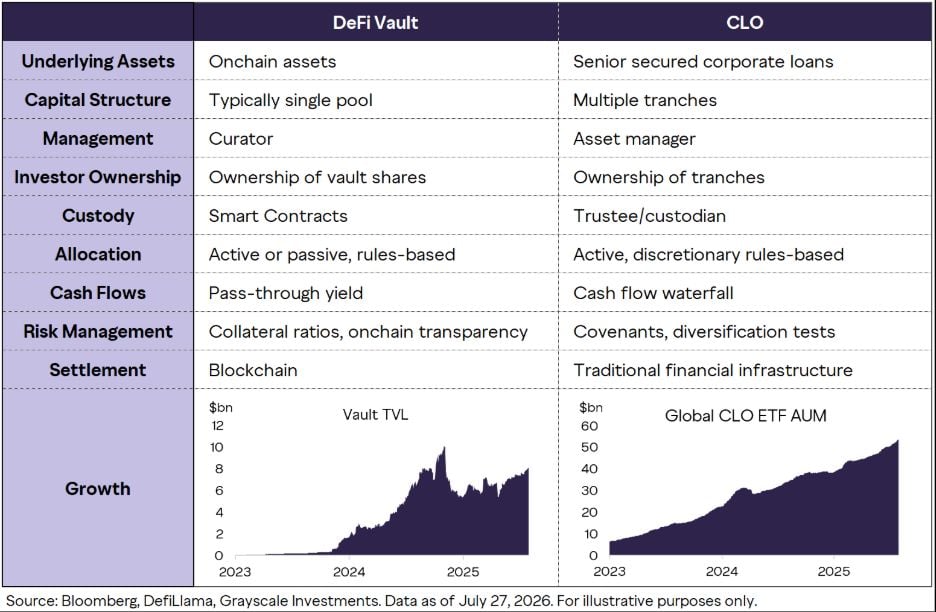
The world’s largest digital asset-focused investment platform, Grayscale, has released a comprehensive report detailing its expectation that institutional capital will initially converge on a quartet of prominent blockchain networks as the regulatory landscape for digital assets becomes more defined. This anticipated influx of sophisticated investment is predicated on the establishment of clearer guidelines, particularly from proposed legislation like the Clarity Act and definitive guidance from the U.S. Securities and Exchange Commission (SEC). Such regulatory advancements are seen as critical catalysts, driving the adoption of burgeoning use cases such as tokenized assets and decentralized finance (DeFi).
In its latest analysis, Grayscale identifies Ethereum (ETH), Solana (SOL), BNB Chain, and the privacy-enabled Canton Network as the primary beneficiaries of this impending wave of institutional investment. These networks, according to the firm, are currently at the forefront of innovation and adoption in the realms of tokenized assets and DeFi, making them attractive initial targets for risk-averse institutional players. This strategic focus underscores a pivotal moment for the digital asset industry, where regulatory certainty is increasingly recognized as the key to unlocking mainstream financial integration.
"This rising tide could eventually lift all boats across the digital assets industry," Grayscale stated in its report, emphasizing the long-term potential for broader market growth. "But for the time being, a small number of blockchains dominate this activity, including Ethereum, Solana, BNB Chain, and Canton Network. Institutional capital will target these networks first, in our view." The sentiment highlights a pragmatic approach, where established ecosystems with robust infrastructure and demonstrable use cases are prioritized by institutional funds seeking a balance between innovation and stability.
The Quest for Regulatory Clarity: A Pivotal Turning Point
The cryptocurrency market has long operated under a patchwork of ambiguous regulations, particularly in the United States, which has hindered broader institutional adoption. Grayscale’s report explicitly links the anticipated institutional surge to improvements in regulatory clarity. Central to these discussions is the concept of a "Clarity Act" – a generalized term encompassing various legislative efforts aimed at providing a definitive framework for classifying and regulating digital assets.
For years, the industry has grappled with the SEC’s stance, often characterized by a "regulation by enforcement" approach. This has led to numerous lawsuits and enforcement actions against digital asset firms, creating an environment of uncertainty regarding which digital assets constitute securities and which are commodities. The lack of clear definitions has forced many institutional investors to remain on the sidelines, wary of potential legal repercussions and compliance burdens.
Proposed legislation, such as the "Responsible Financial Innovation Act" introduced by Senators Cynthia Lummis and Kirsten Gillibrand, or the "Financial Innovation and Technology for the 21st Century Act" (FIT21 Act) passed by the House of Representatives, seeks to establish clear jurisdictional lines between the SEC and the Commodity Futures Trading Commission (CFTC). These bills aim to provide definitions for "digital assets," "payment stablecoins," and "ancillary assets," thereby offering a much-needed roadmap for market participants. The "Clarity for Digital Tokens Act" is another example of bipartisan efforts to create a clear legal framework. Such legislative clarity would enable institutional investors to confidently navigate the market, understanding the rules of engagement and the legal status of the assets they wish to invest in.
Beyond legislative efforts, explicit guidance from the SEC itself is paramount. The industry has been clamoring for clearer rules regarding initial coin offerings (ICOs), secondary market trading, and the registration process for digital asset platforms. A well-defined regulatory perimeter would not only protect investors but also foster innovation by providing a predictable environment for businesses to operate and grow. The UK, often referenced in the broader context of global crypto regulation, has also been actively developing its own comprehensive framework, aiming to become a hub for digital asset innovation while ensuring market integrity. This global push for regulatory certainty underscores the universal need for a balanced approach that nurtures growth while mitigating risks.
Unlocking Institutional Capital: The Driving Force
Institutional capital refers to the vast pools of money managed by professional entities such as hedge funds, pension funds, mutual funds, university endowments, and corporate treasuries. These entities collectively manage trillions of dollars globally. For years, their engagement with digital assets has been limited, primarily due to the aforementioned regulatory ambiguities, coupled with concerns about market volatility, custody solutions, and liquidity.
The entry of institutional capital into the digital asset space is transformative. Unlike retail investors, institutions typically invest larger sums, adhere to stricter compliance protocols, and often have longer investment horizons. Their participation lends legitimacy and stability to the market, significantly increasing market capitalization, liquidity, and overall maturity. The demand for robust, compliant infrastructure, sophisticated risk management tools, and regulated investment products (like spot Bitcoin ETFs, which have seen recent approval and massive inflows) is a direct consequence of this growing institutional interest.
Grayscale’s report suggests that once regulatory hurdles are lowered, institutions will move with purpose. Their investment strategies often involve extensive due diligence, favoring assets with established track records, strong developer communities, and clear use cases. The four networks identified—Ethereum, Solana, BNB Chain, and Canton Network—fit this profile by offering distinct advantages for various institutional applications.
The Frontrunners: Core Blockchain Networks Positioned for Growth
The Grayscale report highlights four specific blockchain networks that are poised to capture the initial wave of institutional investment, each offering unique features and established ecosystems.
1. Ethereum (ETH): The Indisputable Smart Contract King
Ethereum stands as the undisputed leader in smart contract platforms, boasting the largest developer community and the most extensive ecosystem of decentralized applications (dApps), particularly within DeFi. Its transition from a Proof-of-Work (PoW) to a Proof-of-Stake (PoS) consensus mechanism with "The Merge" in September 2022 significantly reduced its energy consumption, making it more environmentally friendly—a crucial factor for ESG-conscious institutional investors. Ethereum’s robust security, battle-tested infrastructure, and network effects make it a natural choice for institutional engagement. It hosts a vast array of tokenized assets, stablecoins, and complex DeFi protocols. While scalability has historically been a challenge, the ongoing development of Layer-2 scaling solutions like Arbitrum, Optimism, and Base, along with future sharding upgrades, promises to enhance its capacity and reduce transaction costs, further solidifying its appeal for high-volume institutional transactions. Its enterprise adoption, through initiatives like the Enterprise Ethereum Alliance, also underscores its potential for real-world business integration.
2. Solana (SOL): High Performance for the Future
Solana has emerged as a formidable contender, known for its high transaction throughput and remarkably low fees, achieved through its unique Proof-of-History (PoH) consensus mechanism combined with PoS. These attributes make Solana particularly attractive for applications requiring speed and efficiency, such as high-frequency trading, gaming, and consumer-facing dApps. Despite some past network outages, Solana’s commitment to performance and its rapidly expanding ecosystem in DeFi and NFTs have garnered significant attention. Institutional investors are drawn to its potential for scalable financial applications that can handle volumes comparable to traditional finance systems. Its growing developer base and innovative projects position it as a strong candidate for institutional capital seeking high-performance blockchain solutions.
3. BNB Chain: The Web3 Powerhouse
BNB Chain, comprising the BNB Beacon Chain and the BNB Smart Chain (BSC), offers a highly scalable and developer-friendly environment. Closely associated with the world’s largest cryptocurrency exchange, Binance, BNB Chain benefits from a massive user base and a robust ecosystem. It has become a popular choice for dApps, NFTs, and GameFi projects due to its low transaction costs and fast processing times. For institutional investors, BNB Chain presents an accessible entry point into the Web3 space, particularly for projects requiring integration with a large, active community and a supportive exchange ecosystem. While regulatory scrutiny around Binance itself remains a consideration, the underlying technology and user adoption of BNB Chain make it an attractive platform for certain institutional use cases, particularly those focused on broad market access and liquidity.
4. Canton Network (CC): Enterprise-Grade Privacy and Interoperability
The inclusion of Canton Network is particularly insightful, highlighting a specific institutional need. Unlike the public, permissionless blockchains above, Canton Network is a permissioned blockchain platform designed specifically for regulated financial institutions. Developed by Digital Asset, Canton aims to provide a secure, interoperable, and privacy-preserving network for a wide range of financial applications. Its core technology, DAML smart contracts, enables institutions to build complex, multi-party workflows with strong data privacy guarantees, a critical requirement for traditional finance. Canton Network’s focus on enterprise-grade security, compliance, and interoperability across various financial ecosystems makes it exceptionally appealing to institutions that must adhere to strict regulatory standards while exploring blockchain technology. It represents a bridge between traditional finance and decentralized innovation, offering a compliant environment for tokenized assets and wholesale DeFi.
Key Use Cases: Tokenized Assets and Decentralized Finance
The report emphasizes that regulatory clarity will primarily drive two transformative use cases: tokenized assets and decentralized finance (DeFi).
Tokenized Assets: This refers to the process of issuing digital representations of real-world assets (RWAs) on a blockchain. Examples include tokenized real estate, bonds, equities, commodities, and even intellectual property. The benefits are profound: enhanced liquidity (through fractional ownership and 24/7 trading), increased transparency, reduced settlement times, and lower administrative costs. For institutions, tokenization offers a pathway to unlock value from illiquid assets, create new investment products, and streamline existing financial processes. Regulatory clarity is essential here to define ownership rights, ensure legal enforceability of tokenized assets, and establish clear guidelines for issuance, trading, and custody. Without this, institutions face significant legal and operational risks.
Decentralized Finance (DeFi): DeFi encompasses a suite of financial services—lending, borrowing, trading, insurance—built on blockchain technology without traditional intermediaries. While retail DeFi has experienced explosive growth, institutional DeFi (or "permissioned DeFi") is a nascent but rapidly evolving sector. Institutions are exploring DeFi’s potential for increased efficiency, transparency, and accessibility, but they require robust Know Your Customer (KYC), Anti-Money Laundering (AML) compliance, and adherence to existing financial regulations. Regulatory clarity would provide the necessary framework for institutions to participate in DeFi markets, potentially leading to the development of institutional-grade lending pools, decentralized exchanges, and structured products that meet their specific compliance and risk management needs. This would merge the innovative aspects of DeFi with the regulatory rigor of traditional finance.
Broader Beneficiaries: Expanding the Digital Asset Ecosystem
While focusing on the initial four, Grayscale acknowledges that the benefits of regulatory clarity will extend to a wider array of blockchain networks and protocols.
Hybrid Networks like Avalanche (AVAX): Avalanche’s unique subnet architecture allows for the creation of custom, application-specific blockchains that can be either public or private, permissioned or permissionless. This flexibility makes it highly attractive for enterprises and institutions looking to deploy tailored blockchain solutions that meet specific compliance and performance requirements. Its ability to host both public DeFi applications and private institutional networks positions it as a versatile platform.
Ethereum Layer-2 Blockchains (Base, Arbitrum, Optimism): These scaling solutions are crucial for alleviating congestion and reducing transaction costs on the main Ethereum network. As institutional activity on Ethereum increases, the demand for efficient Layer-2s will grow exponentially. Platforms like Arbitrum, Optimism, and Coinbase’s Base offer faster and cheaper transactions while inheriting the security of Ethereum, making them vital for scalable institutional dApps and high-frequency trading strategies.
Specialized Protocols like Hyperliquid: Hyperliquid, a decentralized perpetual exchange built on Arbitrum, represents a category of specialized applications that will thrive with regulatory clarity. These protocols focus on specific financial niches, offering advanced trading features, derivatives, or other complex financial instruments. While not a standalone blockchain, its specialized function within the broader ecosystem makes it a candidate for institutional engagement in specific trading strategies.
Stablecoin-Focused Networks like Tron (TRX): Tron has carved out a significant niche as a prominent platform for stablecoin issuance, particularly Tether (USDT). Stablecoins are critical for institutional participation in the crypto market, providing a stable medium of exchange and a bridge between fiat and digital assets. Regulatory clarity around stablecoins themselves (e.g., reserve requirements, auditing standards) would significantly boost confidence in networks that facilitate their widespread use, like Tron.
Bitcoin’s Enduring Role: Security and Collateral
Despite not natively supporting complex smart contracts in the same way as Ethereum or Solana, Bitcoin (BTC) is expected to be a major beneficiary of regulatory clarity. Grayscale emphasizes Bitcoin’s role as the "industry’s most secure asset and leading collateral." Its unparalleled decentralization, robust security, and established track record as a store of value make it a foundational asset for institutional portfolios.
As regulatory clarity improves, Bitcoin’s status as "digital gold" will be further solidified, attracting more traditional asset managers seeking uncorrelated assets and inflation hedges. Its use as collateral in institutional lending and borrowing protocols, both on-chain and through regulated custodians, is also likely to expand significantly. While its layer-2 ecosystem, such as the Lightning Network, is more limited compared to Ethereum’s, ongoing innovations like Ordinals and BRC-20 tokens demonstrate an evolving landscape for Bitcoin, potentially expanding its utility beyond just a store of value. Ultimately, Bitcoin’s fundamental properties—scarcity, security, and global accessibility—will continue to make it a cornerstone of institutional digital asset strategies.
Challenges and Outlook
While the Grayscale report paints an optimistic picture, the path to comprehensive regulatory clarity is fraught with challenges. Political divisions, technological complexities, and the need to balance innovation with consumer protection make legislative progress slow and arduous. Different jurisdictions globally are also adopting varied approaches, potentially leading to regulatory arbitrage or fragmentation.
However, the growing recognition of digital assets as a legitimate asset class, coupled with increasing institutional demand, creates significant momentum. The approval of spot Bitcoin ETFs in the US in early 2024 marked a watershed moment, demonstrating that regulatory bodies are capable of approving compliant crypto products. This precedent is likely to pave the way for further product innovation and broader market access for institutions.
The implications of this institutional inflow are far-reaching. It promises to professionalize the digital asset industry, bringing increased transparency, liquidity, and maturity. It could also accelerate the convergence of traditional finance (TradFi) and decentralized finance (DeFi), leading to hybrid models that leverage the strengths of both. Ultimately, Grayscale’s report serves as a strong indicator that the digital asset market is on the cusp of a significant transformation, driven by the powerful combination of technological innovation and a maturing regulatory environment. The identified blockchains and use cases are set to play a pivotal role in this evolution, redefining the future of global finance.