The decentralized finance landscape faced another unsettling security incident as Avici, a prominent digital asset network operating on the Solana blockchain, confirmed widespread technical difficulties affecting customer card-balance withdrawals. The announcement triggered an immediate and severe market reaction, driving the platform’s native token, AVICI, down by more than a third in a single trading session. While corporate communications have deliberately avoided labeling the disruption as a direct security breach or hack, on-chain data analysis reveals a troubling movement of funds tied to a specific Solana address linked to the incident. With approximately $604,800 drained from accounts connected to roughly 2,500 individual users, investigators and traders are scrambling to piece together the mechanics of the failure. The sudden liquidity crunch has not only devastated token holders in the short term but has also cast a harsh spotlight on the operational vulnerabilities inherent in crypto-linked debit card systems and secondary layer-1 integrations.
The sequence of events leading up to the public disclosure began unfolding on Friday, when numerous users took to social media platforms and community forums to report that they were unable to withdraw funds from their linked card balances. As complaints accumulated, automated transaction monitors flagged unusual outbound transfers from accounts managed within the Avici ecosystem. By tracking the transaction flows on Solscan, blockchain intelligence analysts identified a primary Solana wallet address that held precisely $604,818.97 at the height of the data capture. A granular breakdown of the contents within this suspect address showed a heavy concentration of stablecoins and native assets, including roughly $570,410 in USDC, $34,188 in USDT, and a modest 221 SOL, all inextricably tied to approximately 2,500 distinct user accounts. Shortly after these balances were mapped, the funds were swiftly routed away from the initial collection point. Blockchain records confirm that the stablecoin balances were completely wiped to zero, while remaining assets—specifically 886.94 SOL—were funneled onward to a secondary, untracked destination address, compounding fears that the funds have been successfully laundered out of reach.

In the wake of the mounting crisis, Avici management issued a brief official statement via their designated social media channels acknowledging the ongoing withdrawal issues. The company stated that it was fully aware of the bottlenecks plaguing card-balance liquidations and emphasized that technical teams were collaborating closely with external partners and infrastructure providers to diagnose and resolve the issue. Notably, the preliminary corporate statements refrained from using terms such as "exploit," "hack," or "theft," opting instead for more neutral language concerning system-wide operational difficulties. Furthermore, the network initially declined to provide comprehensive estimates regarding the exact monetary scale of the disruption or the precise number of impacted customers. This communication gap created an information vacuum that was quickly filled by independent blockchain sleuths. While on-chain metrics strongly corroborate the independent estimates pointing to a roughly $600,000 loss, legal and technical experts caution that wallet balances alone do not definitively prove that every single dollar belonged exclusively to distressed Avici customers, leaving room for ongoing forensic accounting to establish the true financial toll.
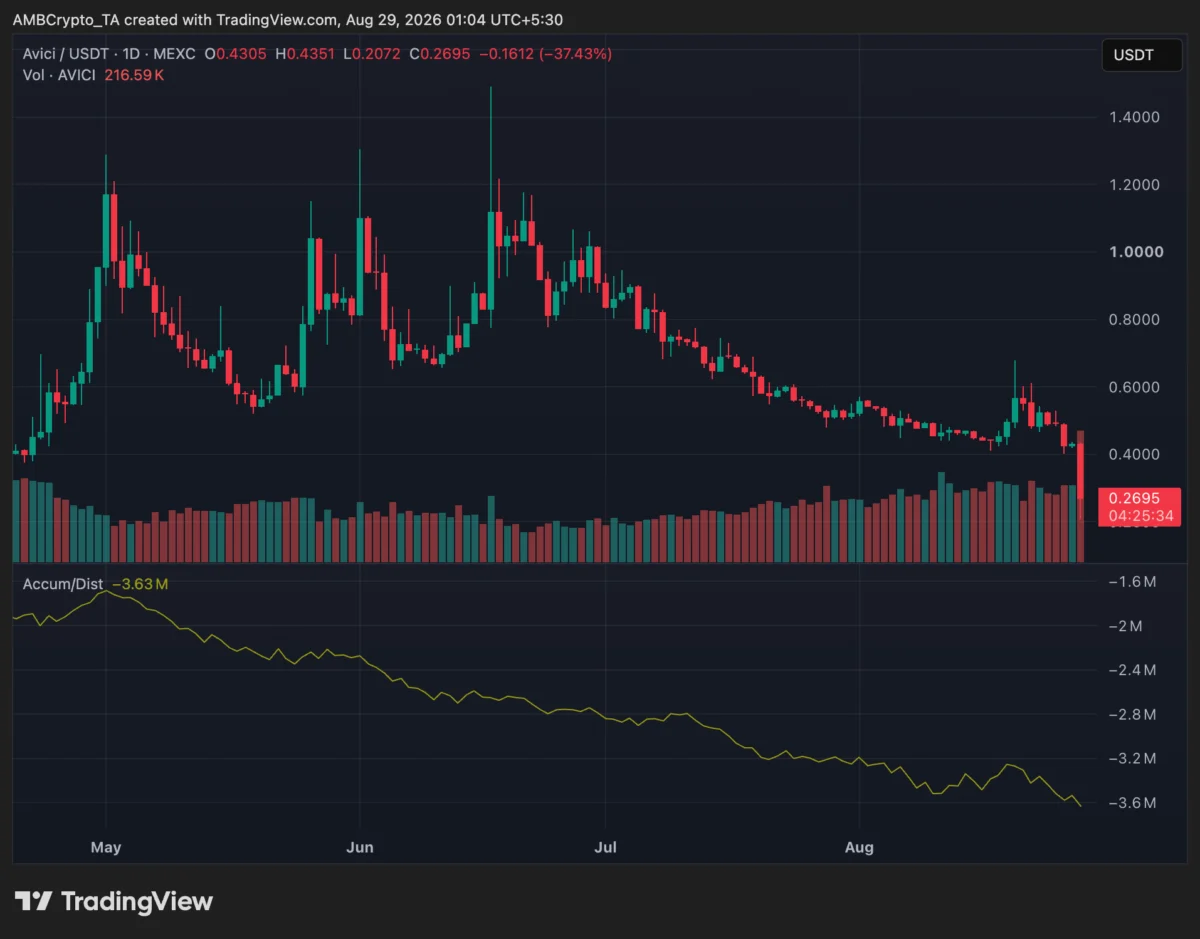
The market response to the operational failure was swift and punishing. Prior to the confirmation of the withdrawal freeze, AVICI opened the trading day at a relatively stable $0.4305. However, as news of the frozen balances and subsequent wallet drain spread across crypto trading communities, aggressive sell pressure materialized. The token price careened downward, touching an intraday low of $0.2072—representing a catastrophic peak-to-trough decline of more than 50% from its daily opening level. Although the asset managed a marginal technical rebound later in the session, stabilizing around the $0.2695 mark, it still closed the day down a staggering 37.43%. Market makers and technical analysts note that AVICI had already been experiencing a prolonged downward trend over the preceding several months, meaning the withdrawal freeze did not initiate the bearish trajectory so much as it acted as an explosive catalyst, compounding pre-existing structural weakness. Because AVICI maintains a relatively small market capitalization and limited liquidity depth, even modest increases in retail or institutional selling pressure are capable of triggering disproportionately massive price volatility. Moving forward, technical analysts are closely monitoring whether the token can maintain a psychological floor above Friday’s low of $0.20, while noting that a sustained recovery would require reclaiming the $0.40 threshold to reverse the damage inflicted by the sudden panic.
Beyond the immediate price action and the frozen user balances, the Avici incident highlights broader systemic vulnerabilities within the intersection of decentralized blockchain networks and traditional financial rails, specifically crypto-funded debit cards. When projects bridge native tokens and stablecoins with real-world spending infrastructure, they often introduce complex smart contract interactions and third-party custody dependencies that can become prime targets for malicious actors or catastrophic software bugs. The fact that approximately 2,500 accounts were linked to the drained Solana address suggests a centralized point of failure within the card-issuing architecture or backend database management systems, rather than a decentralized consensus failure. As regulatory scrutiny on crypto-linked payment products intensifies globally, incidents like the one facing Avici provide ammunition for policymakers arguing that consumer protection standards in the digital asset sector remain inadequate. For the Avici network, the path forward hinges entirely on transparency; until leadership releases a comprehensive post-mortem report detailing the root cause of the withdrawal freeze, outlines a concrete reimbursement strategy for affected cardholders, and restores normal operational functionality, the token is likely to remain shrouded in uncertainty and depressed market sentiment.