The European Union is preparing to significantly broaden the scope of its flagship digital asset legislation, signaling a major regulatory shift for the decentralized finance sector. In a recent comprehensive policy review, the European Banking Authority (EBA)—the agency responsible for shaping and regulating the EU-wide banking sector to preserve financial stability and protect consumers—announced its intent to bring crypto lending and borrowing directly under the oversight of the Markets in Crypto-Assets (MiCA) framework. This prospective regulatory expansion targets both traditional intermediated interfaces managed by crypto-asset service providers (CASPs) and purely decentralized finance (DeFi) protocols.
The primary catalyst for this regulatory tightening is the persistent vulnerability of the EU market to regulatory arbitrage. While the foundational text of MiCA explicitly banned the generation of yields on stablecoins within its current jurisdictional boundaries, market participants have continually found workarounds. Prominent stablecoins, including Circle’s USD Coin (USDC) and Euro Coin (EURC), continue to generate yields by routing funds through sophisticated DeFi lending strategies. Regulatory watchdogs argue that this practice undermines the integrity of the original MiCA framework, creating loopholes that expose the broader financial ecosystem to unforeseen macro-prudential vulnerabilities.
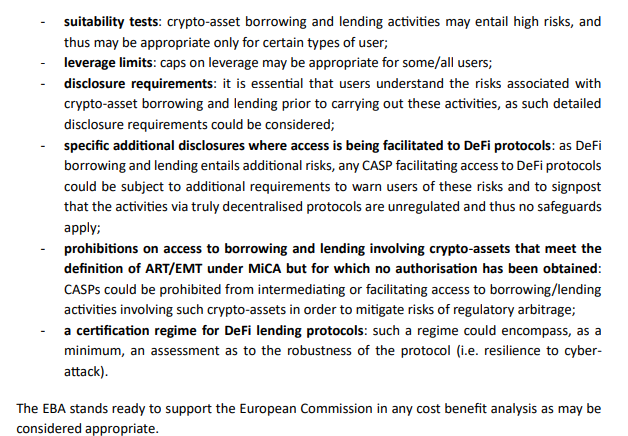
According to joint evaluations conducted by the EBA and the European Securities and Markets Authority (ESMA), the unchecked expansion of on-chain lending activities creates severe risks. Beyond regulatory arbitrage, regulators have highlighted a cascading series of consumer protection hazards, including extreme over-leverage, systemic contagion risks across interconnected protocols, persistent smart contract exploits, and outright fraud. To counteract these threats, the EBA has formally proposed a robust suite of regulatory safeguards. These measures include the implementation of strict leverage caps, comprehensive transparency and disclosure requirements, and mandatory cyber resilience-based certifications for all DeFi protocols operating within or serving citizens of the European Union. Furthermore, the proposed enforcement mechanisms could effectively bar unlicensed stablecoins, such as Tether’s USDT, from being utilized within EU-compliant DeFi lending markets, placing the regulatory bullseye squarely on platforms that offer intermediated gateways to decentralized liquidity pools.
The European Union’s aggressive regulatory posture stands in stark contrast to the strategy currently deployed by regulators in the United States. While the European approach seeks a comprehensive legislative integration under MiCA, the U.S. Securities and Exchange Commission (SEC) has pursued a case-by-case enforcement strategy. The SEC has repeatedly warned that traditional federal securities laws may apply to decentralized finance applications whenever centralized curators actively manage on-chain vaults to generate yields. However, the exact legal classification and regulatory treatment of fully non-custodial, algorithmic vaults remain a gray area in American jurisprudence.
Despite mounting regulatory pressure from both sides of the Atlantic, the decentralized finance industry itself remains deeply fractured regarding how on-chain vaults should be classified and governed. This internal discord was recently thrown into sharp relief by a public dispute between two of the sector’s most dominant lending giants: Aave and Morpho.
The epicenter of this debate is the rapidly growing market for DeFi vaults. These financial instruments allow users to pool their digital assets together and automatically deploy them across various lending and yield-generating opportunities. While some vaults execute strategies strictly based on immutable, pre-set smart contract rules, others grant human curators discretionary power over capital allocation. As of recent market metrics, this booming segment commands roughly $10 billion in total value locked, spread across more than 4,000 active vaults operating within the wider $54 billion DeFi lending ecosystem.
The schism within the industry became apparent when Morpho CEO Paul Frambot proposed a formal categorization framework to help regulators navigate the sector. Frambot suggested dividing vaults into two distinct classes: non-custodial vaults and discretionary vaults. Under his model, non-custodial vaults would impose strict limits on the operational role of curators while granting end-users enhanced flexibility, such as guaranteed exit capacities or obligatory time locks. Conversely, discretionary vaults—those actively managed by human asset managers—would be explicitly recognized as financial products that could trigger the application of strict securities laws, such as those enforced by the SEC.
This proposal, however, faced immediate and fierce pushback from Stani Kulechov, the founder and CEO of Aave. Kulechov publicly dismantled Frambot’s categorization model, dismissing it as both logically flawed and self-serving. According to Kulechov, the only vaults that can genuinely be classified as non-custodial are those that operate entirely without a human manager. Furthermore, Kulechov argued that there is nothing inherently illegitimate or dangerous about discretionary vaults, provided that lawmakers and developers work together to establish a clear and transparent regulatory pathway for their operation.
This high-profile disagreement among industry leaders underscores the broader dilemma facing decentralized finance. As regulatory bodies like the EBA move closer to finalizing rules that will govern on-chain credit markets, the lack of a unified industry stance leaves protocols vulnerable to external definitions imposed by bureaucrats rather than shaped by technological realities.
The implications of the EBA’s proposed policy review extend far beyond European borders. By establishing clear regulatory perimeters around crypto lending, leverage caps, and cyber resilience, the EU is attempting to institutionalize DeFi without crushing its foundational innovation. However, if European regulators succeed in effectively cutting off unlicensed stablecoins and enforcing strict compliance on intermediated DeFi interfaces, liquidity patterns could shift dramatically. Capital may flow away from strict European jurisdictions toward more permissive offshore environments, or conversely, institutional investors may find the newfound regulatory clarity a welcome signal to enter the market at scale.
As the consultation period for the MiCA review progresses, all eyes will be on European regulators to see how they balance consumer protection with the open, permissionless nature of decentralized protocols. Meanwhile, industry heavyweights like Aave and Morpho will need to bridge their philosophical divides if they hope to present a cohesive front in shaping the future of global digital asset regulation.