
The regulatory landscape for digital assets within the European Union is bracing for a significant transformation as the European Banking Authority (EBA) signals its intent to aggressively expand oversight into the decentralized finance (DeFi) sector. In a recent comprehensive policy review, the financial watchdog outlined proposals to bring crypto lending and borrowing—both through centralized crypto-asset service providers (CASPs) and decentralized protocols—directly within the scope of the Markets in Crypto-Assets (MiCA) framework. This aggressive regulatory push is designed to close existing loopholes, protect consumers from structural vulnerabilities, and prevent systemic financial instability across the bloc’s emerging digital economy.
The EBA, tasked with crafting policies and regulating the EU-wide banking sector to maintain economic stability and user protection, has flagged significant regulatory arbitrage risks inherent in current crypto-lending mechanisms. While the foundational MiCA legislation explicitly banned the generation of direct yields on stablecoins, market participants have continually bypassed these restrictions. By utilizing complex DeFi strategies, stablecoins such as Circle’s USDC and EURC continue to generate passive yields for holders. According to the EBA, these workarounds undermine the spirit of the regulation, creating uneven competitive playing fields and introducing hidden structural liabilities into the broader European financial ecosystem.
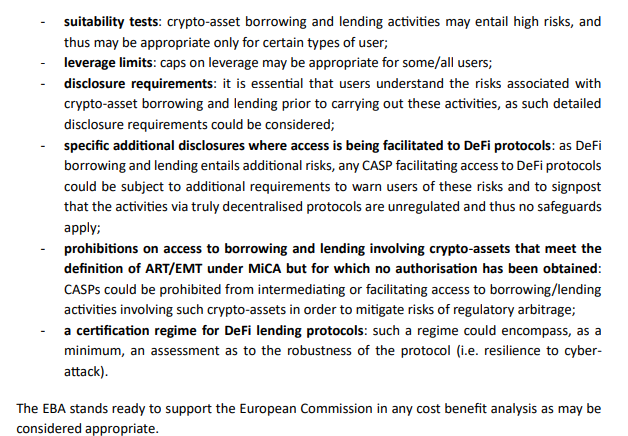
Beyond regulatory arbitrage, the EBA—alongside the European Securities and Markets Authority (ESMA)—has identified a litany of urgent consumer protection risks associated with decentralized lending. Chief among these concerns are excessive leverage caps, deep systemic contagion risks, recurring smart contract exploits, and outright fraud. To effectively mitigate these hazards, the EBA has formally proposed a series of stringent regulatory requirements. These include mandatory leverage caps for lending protocols, comprehensive disclosure mandates for yield-generating platforms, and mandatory cyber-resilience-based certifications for all active DeFi protocols operating within EU jurisdiction.
Furthermore, the implementation of these proposed rules threatens to severely restrict or entirely bar unlicensed stablecoins—such as Tether’s USDT—from participating in European DeFi lending markets. Regulatory enforcement is expected to target intermediaries and platforms that bridge traditional retail users to complex DeFi lending loops, effectively clamping down on user-facing gateways. This proactive stance marks a stark divergence from regulatory philosophies observed in other major jurisdictions, most notably the United States.

While the EU is building a comprehensive statutory framework via MiCA, the U.S. Securities and Exchange Commission (SEC) has primarily relied on enforcement actions and the application of existing federal securities laws. The SEC has repeatedly warned that standard securities regulations may automatically apply whenever curators actively manage yield-generating vaults. However, the legal classification of fully non-custodial, automated vaults remains a contentious gray area under U.S. law, leaving market participants in a state of regulatory limbo.
The complexity of regulating the decentralized lending market is further compounded by deep ideological and structural divisions within the crypto industry itself. Stakeholders remain starkly divided over how to accurately classify on-chain lending vaults and which regulatory standards should apply to each operational model. At the center of this debate are DeFi yield vaults—smart contracts that pool users’ digital assets and automatically deploy them across various lending markets to maximize returns.
While some vaults operate strictly according to immutable, preset rules, others grant human curators the discretion to dynamically reallocate assets based on shifting market conditions. Recent market data indicates that this rapidly expanding sector holds roughly $10 billion distributed across more than 4,000 deployed vaults, representing a substantial slice of the broader $54 billion DeFi lending market. As institutional capital continues to flow into these products, the lack of a standardized regulatory taxonomy has sparked intense public friction between prominent industry players, most notably DeFi lending giants Aave and Morpho.
The debate came to a head when Morpho CEO Paul Frambot proposed a formal categorization framework for DeFi vaults, dividing them into two distinct classes: non-custodial vaults and discretionary vaults. According to Frambot’s proposal, non-custodial vaults would severely restrict the administrative role of curators while granting end-users maximum flexibility, including guaranteed exit capabilities and structured time-locks. Conversely, discretionary vaults—where human asset managers exercise active judgment over capital allocation—would be classified as actively managed financial products, naturally triggering traditional securities laws akin to the framework favored by the SEC.
However, this proposed taxonomy was swiftly and sharply dismissed by Stani Kulechov, the founder and CEO of Aave. Kulechov publicly criticized Morpho’s model, labeling the categorization as fundamentally flawed and self-serving. In public statements, Kulechov argued that the only vaults that can truly be considered non-custodial are those completely devoid of human managers or curators. Furthermore, he asserted that there is nothing inherently unlawful or problematic about discretionary vaults, provided that regulatory bodies establish a clear, navigable compliance pathway for their operation rather than attempting to shoehorn them into rigid legacy frameworks.
This high-stakes disagreement among protocol leaders highlights the broader difficulty regulators face when attempting to apply nineteenth- and twentieth-century financial concepts to twenty-first-century code. Unlike traditional financial intermediaries, DeFi protocols operate on immutable distributed ledgers where code executes autonomously. By pushing to integrate these decentralized mechanisms into the MiCA framework, the EU is attempting a regulatory feat never before achieved at this scale.
The implications of the EBA’s proposed policies extend far beyond the borders of the European Union. Because digital asset protocols are inherently borderless, stringent European rules will likely force global DeFi developers to either implement rigorous geofencing to lock out EU citizens or restructure their protocols to achieve full compliance. For institutional investors looking for safe, regulated exposure to decentralized yield, the formalization of MiCA oversight could provide the legal clarity necessary to deploy billions of dollars safely. Conversely, critics warn that overly burdensome cyber-resilience certifications and leverage caps could stifle permissionless innovation, driving boutique developers and cutting-edge liquidity pools out of the European market entirely.
As the EBA reviews public feedback and refines its legislative recommendations, the tension between decentralized autonomy and systemic financial protection will undoubtedly intensify. The ongoing clash between protocol architectures like Aave and Morpho demonstrates that the industry is still struggling to define its own operational boundaries. Ultimately, the success or failure of the EU’s pioneering efforts to regulate decentralized lending will serve as a definitive global case study, dictating whether open-source financial technology can successfully coexist within a tightly regulated traditional banking framework.