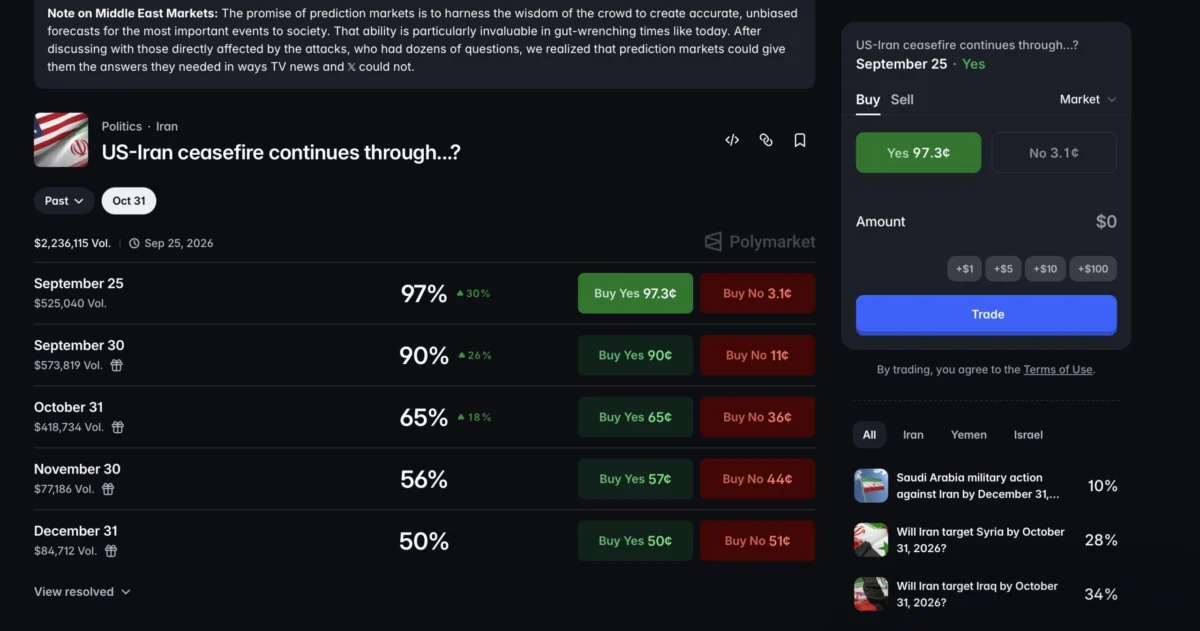
Prediction markets have emerged as sensitive real-time barometers for international geopolitics, capturing sudden shifts in sentiment between Washington and Tehran. On Polymarket, the prominent decentralized prediction platform, event contracts tracking the US-Iran ceasefire are currently pricing a roughly 97% probability that hostilities will remain paused through September 25. However, this high-stakes confidence exhibits notable decay when stretched over a slightly longer horizon, with the probability dropping to approximately 90% for a ceasefire holding through September 30.
These figures do not represent a definitive consensus that a lasting peace treaty has been successfully negotiated. Instead, they reflect a narrow, highly technical calculation tied directly to whether a qualifying United States military action is launched against Iran prior to the specified expiration dates. As diplomats navigate a fragile web of indirect negotiations, the discrepancy between the late-September timelines underscores how rapidly market participants anticipate geopolitical volatility returning to the region.
Understanding Polymarket Mechanics and Contract Triggers
To accurately interpret these prediction market odds, analysts must examine the precise parameters governing the underlying smart contracts. The resolution of the Polymarket contracts does not depend on broader diplomatic metrics, such as the resumption of formal embassy relations, the complete lifting of economic sanctions, or comprehensive nuclear non-proliferation agreements.
Instead, the criteria are strictly operational. The contracts remain in the affirmative (“Yes”) column unless the United States executes a qualifying military strike or officially sanctioned offensive kinetic action against Iranian targets before midnight on the respective expiration dates. If such an action occurs, the market instantly flips to the negative (“No”) outcome, regardless of whether secondary skirmishes, proxy actions in Lebanon or Yemen, or aggressive rhetoric take place.
The downward revision from 97% for September 25 to 90% for September 30 illustrates the mathematical reality of event-driven risk premium accumulation. As the exposure window expands by just five days, traders price in a compounding cumulative risk that unforeseen escalations, intelligence miscalculations, or retaliatory proxy engagements could trigger a kinetic US response. Consequently, while the immediate horizon appears heavily insulated against overt military action, the market views the subsequent days with a distinct degree of caution.
Chronology of a Fragile Accord: From Memorandum to Mediation

The current market pricing exists against a backdrop of severe diplomatic volatility that has defined US-Iran relations throughout 2026. The foundation for the current fragile truce was laid in a memorandum of understanding (MOU) brokered in June 2026. That agreement was designed to establish a definitive pause in hostilities following a series of kinetic exchanges and naval skirmishes that peaked in February of that year.
The June MOU established a multi-pronged framework: a cessation of direct military strikes, an explicit reopening of the vital Strait of Hormuz to international commercial shipping, and the initiation of a 60-day window dedicated to comprehensive nuclear negotiations and phased sanctions relief.
However, the framework proved remarkably fragile. Throughout June and early July, mutual violations—including renewed US defensive or targeted strikes and ongoing Iranian-backed disruptions to maritime traffic—strained the agreement to its breaking point. By early July 2026, President Donald Trump publicly declared that the framework was effectively defunct, citing continuous non-compliance and unverified security infractions.
Despite the collapse of the formal framework, bilateral diplomacy did not completely cease. Over the ensuing weeks, backchannel mediation efforts accelerated, heavily facilitated by regional intermediaries including Pakistan and Qatar. These nations have acted as crucial conduits for passing terms regarding maritime access, prisoner exchanges, and preliminary nuclear guardrails.
Recent Diplomatic Developments and Market Catalysts
The recent surge in ceasefire confidence on Polymarket—pushing probabilities to the 90% and 97% thresholds—stems directly from a flurry of diplomatic statements and high-level meetings occurring around September 22, 2026.
During public remarks, President Donald Trump injected unexpected optimism into the geopolitical landscape, stating that a formal settlement or understanding with Iran might be reached sooner than previously anticipated. This signal was quickly reinforced by international developments. Iranian Foreign Minister Abbas Araghchi engaged with key diplomatic counterparts, formally submitting Tehran’s baseline terms for fully reopening and securing the Strait of Hormuz. Iran’s submitted proposals notably included demands for the lifting of the existing US naval blockade and the unfreezing of billions of dollars in sovereign assets held in foreign accounts.
While these diplomatic maneuvers generated substantial positive momentum among market participants, international relations experts emphasize that neither statement nor proposal constitutes a finalized, legally binding treaty. Core disputes regarding Iran’s domestic uranium enrichment thresholds, long-range ballistic missile development programs, and the structure of ongoing economic sanctions remain entirely unresolved.
Key Variables Driving Prediction Market Volatility
Market intelligence analysts monitoring the situation have identified four primary variables that historically dictate rapid shifts in US-Iran prediction market odds:
- US Military Posture and Deployment: Any repositioning of carrier strike groups, strategic bomber squadrons, or immediate readiness orders issued by the Pentagon serves as the single most critical catalyst for contract resolution.
- Iranian Compliance and Verification Signals: Official statements from the Iranian Islamic Revolutionary Guard Corps (IRGC) or the Ministry of Foreign Affairs regarding maritime transit safety and nuclear inspections heavily influence short-term trader sentiment.
- Proxy Network Dynamics: Activity across regional conflict zones—particularly involving groups in Lebanon, Iraq, and Yemen—acts as a secondary pressure valve that can rapidly force a direct confrontation if escalation thresholds are crossed.
- Third-Party Mediation Interventions: Diplomatic communiques issued by mediators in Doha or Islamabad often provide the market with early indicators of whether a looming crisis has been successfully defused or merely postponed.
Fact-Based Implications of Geopolitical Prediction Markets
The reliance on decentralized prediction markets like Polymarket for real-time geopolitical intelligence has grown exponentially among financial institutions, macroeconomic researchers, and intelligence analysts. Unlike traditional media outlets, which rely on editorial cycles and verified official statements, prediction markets aggregate decentralized capital, forcing participants to put financial skin in the game based on their assessment of incoming information.
However, financial analysts caution against misinterpreting these probabilities as broad barometers of peace. A 97% probability for a five-day window indicates that traders believe high-level political leaders have calculated that an immediate military escalation serves neither nation’s short-term interests. It does not mean that the underlying geopolitical antagonism has dissipated.
Furthermore, past market reactions to US-Iran tensions demonstrate that sentiment can reverse within minutes. For instance, previous announcements regarding potential peace deals have historically triggered sharp, immediate rebounds in global financial markets and risk-on assets, including cryptocurrencies like Bitcoin, only for prices to retrace just as quickly when subsequent intelligence contradicted the initial headlines.
As the September 25 and September 30 deadlines approach, traders and analysts will continue to watch for any sign of operational divergence between diplomatic rhetoric on the ground and military movements in the region. Until a comprehensive and verifiable diplomatic framework is formally signed, these prediction markets will remain sensitive gauges of day-to-day operational calm, measuring peace not by its permanence, but by the absence of kinetic triggers.