
The European Union is preparing to dramatically reshape the decentralized finance landscape as the European Banking Authority pushes to integrate crypto lending and borrowing directly into the existing Markets in Crypto-Assets regulatory framework. This strategic policy shift aims to close perceived regulatory gaps that currently allow digital asset holders to bypass strict European laws regarding stablecoin yields and consumer protection. By targeting both centralized crypto-asset service providers offering decentralized interfaces and pure decentralized finance protocols, European regulators are signaling the end of an era where on-chain lending operated in a regulatory vacuum.
The proposed expansion of the regulatory perimeter comes in response to vulnerabilities identified by European watchdogs, including the European Securities and Markets Authority. Regulators have expressed mounting concern that decentralized lending mechanisms provide an easy workaround to the strict bans on interest-bearing stablecoins enforced under the current MiCA rulebook. While regulated stablecoins like Circle’s USDC and EURC are legally restricted from generating direct yields within the European Union, market participants have increasingly turned to decentralized finance strategies to capture returns, creating a complex web of regulatory arbitrage that policymakers are now determined to unravel.
Background Context and Regulatory Motivation
The Markets in Crypto-Assets regulation was initially heralded as a comprehensive legislative milestone designed to bring legal certainty to the digital asset industry across all twenty-seven member states. However, as the adoption of decentralized finance accelerated, policymakers realized that focusing solely on centralized exchanges and asset issuers left a massive blind spot. Decentralized lending protocols, automated market makers, and yield-generating smart contracts operate without traditional intermediaries, making traditional enforcement models obsolete.
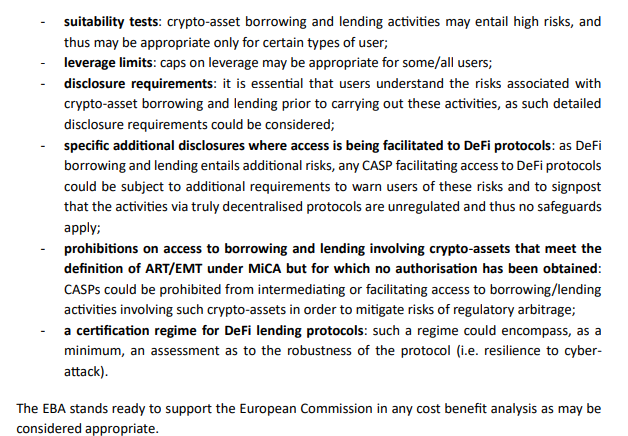
European regulators are particularly alarmed by the systemic risks associated with unmitigated crypto lending activities. According to recent policy assessments, these protocols expose retail and institutional participants to severe hazards, including hyper-leverage, systemic contagion, smart contract exploits, and outright fraud. To safeguard financial stability, the European Banking Authority has outlined a series of rigorous preventive measures. These recommendations include mandatory leverage caps, comprehensive transparency and disclosure mandates, and strict cyber resilience-based certifications for any decentralized finance protocol operating within the European market. Furthermore, these sweeping measures could effectively bar unlicensed stablecoins, such as Tether’s USDT, from being utilized in European decentralized lending markets, forcing compliance onto foreign issuers or pushing them out of the jurisdiction entirely.

Contrasting Global Regulatory Philosophies
The aggressive European approach stands in sharp contrast to the regulatory philosophy adopted across the Atlantic by the United States Securities and Exchange Commission. While European authorities are attempting to craft a bespoke legislative framework tailored to the unique mechanics of decentralized protocols through MiCA, American regulators continue to rely on enforcement actions and the expansion of existing securities laws. The U.S. Securities and Exchange Commission has repeatedly warned that when human curators or centralized entities actively manage liquidity vaults to generate yield, those arrangements may cross the legal threshold into investment contracts, thereby triggering federal securities regulations.
However, the legal status of fully non-custodial, automated vaults remains a gray area in American jurisprudence. This divergence in regulatory philosophy leaves international crypto enterprises navigating a fragmented global landscape, where compliance strategies that satisfy European standards may fall short or directly violate American legal interpretations.
The Rise of On-Chain Vaults and Market Dynamics
At the heart of the current debate within the decentralized finance ecosystem are yield-aggregating vaults. These sophisticated smart contracts pool digital assets from thousands of users and deploy them across various lending markets and liquidity pools to maximize returns. Within the broader fifty-four billion dollar decentralized lending market, the vault sector has grown rapidly, capturing approximately ten billion dollars in total value locked across more than four thousand distinct vaults.
These vaults generally fall into two operational categories: algorithmic vaults that operate strictly according to immutable, preset smart contract rules, and managed vaults where designated curators retain discretion over capital allocation and strategy adjustments. As regulatory pressure mounts, the question of how to legally classify these structures has ignited a fierce debate among the industry’s most prominent protocol architects.
Industry Fractures: Aave Versus Morpho
The internal division within the decentralized finance sector was thrust into the spotlight through a public disagreement between representatives of two dominant lending giants, Aave and Morpho. The debate centers entirely on how regulatory bodies should categorize vault models and whether different legal standards should apply to automated versus managed systems.
Morpho Chief Executive Officer Paul Frambot recently proposed a binary classification system dividing vaults into non-custodial and discretionary categories. Under this framework, non-custodial vaults would severely restrict the authority of curators, ensuring that users maintain absolute control over their capital, including unhindered exit capabilities and time-lock flexibilities. Conversely, discretionary vaults—where asset managers actively direct funds—would be explicitly acknowledged as managed products, inherently accepting that they would likely trigger traditional securities laws and heavy regulatory oversight.
This proposal was swiftly and publicly dismissed by Stani Kulechov, the founder of Aave, who criticized the categorization as legally flawed and self-serving. Kulechov argued that the only structures that can genuinely be classified as non-custodial are those entirely devoid of human management or curation. Furthermore, Kulechov asserted that there is nothing inherently unlawful or problematic about discretionary vaults, provided that a clear, workable regulatory pathway is established to govern them, rather than attempting to design categorization models that evade oversight.
Broader Economic and Market Implications
The ongoing friction between European regulators and industry leaders highlights the growing pains of a maturing digital asset economy. As decentralized finance attempts to transition from a fringe technological experiment into an institutional-grade financial alternative, regulatory compliance is no longer optional.
The European Banking Authority’s push to extend MiCA oversight over crypto lending and borrowing will undoubtedly impose higher operational costs on protocol developers and institutional participants. Smaller decentralized finance projects may find the compliance burdens—such as cyber resilience certifications and stringent disclosure mandates—prohibitive, potentially driving innovation out of the European Union. Conversely, establishing clear regulatory guardrails could unlock trillions of dollars in institutional capital that has previously remained on the sidelines due to legal uncertainty.
Ultimately, the outcome of this regulatory evolution will depend on whether policymakers can successfully adapt traditional financial oversight mechanisms to decentralized architectures without stifling the technological innovation that drives the sector forward. As the European Union moves closer to finalizing these rules, industry stakeholders must decide whether to collaborate on constructive compliance frameworks or face an increasingly hostile regulatory environment.