
The European Union is preparing to tighten its regulatory grip on the digital asset ecosystem by expanding the scope of its landmark Markets in Crypto-Assets (MiCA) framework to encompass decentralized finance (DeFi) lending and borrowing activities. In a comprehensive recent policy review, the European Banking Authority (EBA)—the regulatory agency tasked with maintaining financial stability and consumer protection across the EU-wide banking sector—signaled that decentralized credit markets and crypto lending mechanisms can no longer operate outside regulatory oversight.
According to the EBA’s findings, crypto lending executed either through the intermediated interfaces of Crypto-Asset Service Providers (CASPs) or directly via open-source DeFi protocols creates significant loopholes. Specifically, these mechanisms offer avenues for regulatory arbitrage regarding stablecoin yields. While the core provisions of the MiCA framework explicitly ban algorithmic and direct stablecoin yield-generation methods within regulated institutional boundaries, popular stablecoins such as Circle’s USDC and EURC continue to generate passive yields by plugging into external DeFi strategies.
Financial watchdogs argue that this dynamic undermines the spirit of the legislation, potentially destabilizing traditional financial guardrails. Beyond regulatory arbitrage, the EBA—alongside the European Securities and Markets Authority (ESMA)—has flagged a cascading array of systemic vulnerabilities. These consumer protection risks include extreme over-leverage, structural contagion across interconnected protocols, smart contract exploits, protocol hacks, and sophisticated digital fraud.
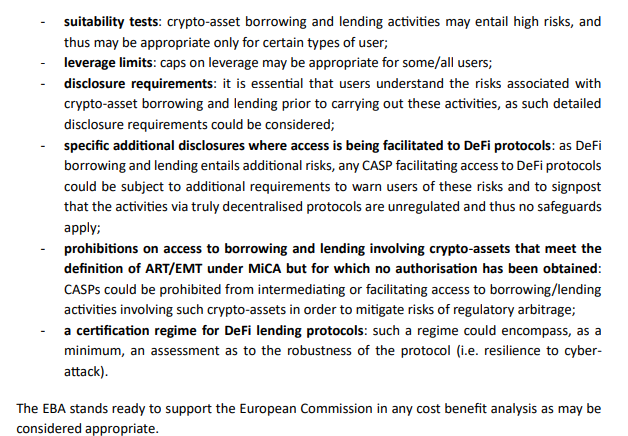
To counteract these threats, the EBA has formally outlined a series of prospective mitigation strategies. These proposals include the implementation of mandatory leverage caps on lending operations, stringent disclosure requirements for market participants, and cyber resilience-based certifications for underlying DeFi protocols. Furthermore, the sweeping nature of these proposed regulations could effectively bar unlicensed stablecoins, such as Tether’s USDT, from being utilized within mainstream DeFi lending pools operating inside the European economic zone. Regulators are expected to direct their primary enforcement focus toward intermediary platforms that grant retail and institutional users seamless access to back-end DeFi protocols.
Global Regulatory Divergence: Europe Versus the United States
The European Union’s aggressive stance on decentralized finance stands in stark contrast to regulatory approaches observed in other major jurisdictions, most notably the United States. While European regulators are seeking comprehensive legislative integration via MiCA extensions, the U.S. Securities and Exchange Commission (SEC) has primarily relied on enforcement actions and existing securities laws to police the sector.
The SEC has repeatedly warned that federal securities regulations may apply whenever centralized curators or platforms actively manage vaults to generate speculative yields for users. However, the legal classification of fully non-custodial, automated vaults where no single entity exercises discretionary control remains legally ambiguous in the United States. This divergence highlights a global regulatory puzzle: how to police autonomous, borderless software code that performs traditional banking functions.

Anatomy of the Crypto Lending Market and the Rise of On-Chain Vaults
To understand the weight of the EBA’s proposed interventions, one must examine the scale and mechanics of the modern decentralized credit market. Currently, the broader DeFi lending ecosystem commands a total valuation of approximately $54 billion. Within this multi-billion-dollar market, yield-generating vaults have emerged as a dominant financial product, commanding roughly $10 billion in total value locked across more than 4,000 distinct deployed vaults.
Vaults function by pooling digital assets from numerous retail and institutional liquidity providers, subsequently deploying those funds across various algorithmic lending opportunities to optimize returns. Within this architecture, vaults generally fall into two operational categories: algorithmic vaults that execute trades and loans strictly based on immutable, preset smart contract rules, and managed vaults that grant human curators discretionary power over where and how assets are allocated.
Despite the rapid expansion of these financial instruments, leading industry players remain deeply divided over how these on-chain vaults should be classified for regulatory purposes and which compliance standards should apply to them.
Industry Infighting: Aave Challenges Morpho’s Vault Classification Model
The debate over vault regulation has sparked fierce public disagreements among foundational giants in the decentralized lending sector, particularly between lending behemoths Aave and Morpho.
The schism became pronounced following a proposal put forward by Morpho CEO Paul Frambot, who attempted to categorize on-chain vaults into two distinct frameworks: non-custodial vaults and discretionary vaults. According to Frambot’s model, non-custodial vaults would severely restrict the active role of curators while granting users greater operational flexibility, including guaranteed exit capacities and transparent time-lock mechanisms. Conversely, Frambot acknowledged that discretionary vaults—where managers actively direct capital allocation—function more akin to traditional managed funds and would logically trigger stricter regulatory scrutiny, including the SEC’s securities laws.
However, this taxonomy was swiftly and harshly dismissed by Stani Kulechov, the founder of Aave. Kulechov publicly criticized Morpho’s classification model, labeling it as fundamentally flawed and self-serving.
"This categorisation doesn’t make sense and is pretty much self-serving," Kulechov stated, challenging the industry narrative. "Vaults that could reasonably be considered non-custodial are those without a manager. There’s nothing inherently wrong with discretionary vaults, as long as the regulatory path is figured out."
Kulechov’s critique underscores a deeper anxiety within the top tiers of the DeFi industry: if protocols attempt to carve out special regulatory exemptions by redefining standard operational terms, they risk inviting arbitrary enforcement actions that could alienate developers and liquidity providers alike.
Broader Market Implications and the Road Ahead
As the European Banking Authority finalizes its review priorities for the MiCA framework, the digital asset industry faces a critical juncture. The friction between regulatory bodies and decentralized finance protocols highlights the inherent tension of trying to fit decentralized, code-based financial primitives into institutional boxes designed for traditional corporate entities.
For European crypto service providers and institutional investors, the integration of DeFi lending into MiCA will likely introduce higher operational costs, stricter compliance hurdles, and potential restrictions on high-yield stablecoin strategies. Simultaneously, it may provide the regulatory clarity necessary to attract institutional capital that has previously remained on the sidelines due to legal uncertainty.
Conversely, decentralized protocols operating out of Europe will need to decide whether to adapt to rigorous compliance standards—such as cyber resilience certifications and leverage caps—or risk being pushed into gray markets. As industry leaders like Aave and Morpho continue to spar over operational definitions and vault classifications, the ultimate shape of European crypto lending will depend heavily on how effectively policymakers can balance consumer protection against the innovative, permissionless ethos of decentralized finance.