
Synthetic dollar protocol Ethena is implementing a major structural evolution for its flagship yield-bearing product, USDe, by expanding its collateral framework to incorporate equity perpetual swaps, commonly known as real-world asset (RWA) tokenization perpetuals. This strategic integration represents a calculated move away from the traditional, highly volatile cyclicality of cryptocurrency markets, positioning the protocol to tap into the vastly larger pools of traditional financial assets.
According to project disclosures, equity perpetuals have experienced remarkable growth, expanding tenfold since March to reach an Open Interest (OI) of $6 billion. Ethena leadership projects that this nascent market possesses the capacity to scale one-hundredfold, unlocking scalable basis yield opportunities completely decoupled from digital asset market cycles.
Understanding the Mechanics of Ethena and the Basis Trade
To comprehend the significance of Ethena’s latest maneuver, one must examine the foundational mechanics of the USDe stablecoin. USDe relies on a "delta-neutral" hedging strategy known as the basis trade. This financial operation involves holding spot crypto assets while simultaneously opening equivalent short positions in perpetual futures contracts. The yield is generated from the funding payments paid by long traders to short traders during bullish market conditions, as well as staking rewards from underlying assets.

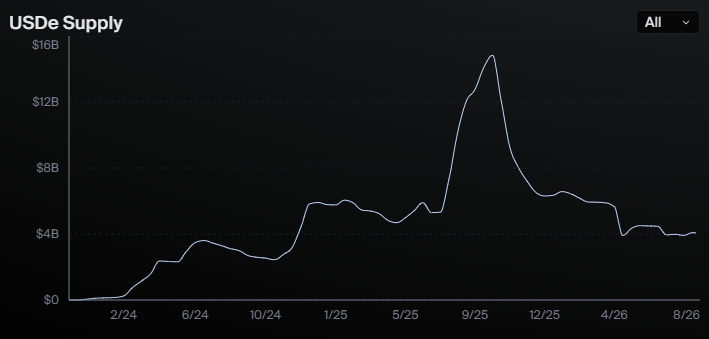
However, this architecture exposes the protocol to severe market cyclicality. During the peak of the 2024–2025 cryptocurrency bull run, market demand surged, propelling USDe’s total supply to nearly $15 billion while generating annualized yields exceeding 80%. Conversely, as the digital asset market entered a prolonged contraction—often termed "crypto winter"—trading volumes dried up, funding rates turned negative, USDe supply plummeted toward $4 billion, and baseline yields dropped below zero.
This inherent vulnerability to macroeconomic sentiment shifts within the crypto industry underscored the urgent need for structural diversification. Ethena’s leadership recognized that relying exclusively on native crypto derivatives left the protocol exposed to systemic liquidity crunches during bearish downturns.
A Phased Approach to Risk Mitigation and RWA Integration
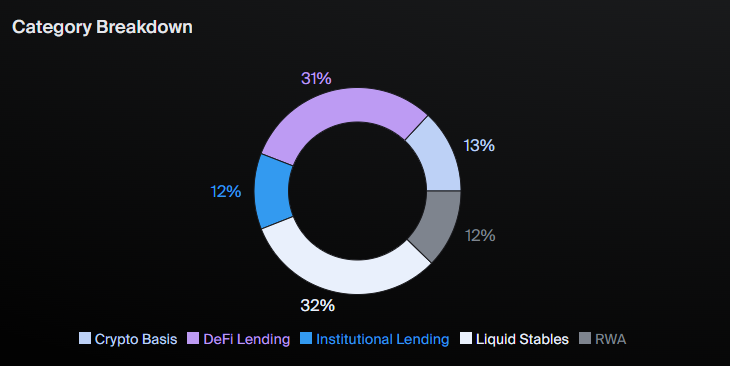
Ethena’s journey toward diversification began with the introduction of traditional credit strategies, utilizing AAA-rated collateralized loan obligation (CLO) funds powered by financial heavyweight Janus Henderson. Currently, traditional credit accounts for approximately 12% of the overall backing for USDe, providing a buffer of stable, non-crypto-correlated returns.
The upcoming deployment of RWA equity perpetuals, scheduled to roll out over the next few weeks, marks the second major phase of this diversification roadmap. The protocol has deliberately adopted a measured pace regarding this integration. Addressing the timeline of the rollout, Ethena founder Guy Young explained that the team purposefully exercised restraint while monitoring the sector.
"We took a cautious approach to what was a nascent market and waited until we saw deep, liquid markets with a data history we could study before moving into the opportunity at scale," Young noted.
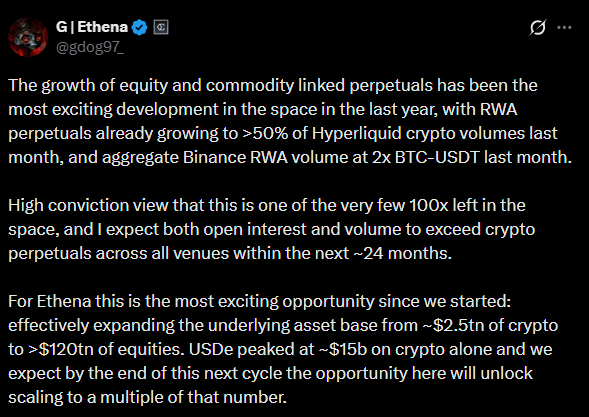
Young further characterized the RWA perpetuals segment as "one of the very few 100x left" in financial technology, predicting that the asset class could surpass the volume and Open Interest of the global crypto market within the next 24 months.
Current Collateral Composition and Yield Comparison
A detailed breakdown of USDe’s current reserve backing illustrates a heavily fortified, multi-layered risk management framework. At present, liquid stablecoins such as USDT and USDC form the largest single category, representing 32% of the total collateral pool. Decentralized finance (DeFi) lending markets across prominent liquidity protocols like Aave and Morpho constitute the second-largest reserve category, holding a 31% share. Traditional credit assets and staking derivatives make up the remaining balance.
When evaluated against traditional fixed-income alternatives, USDe continues to present a competitive yield profile. Comparative data released by the protocol indicates that USDe offers a notable 1.6% spread over short-term U.S. Treasury bills. While this differential makes USDe attractive to yield-seeking capital, institutional allocators must weigh these enhanced returns against the underlying smart contract and DeFi security risks inherent in decentralized protocols.
Ethena’s projections regarding the shift in its collateral base are aggressive. The protocol anticipates that RWA perpetuals will completely eclipse native crypto-derived allocations within USDe’s backing over the next 12 to 24 months.
The Macroeconomic and Scalable Potential of Tokenized Equities
The rationale behind integrating equity perpetuals lies in the sheer scale of traditional capital markets relative to digital assets. The underlying asset base for global equities and real-world assets exceeds $150 trillion, dwarfing the approximately $2.5 trillion total capitalization of the cryptocurrency market. By tethering synthetic yields to traditional equity perps, Ethena is attempting to bridge the gap between institutional-grade TradFi assets and high-velocity DeFi infrastructure.
"The underlying asset base is greater than $150 trillion compared to roughly $2.5 trillion of crypto, making this the most scalable extension of the basis allocation to date," the project stated in an official release. "We expect RWA perpetuals to eclipse crypto allocations in USDe’s backing within 12-24 months."
This expansion taps into a growing institutional demand for tokenized financial instruments that offer predictable, non-correlated yield streams. As institutional adoption of real-world asset tokenization accelerates, protocols capable of safely onboarding these assets are positioned to capture significant market share.
Broader Market Implications and Strategic Outlook
Ethena’s aggressive overhaul of its ecosystem comes as major protocols position themselves ahead of anticipated market cycles. By systematically reducing its reliance on native crypto basis trades, the protocol is attempting to solve one of the most persistent structural flaws of algorithmic and synthetic stablecoins: the inability to sustain yield and peg stability during protracted market downturns.
Whether this second wave of yield diversification successfully drives sustained institutional demand and long-term adoption for USDe remains to be observed. However, by diversifying across liquid stablecoins, DeFi lending markets, traditional credit, and now multi-trillion-dollar equity perpetuals, Ethena is constructing a resilient financial framework designed to weather future market contractions while capitalizing on the ongoing convergence of traditional finance and decentralized architecture.