The company behind the decentralized finance (DeFi) aggregator Odos has officially announced its decision to permanently wind down all operational activities, with services slated to cease entirely by July 30. This development marks a significant event for users of the platform and observers of the broader DeFi ecosystem, highlighting the dynamic and often challenging environment for crypto projects. The protocol’s application will transition into a read-only mode on July 27 before its complete shutdown just three days later, compelling users to take proactive steps to manage their digital assets.
In its official communication regarding the cessation of operations, the Odos team underscored a critical point for its user base: Odos functions as a non-custodial platform. This fundamental design means that users’ digital assets are not held by the company but remain securely on-chain, perpetually under the direct control and ownership of individual users. This assurance is paramount in mitigating potential panic and safeguarding user funds during the transition, differentiating it from custodial services where the platform holds assets. Furthermore, the company clarified that the native ODOS token and the Odos Decentralized Autonomous Organization (DAO) are distinct entities from the operating company itself and are intended to continue their existence independently, suggesting a potential future path for the community-governed aspects of the project despite the corporate shutdown. This distinction is crucial in decentralized finance, where a project’s underlying technology and governance can theoretically persist even if its founding entity dissolves.
A Phased Exit: The Odos Shutdown Timeline and User Actions
The winding down process for Odos is structured as a phased approach, designed to provide users with ample opportunity to manage their assets and transition away from the platform. According to the announcement, current users of the Odos platform will retain the ability to execute token swaps and close any open positions until the final full shutdown date of July 30. This period is crucial for active traders and liquidity providers to reconcile their holdings and minimize any potential losses, allowing for an orderly disengagement from the platform’s functionalities.
However, several key functionalities have already been disabled in anticipation of the complete closure, signaling a controlled and gradual exit. New account registrations are no longer permitted, effectively preventing new users from joining the platform and avoiding further complications. Similarly, the creation of new wallets directly through Odos’s interface has been halted, and the ability to place new limit orders has also been suspended. These initial restrictions are a clear indication of the company’s commitment to winding down operations responsibly, ensuring that no new users or complex orders are initiated on a service that will soon be defunct.
The crucial intermediate phase will commence on July 27, when the Odos application is scheduled to enter a "read-only" mode. During this three-day window, users will no longer be able to initiate new transactions, execute swaps, or modify existing positions. Instead, the platform will exclusively allow access to historical transaction data and current balance information. This read-only period serves as a final opportunity for users to verify their asset status, download transaction histories, and gather any necessary records for tax purposes or personal accounting before the complete cessation of services. It acts as an audit period for users, ensuring transparency up to the final moment.
Following July 30, all services and operations directly managed by Odos will permanently cease. The company has explicitly stated that there will be no further development, technical support, or maintenance provided for the protocol or its associated application. This definitive statement clarifies that the shutdown is absolute and comprehensive, leaving no room for speculation about a potential revival, corporate acquisition, or future corporate involvement with the Odos protocol. It signifies a complete withdrawal from the operational aspect of the project.
For users who utilized Odos’s convenience features, such as social or email logins, to create and manage their wallets, the company has issued specific, urgent guidance. These users are strongly advised to transfer their assets to an external, independently managed wallet (such as a hardware wallet or a self-custodial software wallet) or, critically, to export their private keys before the July 30 deadline. The team has committed to ensuring that instructions for accessing these wallets will remain available via its official support page even after the operational shutdown, providing a critical resource for users who may need to retrieve their assets post-closure. This emphasis on user self-custody and private key management highlights a core principle of DeFi and serves as a vital safeguard during such transitions, underscoring the user’s ultimate responsibility for their digital assets.
Preserving Decentralization: Token and DAO Independence in Focus
A central theme of the shutdown announcement is the clear delineation between the operating company and the decentralized components of the Odos ecosystem. While the corporate entity responsible for the development and maintenance of the Odos aggregator is ceasing operations, the team has strongly emphasized that the ODOS token itself will remain fully on-chain. This means the token’s smart contract and its underlying mechanics are immutable and will continue to function as designed, unaffected by the company’s dissolution. The token’s existence is independent of the company’s operational status, a hallmark of well-designed decentralized assets, allowing for potential future utility driven by the community.
Equally important is the stated independence of the Odos DAO. As a Decentralized Autonomous Organization, its governance and decision-making processes are designed to operate without central corporate control. The announcement explicitly notes that the DAO functions separately from the company and will be responsible for communicating its own future plans and initiatives. This separation could potentially allow the community to explore options for the protocol’s future, perhaps through new development efforts, a fork of the existing protocol, or a pivot in strategic direction, all driven by collective governance rather than a corporate mandate. The continued existence of the DAO poses a fascinating case study in decentralized resilience.
Crucially, the announcement also included a stark warning to the community regarding potential scams, a common occurrence during periods of project uncertainty in the crypto space. Users have been explicitly cautioned not to anticipate or expect any token migrations, the launch of new products under the Odos brand, token claims, or airdrops emanating from the now-defunct operating company. The team’s statement, "There will be NO new Odos products, token migrations, token claims, or airdrops from us," serves as a direct and unambiguous repudiation of any such claims. This warning extends to vigilance against deceptive practices, with users urged to treat any direct messages, fake support accounts, or fraudulent migration websites claiming otherwise as malicious scams. The company further advised users never to share seed phrases or sign transactions from any website purporting to facilitate an Odos migration or relaunch, unless such initiatives are formally announced and verified through the official channels of the Odos DAO. This proactive stance against potential exploits is vital in protecting users during a period of vulnerability.
Market Reaction: ODOS Token Under Pressure
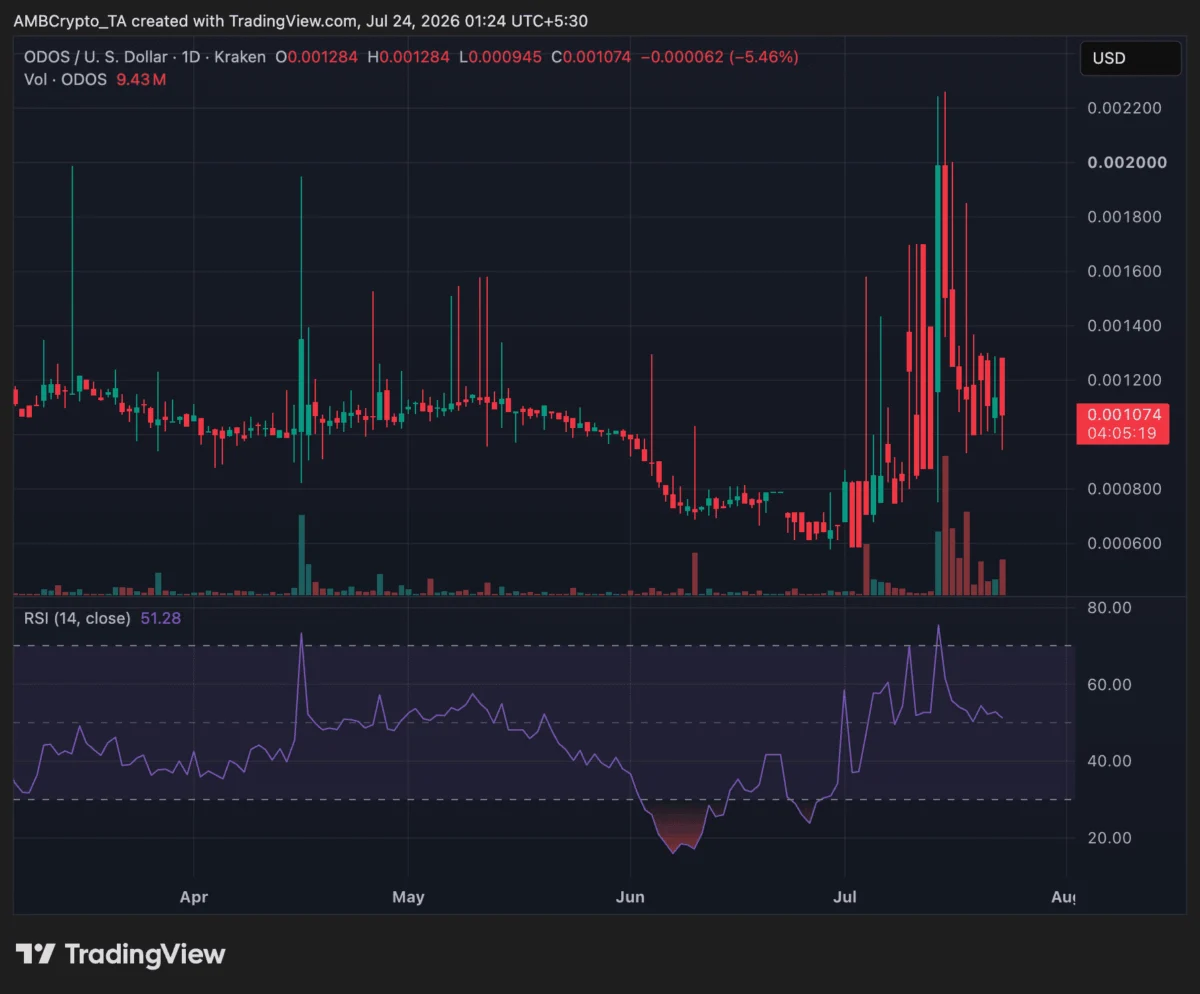
The announcement of the company’s imminent shutdown has predictably triggered a negative reaction in the market for the ODOS token. Data from TradingView indicated that the ODOS token was trading around $0.00107 at the time of the announcement, reflecting an approximate decline of 5.5% over the preceding 24-hour period. This immediate depreciation is a common response in the volatile cryptocurrency market when news of a project’s operational closure emerges, as investors react to the perceived loss of development support and the uncertainty surrounding the token’s future utility and value proposition. Such events often lead to a rapid re-evaluation of an asset’s worth.
The price decline was accompanied by an observable increase in trading volumes, signifying that a significant number of token holders were actively selling their positions in response to the news. Elevated trading volumes during a price drop often indicate a strong market reaction and a broad-based desire to exit positions, suggesting a shift in investor sentiment from holding to divestment. Despite this selling pressure, technical analysis, as indicated by the token’s Relative Strength Index (RSI), showed a value near 51. An RSI of 51 typically suggests neutral momentum, indicating that while there was selling, the token had not yet entered oversold conditions, which usually register below 30. This could imply that some investors held onto their positions, or that the selling, while impactful, was not as extreme as to push the token into deeply undervalued territory, at least at that immediate juncture. However, without a clear corporate entity driving development and utility, sustained lack of demand could lead to further downward pressure over time.
The nuanced market reaction, combining an immediate price drop with increased volume but a relatively neutral RSI, underscores the complex interplay of fundamental news and technical indicators in crypto asset valuation. While the operating company is exiting the scene, the announcement’s clear distinction between the business, the protocol’s governance structure, and the token itself leaves the future decisions concerning the ODOS token and its DAO entirely separate from the company’s wind-down. This structural separation is a core tenet of decentralization, but its practical implications for value retention and future development remain to be seen, contingent on the DAO’s ability to self-organize and execute.
Understanding DeFi Aggregators and Odos’s Place in the Ecosystem
To fully grasp the implications of Odos’s shutdown, it is essential to understand the role of DeFi aggregators within the broader decentralized finance landscape. DeFi aggregators are platforms designed to optimize cryptocurrency trades by routing user orders through multiple decentralized exchanges (DEXs) and liquidity pools. Their primary function is to find the best possible price, minimize slippage (the difference between the expected price of a trade and the price at which the trade is executed), and potentially reduce transaction fees by comparing various liquidity sources across the vast and fragmented DeFi ecosystem. Popular examples in this competitive sector include 1inch, ParaSwap, and Matcha, each employing sophisticated algorithms to achieve optimal trade execution for their users.
Odos aimed to distinguish itself in this competitive arena, often touting an "intent-based architecture" or advanced routing algorithms designed to find highly efficient trade paths, potentially even across different blockchain networks. While specific details of its market share or total value locked (TVL) were not explicitly provided in the original announcement, the presence of a native token and a DAO suggests a commitment to community governance and a potential for broader ecosystem participation, characteristic of many aspiring DeFi projects. In a market characterized by fierce competition, high gas fees on popular networks like Ethereum, and the constant need for innovation to stay ahead, maintaining a competitive edge and a sustainable business model can be exceptionally challenging. The operational costs associated with maintaining such a sophisticated system, coupled with the need for continuous research and development, are substantial.
The decision to wind down operations often stems from a confluence of factors, including intense market competition, difficulties in securing continued funding (especially in challenging market conditions), escalating operational costs, or an inability to achieve sufficient user adoption and consistent revenue generation. The DeFi sector, while a hotbed of innovation, is also prone to rapid shifts in trends, liquidity concentrations, and increasing regulatory scrutiny, all of which can impact the long-term viability of projects. For an aggregator, constant development is required to integrate new liquidity sources, optimize algorithms, and adapt to evolving blockchain landscapes and smart contract standards. Without sustained funding or a clear path to profitability, even technically sound projects can struggle to survive.
Broader Implications for the DeFi Ecosystem
The cessation of Odos’s operations, while specific to one platform, carries broader implications for the DeFi ecosystem. It serves as a stark reminder of the inherent risks, rapid evolution, and sometimes brutal competition within decentralized finance. For users, it reinforces the critical importance of understanding the non-custodial nature of many DeFi protocols and the absolute necessity of managing one’s own private keys or seed phrases. The incident highlights that while protocols may offer convenience features like social logins, users ultimately bear the primary responsibility for their asset security and retrieval. This is a fundamental lesson in self-sovereignty within crypto.
The event also underscores the challenges faced by infrastructure projects in DeFi. Aggregators are foundational tools, providing essential services for efficient trading, yet their long-term sustainability can be precarious. The market is increasingly consolidating around a few dominant players with deep liquidity and strong brand recognition, making it difficult for newer or smaller projects to carve out a significant niche and achieve economies of scale. This could lead to a trend where only the most well-funded, innovative, or strategically aligned aggregators survive, potentially reducing choice and fostering centralization in a sector that champions decentralization.
Furthermore, the emphasis on the continued existence of the ODOS token and DAO raises pertinent questions about the future of decentralized governance in such scenarios. Can a DAO effectively self-organize, potentially fund new development, or pivot to a new use case without a central operating company providing leadership and resources? This will be a critical test case for the true resilience and adaptability of decentralized structures when their corporate backing dissolves. The success or failure of the Odos DAO to chart a new course could provide valuable insights into the long-term viability of fully decentralized projects and the effectiveness of community-driven development models.
Finally, the strong warnings against scams are a crucial takeaway for the entire crypto community. Periods of uncertainty surrounding project shutdowns are frequently exploited by malicious actors who seek to capitalize on user anxiety and confusion. The clear guidance from Odos on what not to expect from the company is an important public service, reminding all crypto participants to remain vigilant against phishing attempts, fake migration schemes, imposter support accounts, and other fraudulent activities. Users should always rely solely on official, verified channels for information and, critically, never compromise their private keys or seed phrases under any circumstances.
Conclusion: A Crossroads for Odos and its Community
The permanent wind-down of Odos’s operational company by July 30 represents a significant moment for its user base and the broader DeFi landscape. While the company’s departure leaves a void in the aggregator market and creates immediate uncertainty, the non-custodial nature of the platform ensures the safety of user assets, provided they take the necessary steps to transfer funds or secure private keys as advised. The continued existence of the ODOS token and the independent Odos DAO offers a glimmer of potential for a community-driven future, albeit one fraught with challenges related to organization, funding, and development.
The market’s immediate reaction, characterized by a decline in the ODOS token’s value and increased trading volumes, reflects the inherent uncertainty in such transitions. As the DeFi sector matures, incidents like the Odos shutdown serve as vital lessons, emphasizing the need for robust risk management, continuous user education on self-custody, and sustained vigilance against evolving threats from both market forces and malicious actors. The coming months will reveal whether the Odos DAO can harness its decentralized power to forge a new path or if this marks the definitive end of the Odos chapter in the annals of decentralized finance. The evolution of the DeFi space continues, demanding adaptability and resilience from projects and participants alike.