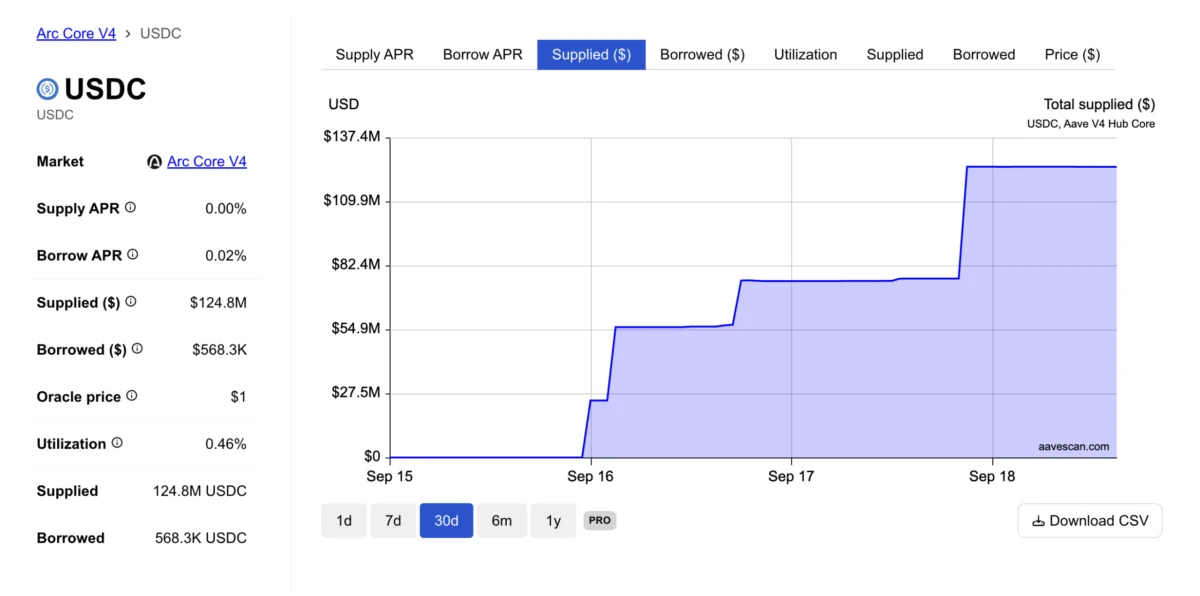
Decentralized finance (DeFi) giant Aave is facing a prominent liquidity imbalance following the rollout of its latest lending market on the Arc network. According to on-chain data retrieved on September 18 from Aavescan, Aave V4’s Arc market has successfully attracted a substantial influx of capital, pulling in nearly $125 million in USDC. However, this massive accumulation of digital assets has exposed a striking disparity between capital supply and user demand. Borrowers have actively utilized less than $600,000 of the total pool, leaving roughly 99.5% of the deposited capital sitting entirely idle.
This stark imbalance underscores a fundamental challenge facing new decentralized finance products: simply deploying a fresh liquidity pool and attracting capital does not automatically translate into a robust, self-sustaining lending economy. As Aave continues to expand its footprint across emerging networks, analysts and developers alike are watching closely to determine whether organic borrowing demand can eventually catch up with the staggering volume of parked liquidity.
Rapid Deposit Growth on Aave V4 Arc
The expansion of liquidity within the Aave V4 Arc market has occurred at an accelerated pace, catching the attention of market observers who monitor capital flows across various decentralized applications. Data provided by Aavescan illustrates a sharp, almost exponential trajectory in USDC deposits over a compressed multi-day window in mid-September.
On September 16, excess reserves within the Arc market stood at a modest $24.5 million. Just one day later, on September 17, newly published reports indicated that total deposits had nearly tripled to roughly $75.8 million. By September 18, the figures surged once again, climbing to approximately $124.8 million. This sequence represents roughly a 65% jump in a single 24-hour period and more than a fivefold expansion since the market first began drawing significant excess liquidity.
Despite this dramatic surge in total value locked (TVL), the accompanying borrowing activity has failed to keep pace. While recent readings indicate that total active borrowing has ticked upward to approximately $568,300—recovering from a low of roughly $73,400 recorded at midnight on September 18—the absolute volume of borrowed capital remains dwarfed by the sheer weight of incoming deposits. With borrowers utilizing a mere 0.46% of the available pool, the vast majority of the capital remains dormant, raising critical questions regarding the immediate utility of the newly launched market.
The Mechanics of DeFi Lending and Idle Capital
To fully understand the implications of this liquidity imbalance, it is necessary to examine the underlying architecture of decentralized lending protocols like Aave. At its core, Aave functions as a decentralized marketplace that bridges the gap between capital providers (lenders) and capital consumers (borrowers). Users deposit digital assets into shared liquidity pools, earning a yield derived from the interest fees paid by individuals who take out loans against their own collateral.
In a healthy, mature market, a high volume of deposits is generally accompanied by steady borrowing demand, creating a dynamic interest rate model that rewards lenders while providing cost-effective leverage or liquidity to borrowers. However, when borrowing demand collapses or fails to materialize during a market’s initial phases, the entire economic engine stalls.
The current state of the Aave V4 Arc market clearly reflects this friction. Because the vast majority of the $125 million in USDC remains untouched, the protocol is generating virtually no economic activity in terms of loan servicing fees. Consequently, current metrics show the market’s supply return resting at 0.00%, while the borrowing rate hovers near an ultra-low 0.02%.

For liquidity providers, this means that parking capital in the Arc market currently yields little to no financial return. While the headline figure of $125 million might suggest overwhelming market validation at first glance, the reality on the ground is that the capital is not generating real-world lending utility or meaningful yields for suppliers.
Navigating the Bootstrap Phase: Context and Chronology
Market analysts point out that judging a decentralized lending protocol solely by its initial few days of operation can be misleading. In the lifecycle of decentralized finance infrastructure, liquidity must often precede demand. Lenders and institutional participants typically require proof of deep liquidity before they are willing to deploy capital, while borrowers often wait for stable interest rates and robust ecosystem integration before executing large-scale loan positions.
The timeline of the Aave V4 Arc market rollout highlights this classic bootstrapping challenge:
- September 16: Excess reserves are registered at a modest $24.5 million, marking the early stages of capital inflow.
- September 17: Deposits swell to $76 million within a 24-hour window, though borrowing activity remains virtually non-existent, highlighting an immediate gap between supply and demand.
- September 18: Total deposits surge to nearly $124.8 million, representing a 65% daily increase. Simultaneously, active borrowing creeps upward from an intraday low of $73,400 to reach approximately $568,300.
While the current utilization rate of roughly 0.46% indicates that the market is severely underutilized, industry participants view this phase as a necessary stepping stone rather than an existential failure. Establishing a secure, highly liquid foundation is a mandatory prerequisite for attracting professional market makers, arbitrageurs, and corporate borrowers who require deep liquidity pools to execute complex financial strategies without suffering from severe slippage.
Implications for Aave’s Broader Ecosystem Expansion
Aave has long maintained a dominant position within the decentralized finance sector, frequently commanding nearly half of the total market share for DeFi loans across various chains and iterations. However, as the protocol transitions toward newer architectures like V4 and explores specialized network environments such as Arc—which is often tailored to meet the strict compliance, privacy, and regulatory needs of institutional participants—the dynamics of user acquisition change significantly.
Institutional-grade or permissioned environments often experience slower adoption curves compared to permissionless retail markets. Entities exploring the Arc network may be conducting preliminary integration tests, auditing smart contract interactions, or establishing internal risk frameworks before committing significant capital to active borrowing positions. Therefore, the rapid accumulation of $125 million in USDC may represent institutional capital positioning itself in anticipation of future utility, rather than a failure of demand.
Nevertheless, the true test for Aave V4 moving forward will be its ability to convert this passive liquidity into active, fee-generating loan volume. Observers note that while high deposit figures serve as an effective marketing metric, the long-term viability of the Arc market will be judged strictly by the velocity of its loans.
Going forward, industry analysts will closely monitor borrowing metrics rather than total deposits as the definitive benchmark of practical adoption. If borrowing demand fails to scale alongside the incoming capital, liquidity providers may eventually reallocate their assets to higher-yielding opportunities elsewhere in the DeFi ecosystem. Conversely, should institutional borrowers begin utilizing the available capital pool, the Aave V4 Arc market could quickly transform from an idle reservoir of cash into one of the most active institutional lending hubs in the decentralized finance landscape.