Synthetic dollar protocol Ethena is advancing its strategic diversification efforts by significantly expanding the collateral backing of its flagship yield-bearing product, USDe. The upcoming integration will introduce equity perpetuals—frequently referred to as real-world asset (RWA) tokenization perpetuals—into the protocol’s foundational reserve architecture. This move represents a calculated shift away from exclusive reliance on native crypto-asset volatility, positioning the protocol to capture sustainable, non-crypto-correlated yields derived from traditional equity and real-world asset markets.
The decision comes at a critical juncture for decentralized finance (DeFi) yield generators, which have historically struggled with the structural limitations of the digital asset credit cycle. By tapping into the trillion-dollar traditional asset base through derivative instruments, Ethena aims to insulate its user base from severe market downturns while cementing USDe as a premier scalable stablecoin alternative in both bull and bear market environments.
The Evolution of USDe Collateral Architecture
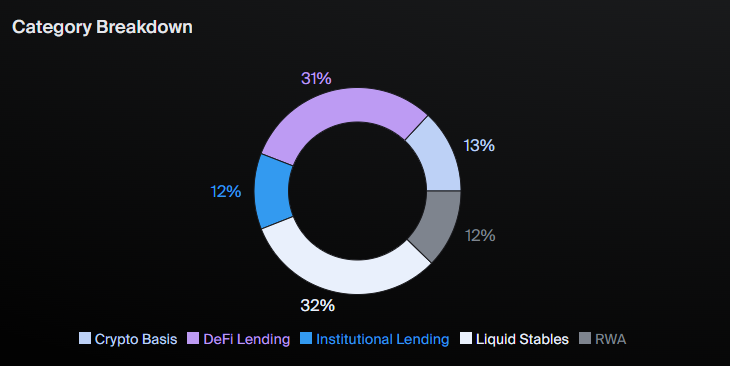
To understand the weight of Ethena’s latest expansion, one must examine the current composition of USDe’s reserve backing. Presently, the protocol relies on a diversified yet crypto-centric distribution of assets. Liquid stablecoins such as USDT and USDC form the largest single category, accounting for 32% of the collateral backing. Decentralized finance lending pools across prominent liquidity markets like Aave and Morpho constitute the second-largest reserve category, representing a 31% share.

Traditional credit products—introduced through partnerships with institutional asset managers such as Janus Henderson, utilizing AAA-rated collateralized loan obligation (CLO) funds—currently account for 12% of USDe backing. This initial foray into traditional finance (TradFi) served as Ethena’s pilot test for non-crypto yields. The upcoming deployment of RWA equity perpetuals in the coming weeks marks the second and most aggressive wave of this diversification strategy.
At its core, Ethena’s traditional yield model relies on the "basis trade," a market-neutral strategy that locks in the spread between the spot price of an asset and its corresponding futures or perpetual contract. While highly lucrative during sustained market uptrends, this mechanism inherently suffers from cyclical vulnerability.
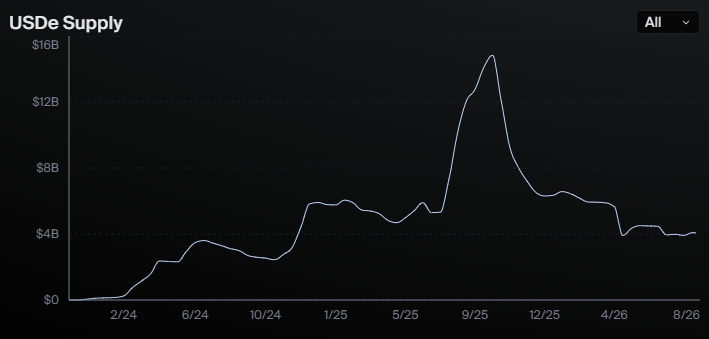
During the height of the 2024–2025 cryptocurrency bull run, USDe market supply experienced explosive growth, peaking at nearly $15 billion with annualized yields consistently exceeding 80%. However, as the broader crypto market entered a protracted contraction phase—commonly referred to as the crypto winter—USDe supply plummeted to approximately $4 billion, and yields compressed significantly, occasionally dipping below zero as funding rates turned negative. This volatility exposed the limitations of maintaining a purely crypto-native delta-neutral strategy, prompting Ethena’s leadership to seek deep, uncorrelated external yield sources.
Explosive Growth in RWA Perpetuals
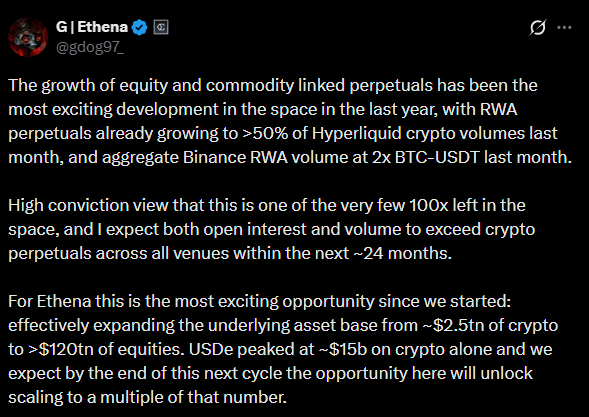
The RWA tokenization perpetuals market has emerged as one of the fastest-growing sectors within alternative financial derivatives. According to data provided by Ethena, equity perps have experienced a staggering tenfold increase in Open Interest (OI) since March, surging to $6 billion.
Project executives believe this trajectory is merely in its infancy. In official statements, the protocol noted that the RWA perpetuals market possesses the capacity to scale up to 100 times its current size. Unlike native crypto derivatives, which derive their underlying value from volatile digital tokens, RWA perpetuals are anchored to traditional equity markets and asset bases.
The scope of this expansion is vast. The underlying asset base for traditional equities and tokenized real-world assets exceeds $150 trillion, dwarfing the approximately $2.5 trillion total market capitalization of the entire cryptocurrency ecosystem. This sheer scale makes RWA perpetuals the most scalable extension of the basis allocation strategy attempted in the decentralized finance sector to date.
Project projections indicate that RWA perpetuals are poised to eclipse native crypto allocations within USDe’s backing structure over the next 12 to 24 months, fundamentally altering the risk and return profile of the synthetic stablecoin.
Leadership Perspective and Cautious Deployment
Ethena founder Guy Young addressed the protocol’s deliberate pacing regarding the integration of RWA equity perpetuals during recent communications. Explaining why the protocol did not rush into the sector earlier, Young emphasized a risk-mitigation philosophy that prioritizes data integrity and market depth over speed-to-market.
"We took a cautious approach to what was a nascent market and waited until we saw deep, liquid markets with a data history we could study before moving into the opportunity at scale," Young stated.
Young further emphasized the transformative potential of the asset class, characterizing the segment as "one of the very few 100x left" in modern finance. He reiterated his expectation that the volume and Open Interest of RWA perpetuals could surpass global crypto-native derivatives within a two-year timeframe, validating the strategic pivot.
Yield Comparison: USDe Versus Short-Term U.S. Treasuries
In the highly competitive landscape of digital yield generation, USDe is frequently benchmarked against traditional risk-free or low-risk assets, most notably short-term U.S. Treasury bills. Recent performance metrics indicate that USDe maintains a competitive edge, offering an approximate 1.6% yield spread over short-term U.S. T-bills.
From an economic standpoint, capital allocators can logically expect higher nominal returns from USDe compared to standard sovereign debt instruments. However, financial analysts routinely caution that this enhanced yield is accompanied by smart contract exposure, counterparty risks inherent in derivatives exchanges, and general DeFi security considerations that do not apply to holding direct government paper. Ethena’s integration of institutional-grade RWA backing is explicitly designed to narrow the risk gap between decentralized yield products and traditional fixed-income securities.
Macroeconomic Implications and Broader Market Impact
The systematic integration of traditional financial instruments into decentralized finance protocols represents a broader maturation of the blockchain industry. By bridging the gap between on-chain liquidity and off-chain real-world assets, protocols like Ethena are attempting to build financial infrastructure capable of weathering macroeconomic tightening and crypto-specific liquidity crunches.
For the wider DeFi ecosystem, Ethena’s aggressive diversification serves as a bellwether. If USDe successfully scales its RWA perpetual backing and maintains attractive yield spreads without compromising stability, other algorithmic and synthetic stablecoin issuers will likely replicate the model. This trend could accelerate the convergence of traditional capital markets and decentralized protocols, driving institutional capital deeper into blockchain-based yield products.
As Ethena rolls out its updated collateral framework over the coming weeks, market participants will closely monitor whether this structural overhaul successfully dampens volatility, stabilizes USDe supply during market downturns, and revitalizes demand ahead of the next major cryptocurrency market cycle.