Prediction markets are signaling a dramatic shift in the American political landscape as the November 3, 2026 midterm elections approach. According to recent data from Polymarket, the world’s largest decentralized prediction platform, bettors increasingly view the Democratic Party as the clear favorite to secure majorities in both the House of Representatives and the Senate. This evolving political outlook carries profound implications for federal policy, particularly regarding the contentious debate over digital asset market structure, regulatory jurisdiction, and the stalled legislative agenda surrounding cryptocurrency oversight in Washington.
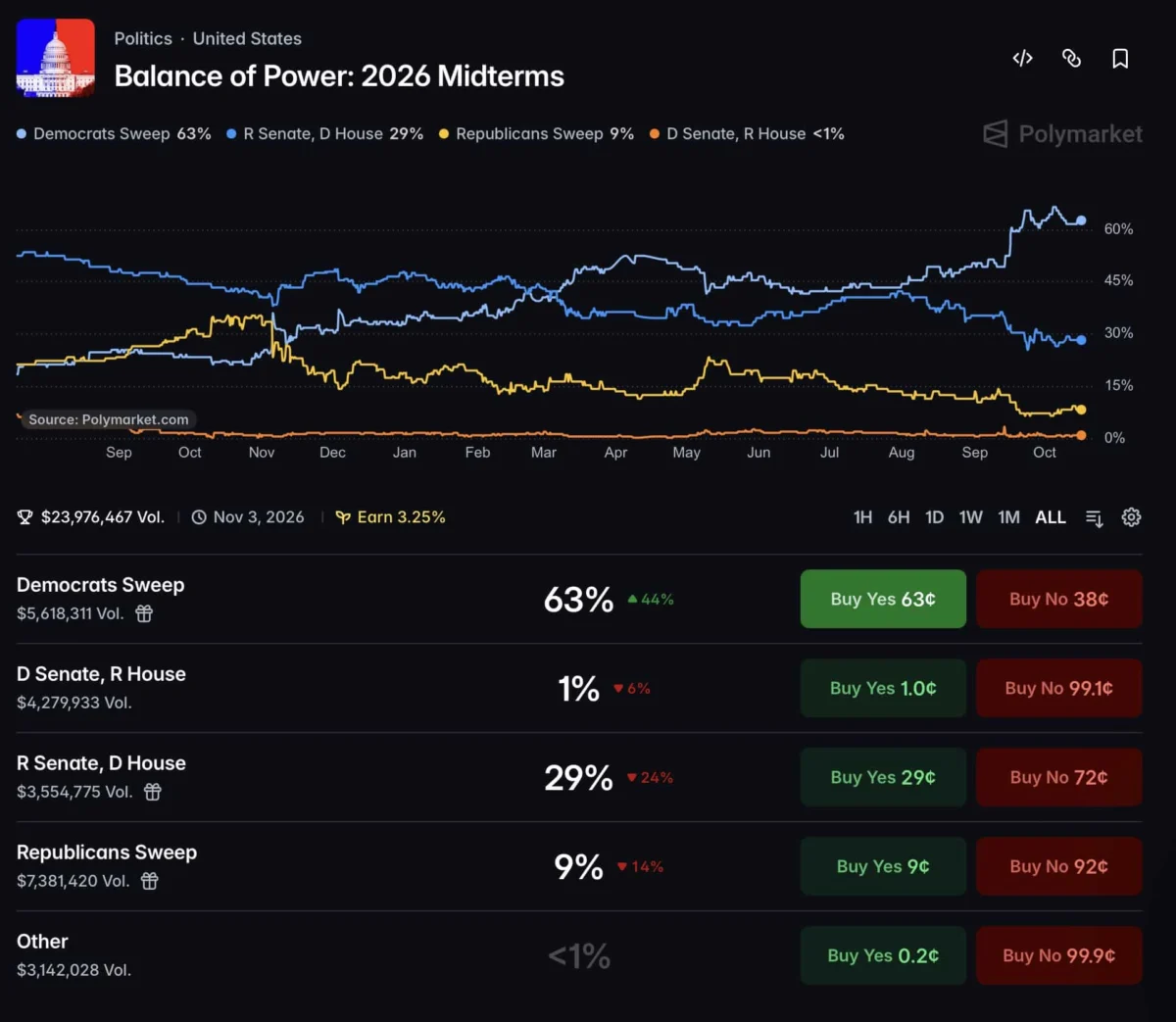
The current pricing on Polymarket’s balance-of-power contracts reveals that market participants assign a high probability to a Democratic trifecta or, at minimum, a split Congress where Democrats retain or capture the lower chamber. Specifically, a total Democratic sweep—capturing both the House and the Senate—is currently trading at 63%. Meanwhile, a scenario featuring a Democratic House paired with a Republican Senate commands a 29% share. When combined, these figures imply an aggregate probability of roughly 91% that Democrats will control the House of Representatives when the next congressional session convenes. In stark contrast, a total Republican sweep is currently priced at just 9%, illustrating a remarkable contraction in bullish sentiment for the GOP since late 2025.
The Stakes in the House of Representatives
All 435 seats in the House of Representatives are up for grabs in the upcoming November midterms. Securing a simple majority requires winning at least 218 seats. Because the Republican Party currently holds a narrow majority in the chamber, any shift toward the Democrats would result in a chamber flip, altering the legislative priorities, committee chairmanships, and subpoena powers of Capitol Hill.

The financial backing behind these prediction contracts underscores the seriousness with which traders are approaching the market. Polymarket’s overarching balance-of-power market has attracted approximately $24 million in trading volume, providing a robust sample size of speculative capital. The individual Senate markets have similarly drawn significant engagement, pulling in roughly $6.7 million in volume. These figures demonstrate that millions of dollars in real capital are actively betting on these electoral outcomes, elevating prediction markets as valuable barometers of political sentiment alongside traditional polling.
A Volatile Trajectory in the Senate
While the House odds suggest a comfortable margin for Democrats, the battle for the upper chamber has been characterized by extreme volatility. Currently, Democrats are trading at 65% to win the Senate, while Republicans sit at 38%. This represents a sharp reversal from autumn 2025, when market participants heavily favored the GOP, pricing Republican control near 70%.
The cross-over point occurred in March 2026, driven by shifting economic conditions, voter sentiment regarding ongoing fiscal policies, and localized legislative battles. The senate market reflects a much tighter contest than the House, keeping political analysts and lobbyists on edge as they attempt to handicap the final makeup of the 119th and 120th Congresses.
Implications for Crypto Regulation and the CLARITY Act
For the digital asset industry, the shifting political winds on Polymarket carry direct consequences for ongoing legislative efforts, most notably the Digital Asset Market Clarity Act. Often referred to simply as the CLARITY Act (H.R. 3633), the bill is designed to establish a comprehensive statutory framework for digital asset market structure, explicitly defining the regulatory boundaries between the Securities and Exchange Commission (SEC) and the Commodity Futures Trading Commission (CFTC).

The legislative timeline of the CLARITY Act highlights the arduous path of crypto-related bills through Capitol Hill. The measure previously passed the House on July 17, 2025, in a decisive 294-to-134 vote, signaling broad bipartisan interest in providing regulatory clarity to the burgeoning blockchain sector. However, the bill has faced procedural hurdles in the upper chamber. Most recently, on September 15, 2026, the legislative process saw a motion to reconsider the vote by which cloture on a motion to proceed was not invoked, underscoring the deep partisan and structural divides that continue to stall comprehensive digital asset legislation.
Market observers note that prediction market odds should not be interpreted as direct gauges of whether a specific bill will become law. Instead, they serve as indicators of institutional control. If Democrats capture the House, the resulting shift in committee leadership—such as the leadership of the House Financial Services Committee—would fundamentally alter oversight priorities. A Democratic-led House could approach digital asset regulation with a different emphasis, potentially prioritizing consumer protection, anti-money laundering compliance, and systemic risk mitigation over the structural exemptions sought by various crypto advocacy groups.
Legislative Realities and Broad Economic Backdrop
Despite the high-stakes political maneuvering, analysts emphasize that federal policymaking is constrained by the constitutional requirement of bicameral agreement and presidential assent. Even if Democrats secure both chambers of Congress, any comprehensive market structure bill would still require sufficient bipartisan compromise to survive a Senate filibuster and ultimately earn the signature of the president.
The resilience of the broader digital asset market amid these legislative uncertainties has surprised many traditional financial analysts. Commentators within the Web3 ecosystem have pointed out that Bitcoin and major altcoins have continued to hold their ground despite persistent macroeconomic headwinds, including sticky inflation data reflected in recent Consumer Price Index (CPI) and Producer Price Index (PPI) reports, alongside hawkish signals from the Federal Open Market Committee (FOMC).

Social media commentary from prominent industry analysts captures this sentiment, highlighting that the crypto market has increasingly decoupled from isolated legislative setbacks. While the defeat or stalling of bills like the CLARITY Act creates short-term volatility, the underlying liquidity and structural adoption of decentralized networks continue to provide a strong market floor.
Conclusion and Future Outlook
As the November 3, 2026 midterms draw closer, Polymarket odds will continue to serve as a real-time sentiment tracker for political strategists, institutional investors, and digital asset stakeholders alike. With Democrats currently favored to maintain or expand their legislative footprint—holding roughly a 91% implied probability for House control and a 65% chance in the Senate—the political calculus in Washington is undergoing a palpable transformation.
Nevertheless, with a non-zero probability still assigned to Republican victories, and the complex machinery of congressional lawmaking still requiring broad consensus, the ultimate fate of federal crypto regulation remains an open question. Industry participants will be watching the final weeks of the campaign closely, knowing that the outcome at the ballot box will shape the regulatory environment for digital assets for years to come.