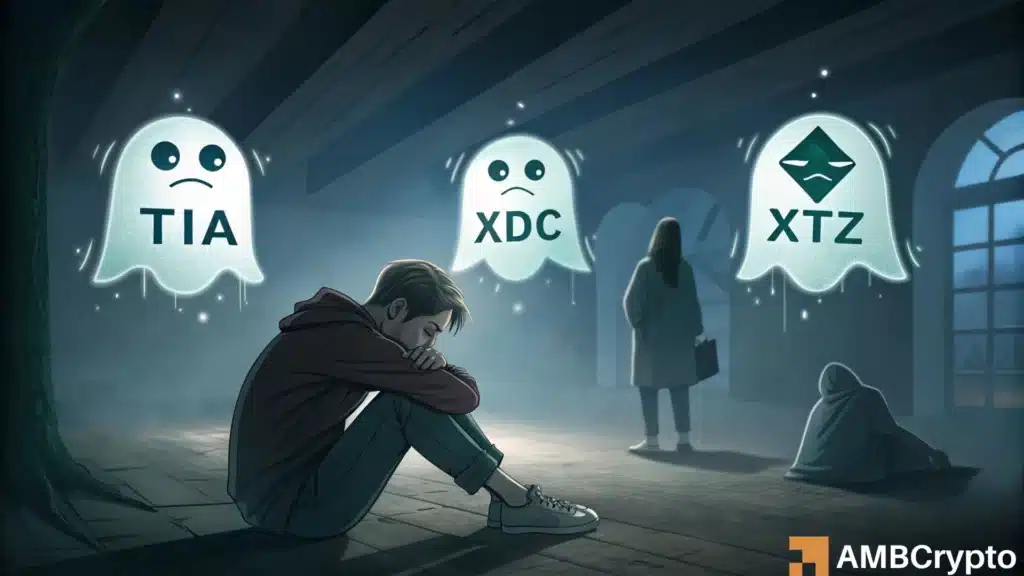
The contemporary landscape of distributed ledger technology is characterized by a paradoxical divergence: while the total number of blockchain networks has exploded—with aggregators like DefiLlama now tracking upwards of 500 distinct chains—the actual utilization of these networks remains highly concentrated. This proliferation, often dubbed the "blockchain boom," has created a crowded market where raw market capitalization frequently masks a profound lack of underlying network activity. As institutional and retail investors reassess their portfolios, a growing cohort of "ghost chains" has emerged—projects that maintain multi-million or billion-dollar valuations despite suffering from precipitous declines in active user counts and transaction throughput.
The Evolution of the Blockchain Ecosystem
The chronology of the current blockchain market began in earnest with the post-2020 infrastructure surge, which saw the rise of modular blockchains and specialized Layer-1 protocols. During the 2021-2022 bull cycle, capital flowed indiscriminately into the sector, driven by speculative interest in decentralized finance (DeFi) and non-fungible tokens (NFTs). Alchemy, a leading infrastructure provider, now monitors 64 major chains that have secured significant market presence. However, the maturation of the market has highlighted a clear demarcation between "utility-driven" chains and those that appear to be stagnating.
In the current environment, the metric of "Daily Active Addresses" (DAA) has become the primary benchmark for network health. Unlike market capitalization, which is susceptible to volatility and liquidity constraints, DAA offers an objective window into the real-world demand for block space. The recent data indicating a decoupling of market price from active user engagement suggests that the industry is undergoing a "utility correction," where speculative value is being stripped away from underutilized protocols.
Case Study: The XDC Network Disconnect
The XDC Network serves as a primary example of this phenomenon. At its peak, the network commanded a market capitalization exceeding $2 billion. Yet, recent analysis from Token Terminal reveals a stark decline in the network’s foundational metrics. From a high of 288,000 daily active addresses in 2021, the network has seen its engagement plummet to approximately 16,000 users—a contraction of over 94% from its historical peak.
The implications for the XDC token have been severe. As the network’s utility—measured by transaction fees and dApp interaction—declined, the native token saw an annualized drop of 62.5%. This downward pressure suggests that the market is beginning to price in the "ghost chain" status of projects that fail to retain their initial user base. Investors who entered the market during the project’s inception have faced sustained headwinds, as the token’s value struggles to reclaim the heights reached during periods of higher network activity.
Celestia: A Study in Rapid Adoption Cycles
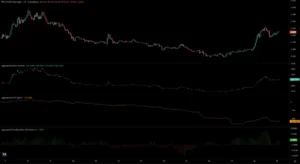
Celestia, a modular data availability layer, has faced a different, yet equally challenging, trajectory. Following a surge in interest throughout 2023 and early 2024, the network experienced a rapid ascent in active addresses, peaking at roughly 39,000. However, the subsequent decline has been statistically significant. Current data indicates a 96.92% drop in active addresses, with the figure hovering near 1,200 at the time of reporting.
This cooling of activity has triggered a corresponding reaction in the valuation of the TIA token. Having shed approximately 98.2% of its value from its all-time high, TIA’s current price of $0.35 reflects a broader market sentiment that prioritizes sustained network growth over initial architectural innovation. The Celestia case illustrates the volatility inherent in modular blockchain infrastructure: without a consistent ecosystem of rollups and developers actively utilizing the data availability layer, the token’s economic model remains fragile.
Tezos and the Sustainability Crisis
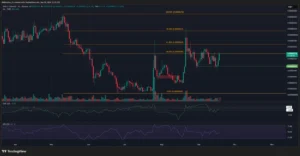
The Tezos network, once heralded for its on-chain governance and self-amending capabilities, currently faces its own existential challenges. Despite a market capitalization that has held above the $400 million threshold, the network has seen a significant erosion of its core revenue streams. According to data provided by Artemis, Tezos’s generated fees and total protocol revenue have contracted by 68% over the past 12 months.

In the realm of blockchain economics, revenue is a direct proxy for demand. When users are unwilling to pay fees for block space, it serves as a leading indicator that the ecosystem’s demand-side activity is evaporating. The 95% decline in the XTZ token from its all-time high is a reflection of this systemic weakness. For a protocol designed to evolve, the current stagnation in user participation presents a difficult hurdle for long-term sustainability, as the incentive structures for validators and developers rely heavily on network throughput.
Market Implications: The Correlation Between Usage and Value
The persistent decline in active user bases across XDC, Celestia, and Tezos provides a clear lesson for modern blockchain participants: there is an immutable correlation between protocol utility and long-term price stability. When a network experiences a sustained exodus of active addresses, it often signifies that the project has failed to establish a "moat"—a set of applications or services that provide intrinsic value to the end user.
This shift has profound implications for institutional investors. Whereas previous investment strategies focused on "Total Value Locked" (TVL), which can be easily manipulated through incentivized liquidity mining and artificial yield, the market is now pivoting toward "Sustainable Usage Metrics." Projects that cannot demonstrate a growing, organic user base are increasingly being relegated to the "legacy" category, regardless of their technological sophistication or historical pedigree.

Future Outlook and Strategic Considerations
The current state of the market suggests a period of consolidation. We are likely to see a "flight to quality," where capital migrates toward chains that provide verifiable utility and consistent developer activity. For developers, this environment necessitates a focus on product-market fit rather than just protocol architecture. For networks currently experiencing a downturn, the path to recovery is narrow; it requires not just a recovery in token price, but a fundamental reactivation of the developer and user ecosystem.
Industry analysts suggest that the next cycle of growth will be driven by real-world asset (RWA) integration and institutional-grade dApps. Networks that can provide a stable, secure, and cost-effective environment for these applications will likely be the ones that reverse the current trend of declining active addresses. Conversely, those that continue to rely on speculative interest while their technical utility remains dormant face the risk of becoming permanent fixtures in the growing graveyard of "zombie" or "ghost" networks.
In summary, the blockchain industry is moving past its experimental phase. The era of high valuations fueled solely by the promise of future utility is ending. As evidenced by the current performance of XDC, TIA, and XTZ, the market is no longer content with the potential for utility; it demands proof of usage. Investors, developers, and stakeholders should interpret these declining metrics not merely as temporary setbacks, but as critical signals that the fundamental value proposition of these networks requires significant, if not total, re-evaluation. The blockchain boom has evolved into a blockchain competition, and in this landscape, usage is the only metric that truly sustains value.