As the April tax filing deadline approaches for the 2026 fiscal year, American cryptocurrency investors and validators remain caught in a regulatory limbo that many in the industry describe as a significant barrier to domestic innovation. At the heart of the frustration is the Internal Revenue Service’s (IRS) current stance on digital asset staking rewards, which mandates that these rewards be taxed as ordinary income at the moment of receipt. Because these assets are often subject to capital gains tax upon their eventual sale, the resulting "double taxation" structure has drawn sharp criticism from lawmakers and industry experts alike.
The lack of clear, modernized guidance has left the digital asset sector in a state of uncertainty. Despite a formal appeal from a bipartisan group of legislators to the Treasury Department and the IRS, the regulatory framework remains static. For taxpayers, this means that the administrative burden of calculating, tracking, and reporting volatile staking rewards remains high, while the threat of potential audit scrutiny looms over those attempting to navigate the complex tax landscape.
A Chronology of Regulatory Stagnation
The tension between the digital asset industry and federal tax authorities did not emerge overnight; it is the culmination of years of shifting administrative interpretations.
In July 2025, a pivotal moment occurred when an amendment to the "Big Beautiful Bill," championed by Senator Cynthia Lummis, failed to gain the necessary legislative traction. This amendment was specifically designed to provide relief for Bitcoin miners and staking participants by reclassifying how these rewards are treated under tax law. Following the failure of that legislative vehicle, Lummis introduced Senate Bill 2207, a dedicated piece of legislation aimed at providing a more permanent fix for crypto-related tax issues. However, as of early 2026, the bill remains stalled in committee, highlighting the difficulty of passing standalone crypto legislation in a divided Congress.

The urgency of the situation was amplified in December 2025, when Representative Mike Carey spearheaded a letter to Treasury Secretary Scott Bessent and the acting Commissioner of the IRS. The letter served as a formal protest against the current tax regime, characterizing it as "burdensome" and "out of step" with the technological reality of proof-of-stake networks. The lawmakers argued that by taxing rewards as income at the time of receipt, the IRS is forcing taxpayers to pay taxes on assets that may experience significant price depreciation before they can be liquidated.
Despite the high-level nature of this appeal, the Treasury and the IRS have remained silent. More than a month after the letter’s delivery, no formal guidance has been issued, leaving the "loophole"—or rather, the lack of clarity—to persist through the current tax season.
The Economic Implications of the "Staking Tax"
The economic consequences of this policy are beginning to manifest in the competitive landscape of the global crypto industry. In October 2025, the Senate Finance Committee held a series of hearings to better understand the impact of tax policy on the adoption and development of blockchain technology in the United States.
Lawrence Zlatkin, Vice President of Tax at Coinbase, provided testimony that resonated with many industry stakeholders. Zlatkin argued that the current tax treatment acts as a deterrent for institutional and retail investors, who are increasingly looking to avoid U.S.-based validators. "This uncertainty pushes investors to avoid U.S. validators entirely," Zlatkin noted in his testimony. "That outcome would be disastrous for U.S. competitiveness."
The concern is that capital and technological infrastructure are being pushed toward jurisdictions with more favorable or clearer tax frameworks. When investors choose to stake their assets with validators outside of the United States, the U.S. loses out on the associated economic activity, tax revenue, and technological leadership in the burgeoning field of decentralized finance (DeFi).

Tax Administration and the "Double Taxation" Problem
From a technical standpoint, the current IRS approach creates a significant accounting hurdle. Under the current guidance, an investor who receives a staking reward must determine the fair market value of that token at the exact time it is received. This value is then reported as ordinary income, subject to standard federal income tax rates, which can be significantly higher than the long-term capital gains rates applied to assets held for over a year.
If the value of the token subsequently drops, the investor has already paid tax on a higher valuation. If they then sell the token, they must calculate a capital gain or loss based on the cost basis established at the time of receipt. This necessitates rigorous record-keeping for every single staking reward, which can number in the thousands for active participants in high-yield protocols. For many retail investors, this level of reporting is prohibitively complex, leading to widespread calls for a "de minimis" exemption for small transactions or a deferral of the taxable event until the rewards are actually converted to fiat currency.
Legislative Deliberations: The CLARITY Act
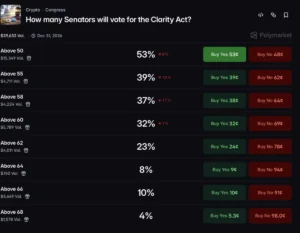
While the specific issue of staking taxes remains unresolved, it is currently being debated within the context of the broader market structure bill, known as the CLARITY Act. This legislation aims to establish a comprehensive framework for digital assets, covering everything from stablecoin regulation to the tax treatment of small-scale payments.
Proponents of the CLARITY Act suggest that small, everyday transactions—such as paying for a cup of coffee with crypto—should be tax-exempt to encourage the use of digital assets as a medium of exchange. However, the inclusion of staking tax reform within this broader bill creates a "wait and see" scenario. If the broader market structure bill faces delays, the relief for staking participants may be indefinitely postponed.
The political reality is that while there is bipartisan recognition that the current system is broken, there is no consensus on how to replace it without creating new loopholes or sacrificing federal revenue. The IRS, meanwhile, has taken a cautious approach, prioritizing the enforcement of existing, albeit dated, tax code over the implementation of new, industry-specific guidelines that might require Congressional approval.

Analysis: What Lies Ahead for Taxpayers
For the individual taxpayer, the advice for the 2026 tax season remains unchanged: proceed with extreme caution. Until the IRS issues an official correction or a new bill is signed into law, the existing interpretation stands.
- Document Everything: Given the lack of clarity, maintaining detailed logs of every staking transaction—including date, time, and fair market value at the time of receipt—is essential for defending against future audits.
- Consult Professionals: Tax professionals with expertise in digital assets are increasingly necessary, as the interpretation of "income" versus "capital gains" can vary based on the specific nature of the staking arrangement.
- Monitor Policy Updates: Changes to tax guidance can occur throughout the year. While the IRS has been silent since the December letter, any sudden shift in administrative policy could impact how investors should report their 2026 earnings.
The standoff between the legislative branch and the tax authority underscores a fundamental challenge in the digital age: the speed of financial innovation far outpaces the speed of the legislative and regulatory process. As long as the U.S. tax code treats staking rewards as immediate, ordinary income, the country risks losing its competitive edge in the global blockchain economy. Whether a resolution arrives via a quiet update to IRS guidance or through the passage of the CLARITY Act remains the most significant question facing the industry as it moves further into 2026.
The ongoing silence from the Treasury Department suggests that a quick fix is unlikely. For now, the "burdensome" tax regime that Representative Carey and his colleagues criticized remains the status quo, and the responsibility for navigating this complex, and arguably outdated, system falls squarely on the shoulders of the American crypto investor.