The digital asset landscape has undergone a profound transformation over the past half-decade, transitioning from an obscure technological experiment into a multi-billion-dollar global economy. At the center of this revolution are Non-Fungible Tokens (NFTs), cryptographic assets that establish verified, immutable ownership of unique digital or physical items on a decentralized blockchain ledger. For creators, artists, developers, and entrepreneurs, the ability to mint and manage custom NFTs offers unprecedented control over intellectual property, direct monetization channels, and the capacity to cultivate deeply engaged digital communities. Beyond traditional fine art and digital illustrations, NFTs have expanded to encompass music production, video media, virtual real estate, gaming assets, and access-restricted membership passes.
Despite the undeniable allure and financial potential of token creation, entering the Web3 ecosystem requires careful preparation. Minting digital assets is not merely a creative endeavor; it is a technical process that demands a foundational understanding of blockchain architecture, smart contracts, gas fees, and wallet security. Furthermore, creators must navigate a complex regulatory and financial landscape, balancing the opportunities of decentralization against inherent market volatility and network-congestion costs. This comprehensive guide provides an exhaustive, technical walkthrough of how to conceptualize, deploy, and mint your own NFT collection directly to your Web3 wallet using industry-standard decentralized infrastructure.
Understanding the Fundamentals of Non-Fungible Tokens

To successfully navigate the creation process, one must first understand the fundamental mechanics that differentiate NFTs from other cryptographic instruments. Unlike fungible cryptocurrencies such as Bitcoin or Ethereum—where each individual unit holds an identical value and can be exchanged on a direct, one-to-one basis—NFTs are entirely unique. Each token possesses a distinct cryptographic identifier, immutable metadata, and a verified provenance history recorded directly on the blockchain. This uniqueness is what gives NFTs their value when representing scarcity, authenticity, and ownership rights for specific assets.
The vast majority of NFTs are minted, traded, and managed on EVM-compatible (Ethereum Virtual Machine) blockchains, with Ethereum remaining the dominant network for high-value digital art and institutional projects. Other networks, such as the Binance Smart Chain, Polygon, and Solana, have also captured significant market share by offering faster transaction speeds and significantly lower transaction fees. These blockchain networks rely on smart contracts—self-executing code stored on the blockchain—to automate the transfer of ownership, enforce creator royalties, and ensure that transactions remain transparent, decentralized, and tamper-proof.
Preparing for the Journey: Assessing Goals and Technical Requirements
Before initiating the smart contract deployment process, creators must conduct a rigorous assessment of their project goals, target audience, financial resources, and technical readiness. Rushing into token creation without a clear strategy frequently leads to wasted capital on unnecessary transaction fees, failed mints, and poor community engagement.
Creators should define the utility and format of their digital assets. Are you launching a one-of-one piece of fine art, a 10,000-piece generative profile picture (PFP) collection, or utility-driven tokens that grant holders exclusive access to real-world events or digital platforms? Once the creative direction is established, creators must select a secure Web3 wallet—such as MetaMask, Coinbase Wallet, or OKX Wallet—to store their private keys, sign smart contract transactions, and hold their newly minted digital assets. Ensuring that your wallet is adequately funded with the native cryptocurrency of your chosen blockchain (such as Ether for the Ethereum network) is an essential prerequisite, as every interaction with the blockchain incurs computational costs known as gas fees.
Navigating the Ethereum Ecosystem and OpenSea Infrastructure
For the purposes of this guide, we will examine the standard workflow utilizing OpenSea, currently the largest decentralized marketplace built on the Ethereum blockchain. OpenSea provides a robust, user-friendly interface that simplifies the often intimidating process of smart contract deployment and asset minting. By leveraging its decentralized architecture, users can interact directly with the Ethereum blockchain without needing to write custom Solidity code from scratch.
OpenSea functions as a comprehensive ecosystem where collectors, creators, and enthusiasts can buy, sell, and discover digital assets. The platform provides streamlined tools—collectively known as OpenSea Studio—designed to help creators deploy custom smart contracts, manage collection parameters, and mint tokens directly to their personal custody wallets. Understanding how to utilize these tools effectively is the first critical milestone in launching a successful Web3 project.
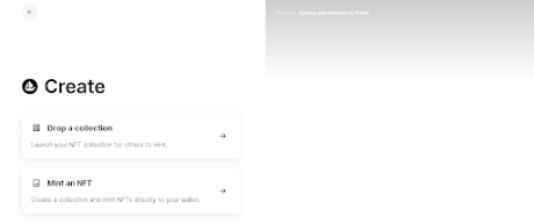
Phase One: Connecting Your Web3 Wallet and Initial Setup
The journey to creating your first NFT collection begins with establishing a secure connection between your Web3 wallet and the OpenSea platform.
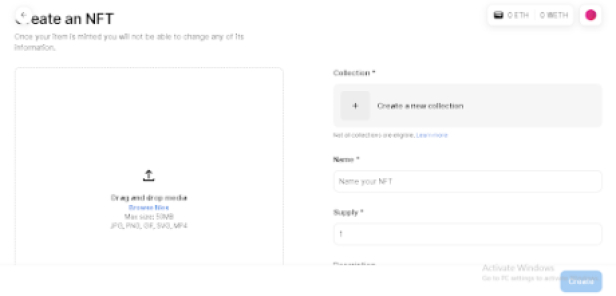
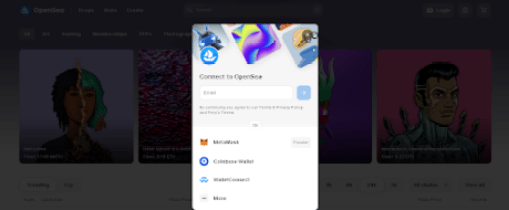
- Navigate to the official, verified OpenSea website through a secure browser extension or mobile application.
- Locate and select the "Login" or "Connect Wallet" button typically positioned in the top-right corner of the interface.
- Choose your preferred Web3 wallet from the list of supported providers (e.g., MetaMask, WalletConnect). A prompt will appear in your wallet extension asking you to approve the connection request. Review the permissions carefully and authorize the connection.
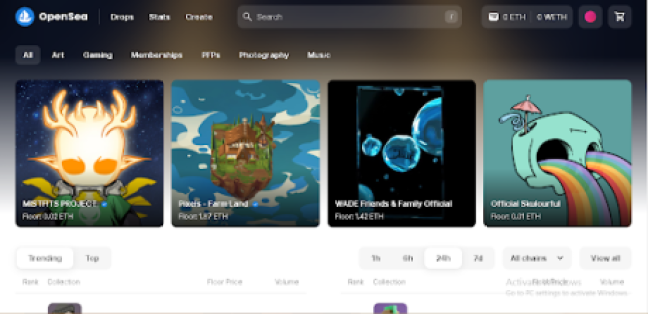
- Once your wallet is successfully linked, click on your "Profile Icon" in the top-right corner of the OpenSea dashboard to open the account management drop-down menu.
- From the available options, select "Studio" to access the advanced creation and smart contract deployment suite.
Phase Two: Deploying Your Custom Smart Contract
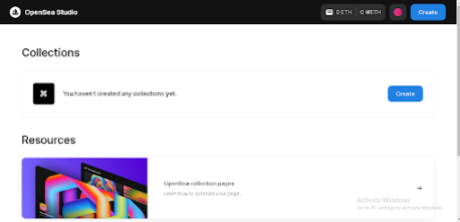
Within the OpenSea Studio environment, creators have the ability to either launch an entire collection drop or mint individual tokens directly to their wallets. If you are using the platform for the first time, you will need to establish a new collection and deploy a custom smart contract to the blockchain.
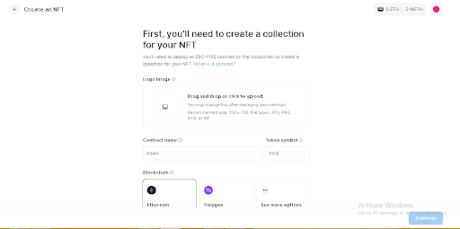
- Click the "Create" button located in the top-right corner of the Studio interface.
- Select the option to "Create a new collection." This action initiates the smart contract deployment wizard, which will guide you through the necessary parameter configurations.
- Customize your smart contract by uploading a high-resolution logo image, entering a unique contract name, and designating a distinct token symbol (e.g., a three-to-four-letter ticker representing your project).
- Select your target EVM blockchain. While Ethereum offers the deepest liquidity and highest security, alternative EVM networks like Polygon or Arbitrum can be selected to minimize gas fees for your users.
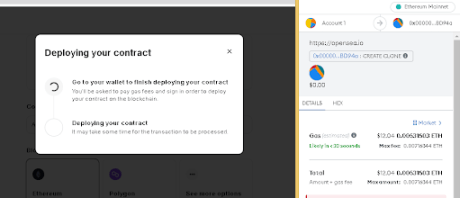
- Review the estimated gas fees associated with deploying the smart contract. Gas fees fluctuate dynamically based on overall network congestion and demand. If current network fees are excessively high, you may choose to wait until network activity subsides before proceeding.
- Click "Continue" to finalize your settings. Your wallet will prompt you to review and sign the deployment transaction, which will consume a small amount of native cryptocurrency to broadcast the smart contract to the blockchain.
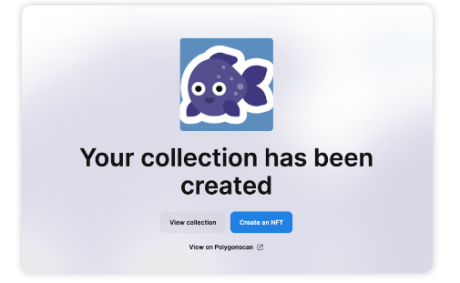
- Upon successful blockchain confirmation, you will receive a notification confirming that your smart contract has been permanently deployed.
Phase Three: Minting Your NFT Collection
With your smart contract successfully deployed to the blockchain, you are fully prepared to mint your digital assets. It is vital to understand that once an NFT is minted and recorded on the blockchain ledger, its core metadata cannot be altered or edited. Therefore, creators must meticulously verify all asset files and details before executing the final minting transaction.
For this guide, we will focus on the creation of an ERC-1155 token standard, which allows creators to mint either a single unique item (a one-of-one) or multiple identical copies (editions) of the same digital asset under a single smart contract.
- Select the "Create an NFT" option from your dashboard and upload the primary digital media file associated with your artwork (supported formats typically include PNG, JPEG, GIF, MP4, or audio files).
- Assign your newly minted NFT to the specific collection you deployed in the previous step.
- Provide a descriptive name for your item, draft a compelling description highlighting its features or utility, and set the desired item supply. The item supply dictates how many copies of this specific digital asset will be generated. Setting the supply to "1" creates a rare, single-edition collectible, while a higher number creates a multi-edition series.
- Review all input parameters carefully, then click the "Create" button located at the bottom of the screen.
- Your wallet will prompt you to approve the final minting transaction and pay the associated network gas fees. Authorize the transaction in your wallet.
- A brief loading screen will appear as the transaction is validated by blockchain validators. Once the block is confirmed, you will receive an official success notification confirming that your digital asset has been successfully minted and deposited directly into your Web3 wallet.
Broader Implications and the Future of Digital Ownership
The ability for independent creators to bypass traditional intermediaries and directly issue cryptographic assets has fundamentally democratized the art and media industries. However, the maturation of the NFT ecosystem also brings heightened regulatory scrutiny, intellectual property considerations, and the ongoing challenge of environmental and financial sustainability. As blockchain infrastructure evolves toward layer-2 scaling solutions and energy-efficient consensus mechanisms, the barriers to entry for digital creators continue to lower.
Ultimately, whether utilized for digital fine art, community membership, or corporate loyalty programs, NFTs represent a permanent paradigm shift in how human society defines, exchanges, and protects digital property rights. By approaching token creation with technical diligence, informed risk assessment, and a commitment to quality, creators can successfully navigate this dynamic frontier and establish a lasting presence in the decentralized digital economy.