Uniswap, the leading decentralized exchange (DEX) by volume, has officially initiated three critical governance proposals aimed at activating protocol fees across various chains and different iterations of its platform. These proposals represent a significant strategic move, poised to reshape the economic model of the protocol and potentially enhance the value proposition for its native UNI token holders through an enhanced burn mechanism.
The core of these proposals revolves around redirecting a portion of the swap fees, traditionally allocated almost entirely to liquidity providers (LPs), towards the Uniswap protocol treasury. This revenue, if approved, would then be funneled into the existing UNI token burn mechanism, a deflationary measure designed to reduce the token’s circulating supply over time. This development follows years of debate within the decentralized finance (DeFi) community regarding how protocols should accrue value for their token holders while maintaining a competitive environment for liquidity providers.
Background: Uniswap’s Evolution and Fee Structure
Uniswap has been a cornerstone of the decentralized finance landscape since its inception, pioneering the Automated Market Maker (AMM) model that revolutionized how digital assets are traded without intermediaries. Launched in 2018, Uniswap’s initial versions (V1 and V2) provided a simple, open-source platform for swapping ERC-20 tokens on Ethereum. Its design, which allowed anyone to become a liquidity provider by depositing an equal value of two tokens into a pool, quickly gained traction due to its permissionless nature and efficiency.
The introduction of Uniswap V3 marked a significant leap forward, introducing concentrated liquidity, which allowed LPs to allocate their capital within specific price ranges. This innovation drastically improved capital efficiency for LPs and reduced slippage for traders, cementing Uniswap’s position as a dominant force in the DEX space. However, V3 also brought increased complexity for LPs, often requiring more active management to optimize returns and avoid impermanent loss.
Throughout its history, the vast majority of trading fees generated on Uniswap have gone directly to liquidity providers as compensation for supplying capital. This model ensured deep liquidity, which is crucial for any exchange. While the protocol had a "fee switch" mechanism built into its smart contracts, allowing a percentage of these fees to be diverted to the protocol treasury, it remained inactive for years. The UNI token, launched in 2020, primarily served as a governance token, enabling holders to vote on key protocol decisions, including the activation of this fee switch. The current proposals mark a pivotal moment, as the community is now actively considering turning this dormant switch on.
The Specifics of the Governance Proposals
Uniswap Labs, the development team behind Uniswap, has put forward a series of proposals designed to activate protocol fees strategically across its ecosystem.
The first proposal targets Uniswap V2 and V3 instances operating on the recently launched Robinhood chain. This new Ethereum Layer 2 (L2) solution, which debuted just this month, has rapidly attracted significant attention and liquidity from various DEXes, including Uniswap. In a testament to its burgeoning ecosystem, Uniswap recorded an impressive $1 billion in trading volume on the Robinhood chain within approximately ten days of its launch, underscoring its growing traction and potential as a key liquidity hub. Activating fees on these established versions within such a high-growth environment is intended to capitalize on this momentum.
The second, broader proposal seeks to activate fees on Uniswap V4 across a wider array of blockchain networks. These include major L1s and L2s such as Ethereum mainnet, Base, Arbitrum, the aforementioned Robinhood chain, BNB Chain, Polygon, and Optimism. Uniswap V4, while still in development and not yet fully deployed, represents the next iteration of the protocol, promising even greater flexibility and customization for liquidity providers through "hooks" – custom smart contracts that can modify the behavior of liquidity pools. Activating fees on V4 across these diverse chains early on signifies a long-term vision for sustainable protocol revenue generation.
Hayden Adams, the CEO of Uniswap Labs, further confirmed that a third fee proposal, targeting the remaining chains where Uniswap V4 will eventually be deployed, is also slated for submission in the near future. This phased approach suggests a comprehensive strategy to integrate protocol fees across the entire Uniswap ecosystem as V4 rolls out.
Adams articulated the primary objective of these fee activations, stating, "Both direct all new protocol fees into the existing UNI burn mechanism. Based on current volumes, especially Robinhood, we expect the impact on UNI burn to be substantial." This statement highlights the direct link between increased protocol revenue and the deflationary pressure on the UNI token, which is a significant incentive for UNI holders.
Understanding the Mechanics: LP Fees vs. Protocol Revenue
To fully grasp the implications of these proposals, it’s crucial to differentiate between the fees users pay for swaps and how they are currently distributed versus how they would be under the new system. When a user executes a swap on Uniswap, they pay a small percentage fee (e.g., 0.05%, 0.3%, or 1%, depending on the pool). Historically, the vast majority, if not all, of this fee has been directed to the liquidity providers who supply the assets for the trade. These LP fees are their primary incentive for risking capital and potentially incurring impermanent loss.
Protocol revenue, in contrast, is a percentage of these swap fees that, after a successful governance vote, would be diverted to the Uniswap protocol treasury. For example, if a swap fee is 0.3%, the protocol might take a fraction of that, say 0.05% or 0.1%, with the remainder still going to LPs. The funds collected by the protocol would then be used for various purposes, including funding development, security audits, ecosystem grants, or, as proposed, for the UNI token burn mechanism.
This means that if these proposals pass, the share of swap fees collected by individual liquidity providers would be directly reduced. This shift inevitably creates a tension between the protocol’s desire for self-sustainability and value accrual for token holders, and the need to maintain attractive incentives for liquidity providers.
Mixed Reactions from the Ecosystem
The announcement of these fee proposals has naturally elicited a range of reactions across the Uniswap ecosystem, particularly from liquidity providers who stand to see their revenue streams directly impacted.
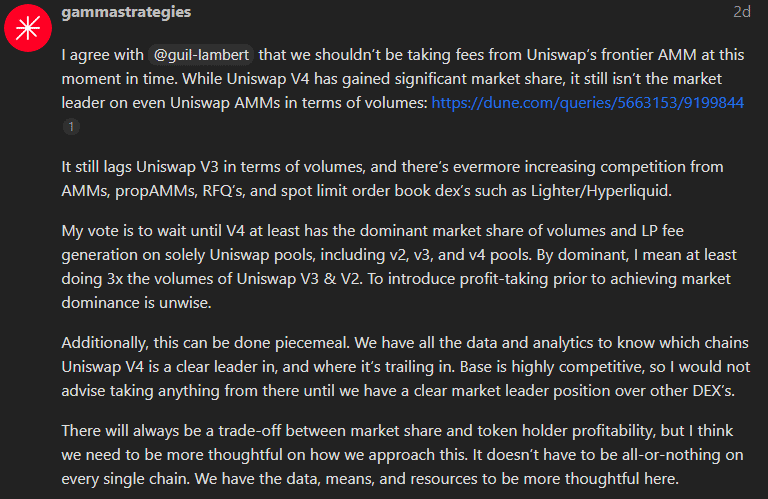
One prominent voice of opposition has been Gamma Strategies, a significant liquidity provider on Uniswap. Gamma Strategies explicitly stated its opposition to the V4 fee proposals, arguing that such a move would adversely affect their "lifeline" – the fees they earn for providing liquidity. Their argument extends beyond mere self-interest, positing that Uniswap V4, in its current state, is not yet competitive enough to withstand a reduction in LP incentives.
Gamma Strategies highlighted several key concerns regarding V4’s market position: "It (V4) still lags Uniswap V3 in terms of volumes, and there’s evermore increasing competition from AMMs, propAMMs, RFQ’s, and spot limit order book DEX’s such as Lighter/Hyperliquid." This statement underscores a critical challenge for Uniswap: while it remains a dominant force, the DEX landscape is rapidly evolving and becoming increasingly competitive. Introducing protocol fees at a stage where V4 is still finding its footing and competing with more specialized or capital-efficient alternatives could potentially deter LPs, leading to shallower liquidity and reduced trading volumes. For a decentralized exchange, maintaining deep and competitive liquidity is paramount to attracting users and fending off rivals.
On the other hand, UNI token holders and proponents of a more robust protocol treasury generally view these proposals positively. The prospect of increased UNI burn rates offers a direct mechanism for value accrual, potentially leading to price appreciation of the UNI token due to supply reduction. A stronger protocol treasury could also fund future innovations, security measures, and ecosystem growth initiatives, benefiting the entire Uniswap community in the long run. The debate thus boils down to balancing short-term LP incentives with long-term protocol sustainability and token value accrual.
Broader Impact and Implications
The activation of protocol fees on Uniswap carries far-reaching implications for its tokenomics, ecosystem, and the broader DeFi landscape.
On UNI Tokenomics: The most immediate and significant impact would be on the UNI token itself. By directing new protocol fees into the UNI burn mechanism, the proposals aim to create a deflationary force. As Adams suggested, with substantial trading volumes, particularly from the rapidly growing Robinhood chain, the amount of UNI tokens burned could be considerable. This reduction in circulating supply, assuming constant or increasing demand, could lead to an increase in the per-token value of UNI. Historically, Uniswap has burned a total of 107.49 million UNI tokens. The recent surge in UNI burn rates, tripling from $51,000 to over $160,000 in the past week (likely in anticipation of these proposals or due to increased usage), hints at the potential scale of impact. This move could solidify UNI’s position as a value-accrual token, moving beyond its sole governance function.
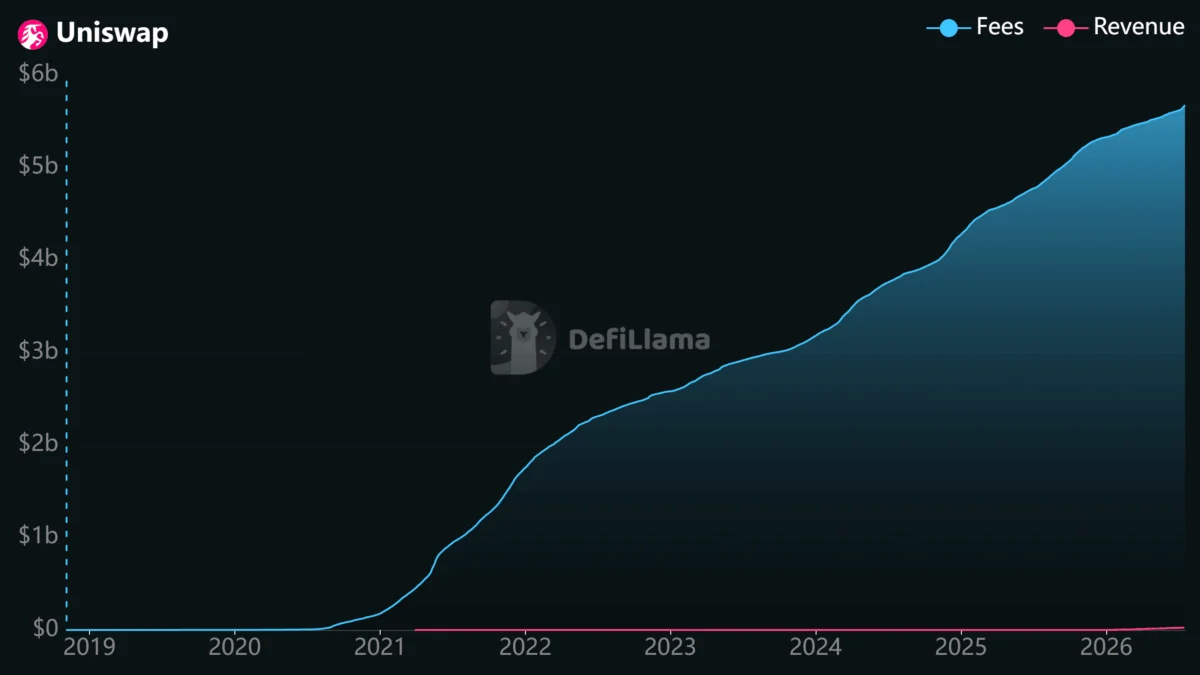
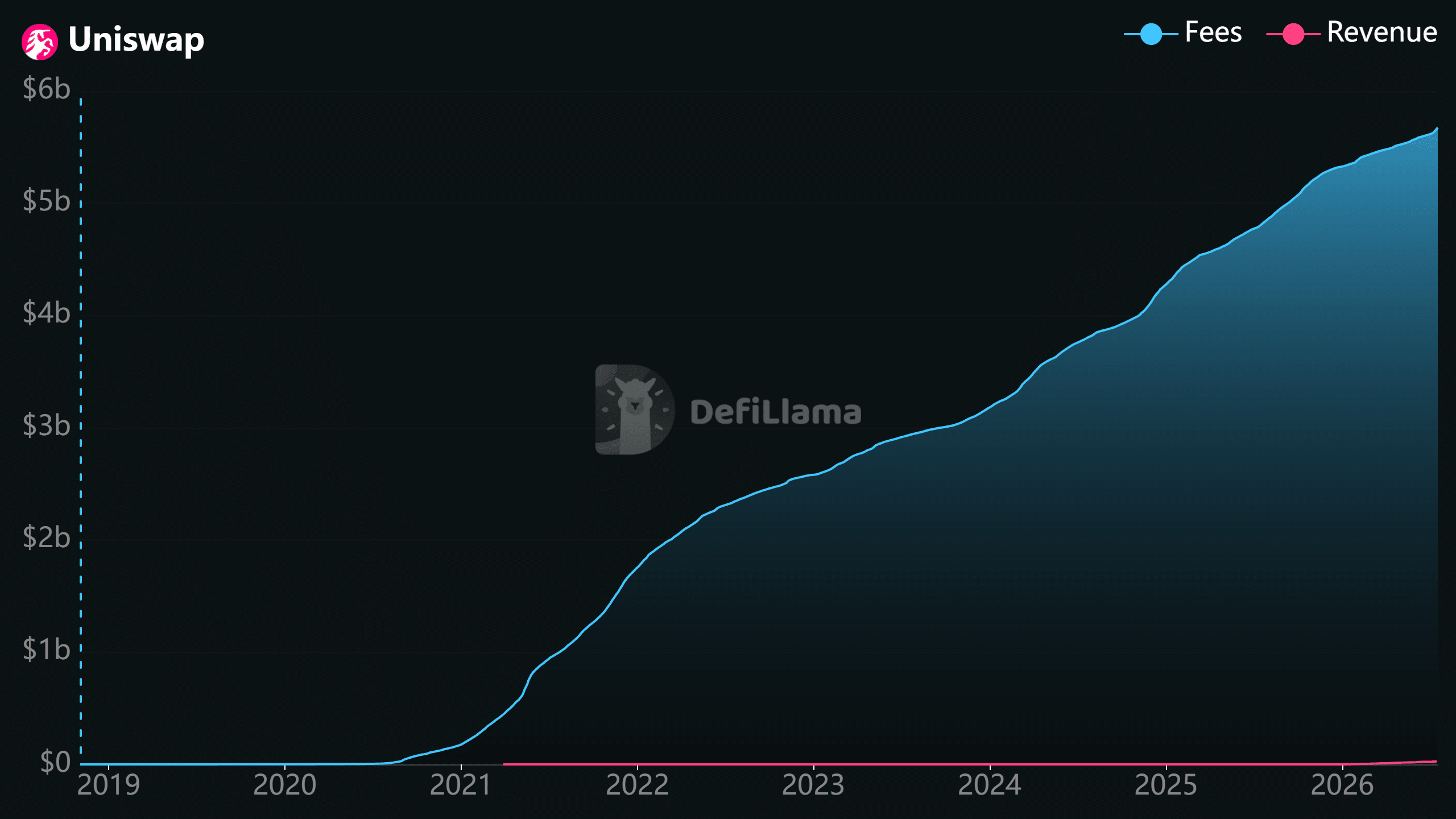
On Uniswap’s Ecosystem: The successful implementation of these proposals would fundamentally alter the relationship between the protocol and its liquidity providers. While the proposals aim to enhance protocol value, careful calibration will be essential to ensure that LP incentives remain attractive enough to maintain deep liquidity. If LPs perceive the reduction in their fees as too significant, they might migrate their capital to competing DEXes that offer better returns, potentially eroding Uniswap’s market share. The challenge for Uniswap governance will be to find a "sweet spot" where protocol fees generate substantial revenue for UNI burn without unduly punishing LPs or hindering V4’s adoption and competitiveness. The impressive $5 billion in cumulative fees earned by LPs since 2018, compared to a mere $25 million in cumulative protocol revenue, clearly illustrates the current imbalance and the massive potential upside for the protocol.
The rapid success of Uniswap on the new Robinhood chain, exceeding $1 billion in volume within days, is a critical factor. This new L2 represents a fresh growth avenue, and if fee activation can capture a portion of this burgeoning activity, it could provide a strong initial boost to protocol revenue and UNI burn, proving the viability of the fee switch.
On the Broader DeFi Landscape: Uniswap’s decision to activate protocol fees could set a significant precedent for other decentralized protocols. As the DeFi space matures, many projects are exploring sustainable revenue models and value accrual mechanisms for their native tokens. A successful implementation by Uniswap, a market leader, could encourage other DEXes and DeFi protocols to follow suit, leading to a broader trend of "value capture" for protocol treasuries and token holders. This could intensify the debate around decentralization, protocol ownership, and the optimal balance between providing free public goods (liquidity) and generating revenue for the protocol’s long-term health and token holders.
Market Performance of UNI Token
The anticipation surrounding Uniswap’s strategic moves has already had a tangible impact on the market performance of its native token, UNI. In July, the UNI price experienced a notable rally, surging by 41% from approximately $2.7 to $3.8. This bullish momentum was largely front-run by traders speculating on the positive implications of the Robinhood Layer 2 integration and the impending fee proposals. The rapid adoption and volume growth on the Robinhood chain fueled optimism about Uniswap’s future revenue potential.
However, the initial bullish strength appears to have somewhat eased, with the UNI price encountering resistance near the 200-day Moving Average (a key technical indicator often signaling long-term trend direction). This suggests that while the market reacted positively to the initial news, further significant price appreciation may require more concrete developments. In the short term, the price could consolidate sideways above the $3.5 mark, or potentially retreat towards $3 if the Robinhood momentum stabilizes and does not translate into immediate, substantial protocol revenue.
Looking ahead, the next significant upward movement for UNI could be triggered by renewed and sustained momentum from the Robinhood chain, demonstrating continued strong trading volumes. Crucially, the successful passage and implementation of the fee proposals, leading to a projected increase in the UNI burn rate, would provide a fundamental catalyst. If these proposals translate into tangible, "substantial" UNI burns as projected by Hayden Adams, it would reinforce the token’s deflationary narrative and potentially drive further investor confidence and price appreciation.
Conclusion
Uniswap’s submission of governance proposals to activate protocol fees marks a watershed moment for the leading decentralized exchange. This strategic pivot, aimed at directing a portion of trading fees into the UNI burn mechanism, is a clear signal of the protocol’s intent to enhance value accrual for its token holders and establish a more robust, sustainable revenue model. While met with mixed reactions, particularly from liquidity providers concerned about reduced incentives, the proposals reflect a growing trend within DeFi towards self-sustainability and token utility. The success of these initiatives, especially on high-growth platforms like the new Robinhood chain, will not only dictate the future trajectory of the UNI token and its ecosystem but also set a significant precedent for the broader decentralized finance industry as it grapples with the intricate balance between innovation, liquidity provision, and value capture. The coming weeks will be critical as the Uniswap community engages in governance discussions that could redefine the economics of decentralized trading.