A recent and comprehensive report by Dune analytics has cast a critical spotlight on a persistent challenge within the decentralized finance (DeFi) ecosystem: a significant portion of the liquidity contributed by users to decentralized exchanges (DEXs) is not being effectively utilized to facilitate trades, leading to substantial capital inefficiency and lost earnings for liquidity providers (LPs). The findings, covering the first half of 2026, paint a concerning picture of capital deployment across some of the most prominent DEX platforms.
The advent of concentrated liquidity mechanisms was heralded as a revolutionary step forward for decentralized exchanges. Introduced most notably by Uniswap v3, the concept aimed to dramatically increase the capital efficiency of DEXs. Unlike earlier automated market maker (AMM) models where liquidity was distributed uniformly across all possible price ranges, concentrated liquidity allowed LPs to allocate their funds within specific, narrower price ranges where they anticipated the majority of trading activity would occur. The promise was clear: LPs could earn more fees with less capital, and traders would benefit from deeper liquidity around current market prices, resulting in reduced slippage. This innovation was designed to overcome the capital-intensive nature of earlier AMM designs, making DEXs more competitive with traditional centralized exchanges.
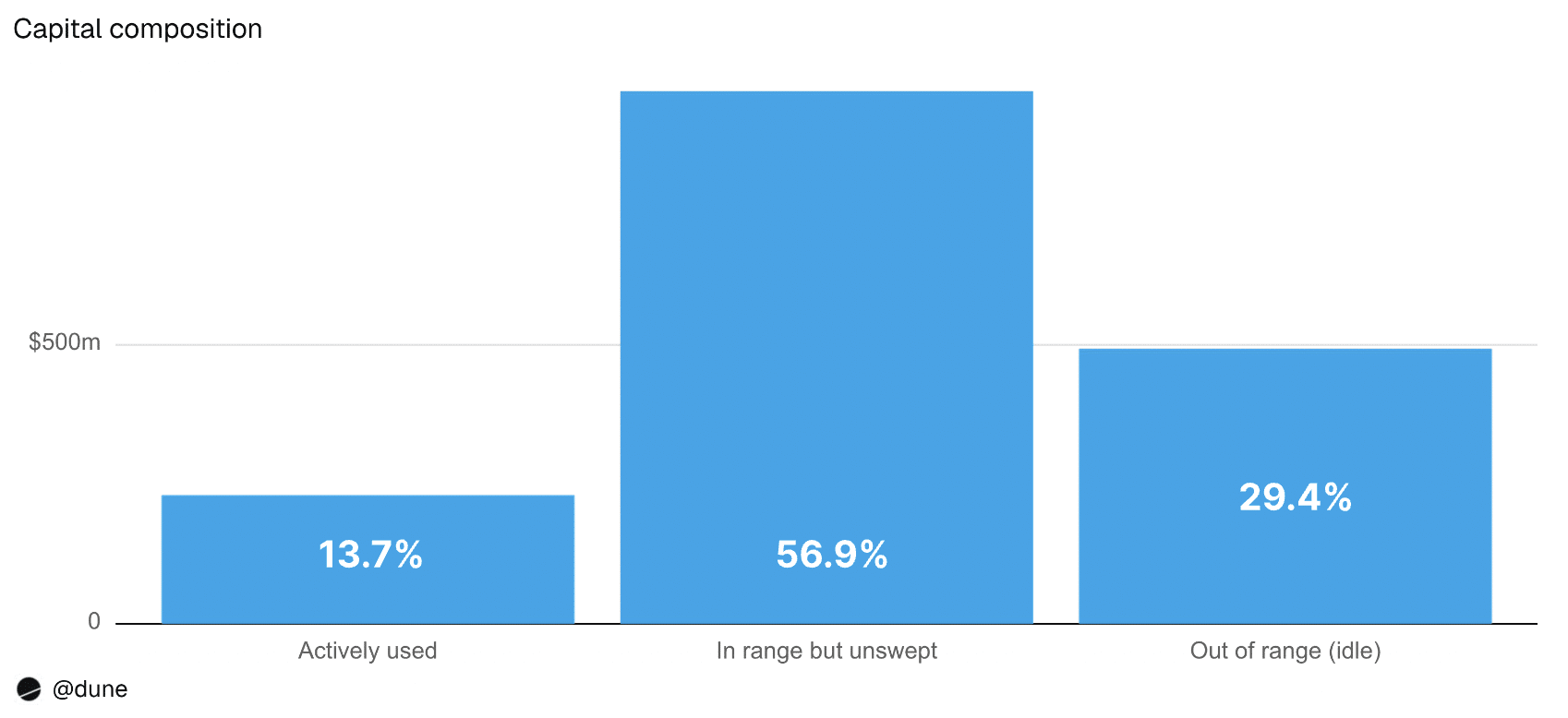
However, Dune’s recent study reveals a stark discrepancy between this promise and the current reality. During the first six months of 2026, the report discovered that an average of 29.4% of all concentrated liquidity deployed across the analyzed protocols resided outside the range of active trading. Critically, this "out-of-range" liquidity generates no trading fees for the LPs who provided it, effectively becoming dormant capital that still carries the risks inherent in providing liquidity without the corresponding rewards.
The Staggering Cost of Idle Capital

The financial implications of this inefficiency are considerable. The report estimates that this substantial proportion of idle capital translated to approximately $542 million in underutilized assets per week. Extrapolating this weekly figure, the annual cost in lost fee income for liquidity providers across the four protocols examined — Uniswap v3, Uniswap v4, PancakeSwap v3, and Aerodrome Slipstream — is an estimated $150 million. These figures underscore not just a technical inefficiency but a tangible economic drain on the LPs who are the lifeblood of these decentralized markets.
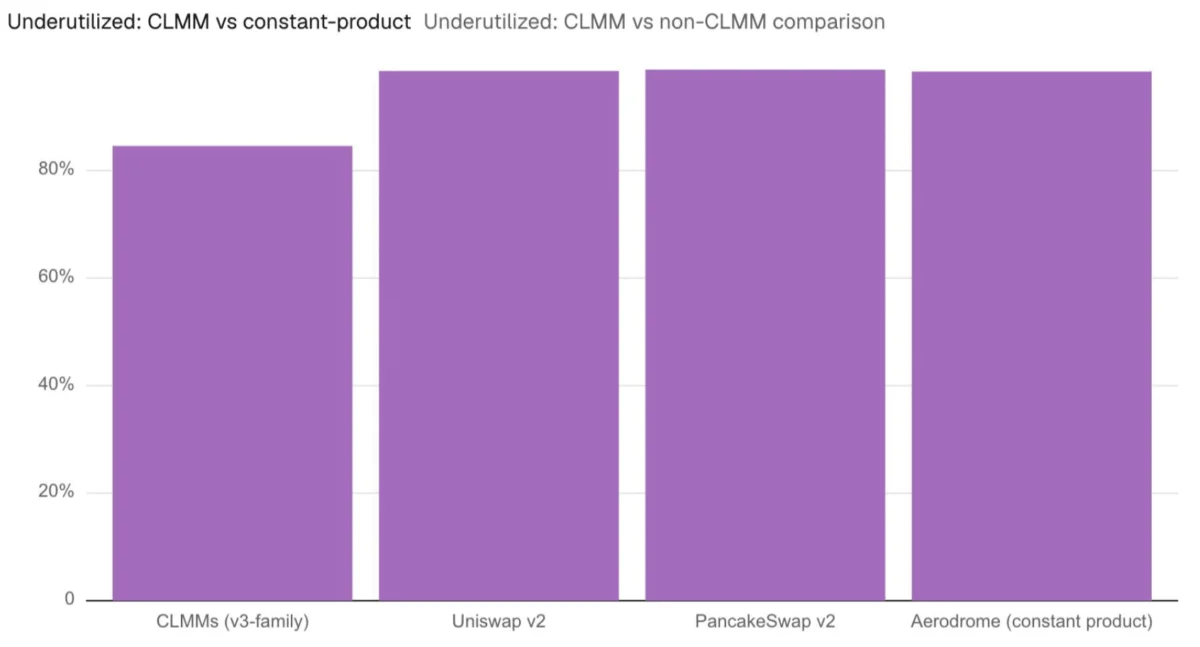
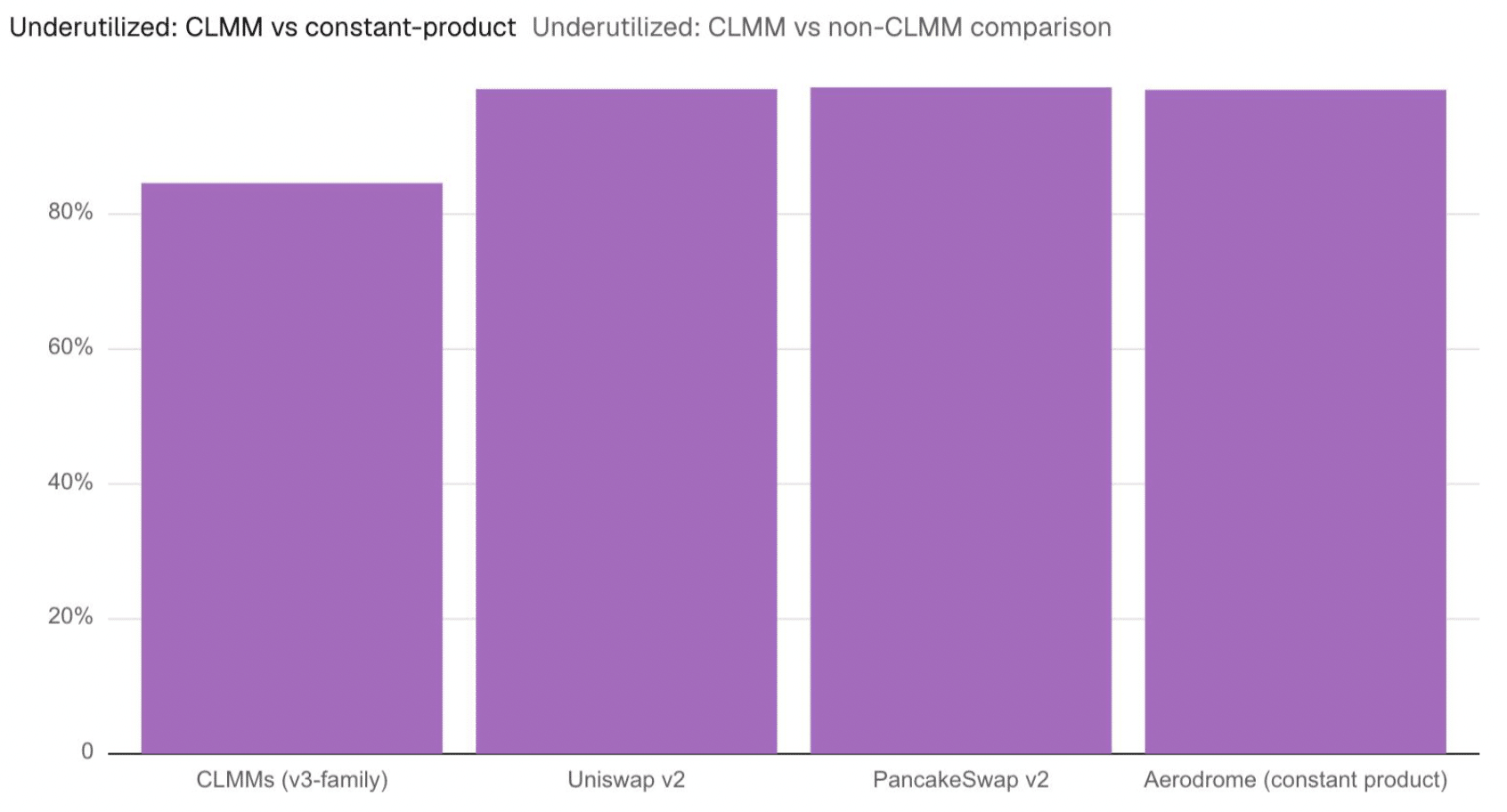
Furthermore, the issue extends beyond merely "out-of-range" positions. When considering technically available liquidity that was never used for trades, the report found that a staggering 85% of capital remained underutilized. This broader metric highlights a deeper problem of liquidity deployment strategies, suggesting that even within the intended active ranges, a significant chunk of capital is over-provisioned or poorly managed.
The protocols included in the study represent a substantial portion of the DEX landscape. Uniswap, particularly its v3 iteration, has been a trailblazer in concentrated liquidity, and its subsequent v4 iteration aims to build on this. PancakeSwap v3 brought concentrated liquidity to the BNB Chain, while Aerodrome Slipstream is a key player in the Base ecosystem. The fact that this inefficiency is prevalent across such diverse and widely adopted platforms indicates a systemic challenge rather than an isolated incident.
The Dynamics of Liquidity Provision and LP Management Challenges
Concentrated liquidity provision, while offering the potential for higher capital efficiency, introduces a new layer of complexity for LPs. Unlike simpler AMM models where "set it and forget it" strategies were more viable, concentrated liquidity requires active management. LPs must constantly monitor market price movements relative to their chosen price ranges. If the market price moves outside an LP’s defined range, their liquidity ceases to earn fees and effectively becomes a single-asset position, fully exposed to the price volatility of that asset without the benefit of earning trading fees. To resume earning fees and mitigate potential impermanent loss, LPs must "reposition" their liquidity by adjusting their price ranges, which typically incurs gas fees.
The Dune report provides compelling evidence that many LPs are struggling with this active management requirement. It highlights that more than $200 million in idle liquidity had not been repositioned in over 90 days. This prolonged inactivity strongly suggests that a significant number of LPs are either unaware of the need for active management, lack the tools or time to do so, or are deterred by the associated transaction costs. This passive approach directly contradicts the core premise of concentrated liquidity, which is to maximize capital utility through strategic, dynamic deployment. The difficulty in maintaining positions in line with dynamic market prices is a major hurdle, preventing LPs from realizing the full benefits of this innovative liquidity model.
Individual Investors Bear the Brunt of Inefficiency
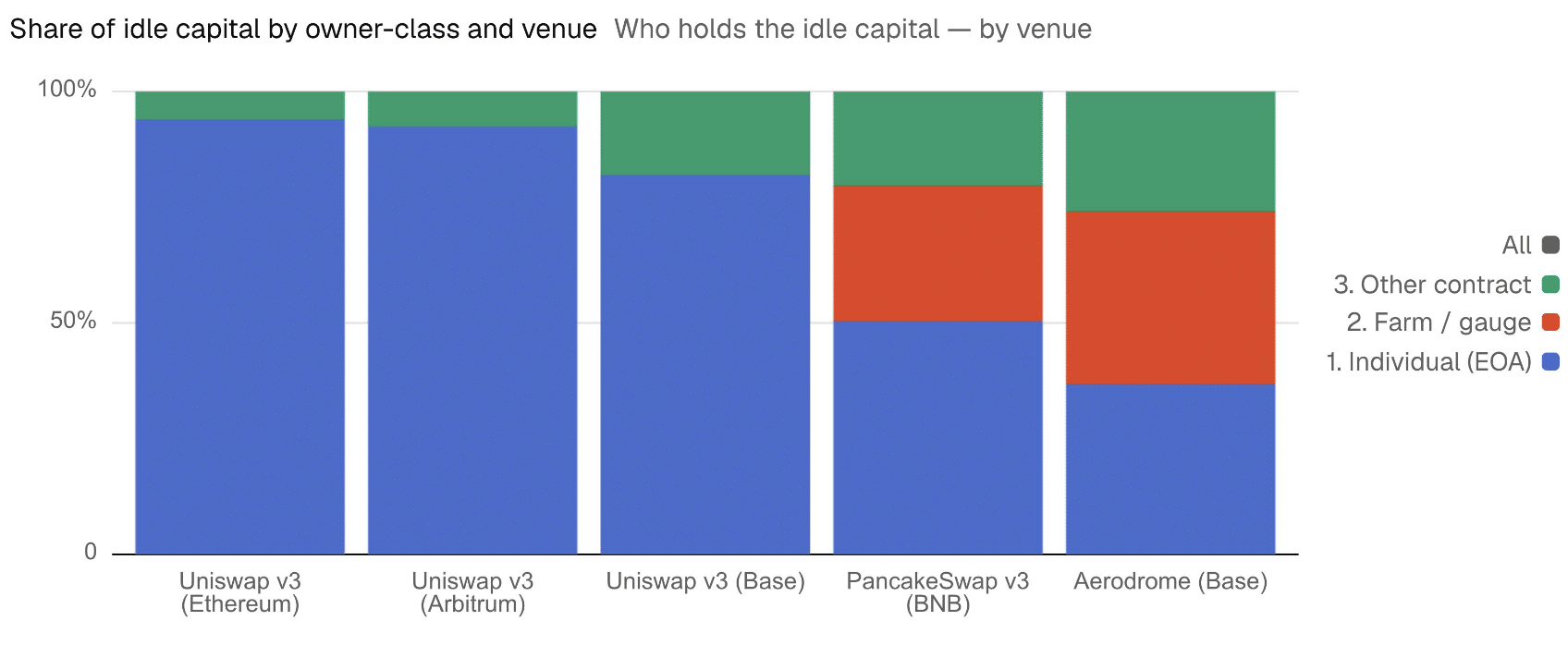
A particularly striking finding of the study is the pronounced disparity in capital efficiency between individual investors and automated liquidity managers. The report unequivocally discovered that the vast majority of idle liquidity is held by individual investors, typically managing their funds through standard cryptocurrency wallets, while automated managers consistently maintained higher capital activity and efficiency.
On the Ethereum blockchain, for instance, individual wallets were responsible for a staggering 94% of the idle capital and controlled 91% of the Uniswap v3 liquidity. A similar trend was observed on Arbitrum, where individual users oversaw 92% of idle liquidity and 78% of the total liquidity. Even on Base, where smart contracts held approximately 50% of the overall liquidity, individual users were still responsible for 82% of the idle capital.
This contrasts sharply with the performance of automated managers – entities that deploy sophisticated algorithms, bots, or specialized protocols to actively manage concentrated liquidity positions. These professional or semi-professional managers demonstrated remarkable efficiency, with only about 6.5% of their positions falling out of the active trading range. This figure is significantly lower than the approximately 30% observed for individual wallets.
The implications of this disparity are profound. It suggests that while concentrated liquidity aims to democratize access to sophisticated financial strategies, its complexity inherently favors those with the resources, technical expertise, and infrastructure to implement automated management solutions. Individual LPs, often engaging in manual rebalancing or simply leaving their positions untouched, are effectively being outmaneuvered. This raises questions about the long-term accessibility and profitability of liquidity provision for retail participants in DeFi, potentially leading to a greater concentration of profits and control among a smaller group of sophisticated players or institutions. The barrier to entry for effective concentrated liquidity management is not just capital, but also expertise and technological capability.
Uniswap v4: A Promise Yet Unfulfilled for Idle Capital
The report also scrutinized the performance of Uniswap v4, the latest iteration of the leading decentralized exchange, which was designed with a modular architecture featuring "hooks." These hooks were introduced as a highly anticipated feature, enabling developers to implement custom logic that could potentially allow for innovative strategies, including utilizing idle capital in external yield-generating protocols. The hope was that v4 would inherently address some of the capital inefficiency issues seen in v3 by offering LPs more options for their out-of-range liquidity.
However, Dune’s study indicates that Uniswap v4, at least in its current state, has not yet resolved the idle liquidity problem. Mirroring the performance of its predecessor, approximately 30.5% of Uniswap v4’s liquidity remains out of the active trading range. More critically, despite the promise of hooks, only about 10% of v4’s Total Value Locked (TVL) currently utilizes these custom logic modules. Furthermore, the report found that none of the existing hook implementations are actively generating yield from idle liquidity.
This finding suggests that while the technological framework for greater efficiency exists within Uniswap v4, its potential has not yet been realized. This could be due to several factors: the relative newness of the v4 deployment, the complexity involved in developing and deploying effective hooks, or a lack of widespread adoption and integration of these yield-generating strategies. The implication is that even cutting-edge DEX technology requires significant time, development, and user education to deliver on its promises of enhanced capital efficiency.
Broader Implications for the DeFi Ecosystem
The widespread underutilization of liquidity has significant ramifications for the entire decentralized finance ecosystem.
- Undermining Capital Efficiency Narrative: Capital efficiency is a cornerstone of DeFi’s appeal, promising to do more with less capital compared to traditional finance. The findings from Dune directly challenge this narrative, revealing that a substantial amount of capital is locked up in an unproductive state. This inefficiency can lead to higher trading costs for users due to thinner effective liquidity and lower returns for LPs.
- LP Profitability and Participation: If a significant portion of LPs’ capital is not earning fees, their overall profitability decreases. This reduced profitability could deter new LPs from entering the market or encourage existing LPs to withdraw their funds, potentially leading to a reduction in overall liquidity across DEXs. This creates a negative feedback loop, where lower liquidity leads to worse trading conditions, further discouraging participation.
- Market Structure and Centralization Concerns: The stark contrast between individual and automated managers highlights a growing sophistication gap. As automated strategies become more prevalent and effective, they could centralize the effective control of liquidity provision among a smaller group of technically advanced players. While decentralization of governance remains a core principle, the operational aspects of liquidity provision might inadvertently become more centralized in terms of expertise and profitability.
- Innovation Imperative: The report serves as a clear call to action for the DeFi community. It underscores the urgent need for more intuitive tools, automated rebalancing solutions, and advanced liquidity management protocols that can bridge the gap for individual LPs. Future DEX designs and protocol upgrades must prioritize not just the potential for efficiency but also its realized outcome for a diverse range of participants.
- Risk Management: Idle capital, while not earning fees, is still exposed to market risks, including impermanent loss. LPs with out-of-range positions are essentially holding single assets that can devalue, without the offsetting benefit of earning trading fees. This exacerbates the risk profile for passive LPs.
Moving Forward: Solutions and the Future of Liquidity
Addressing the persistent challenge of idle liquidity will require a multi-faceted approach from the DeFi community.
- Automated Liquidity Management (ALM) Protocols: The success of automated managers points to the potential of specialized protocols that offer automated rebalancing and optimization strategies. These platforms can abstract away the complexity of active management for individual LPs, allowing them to deposit funds into strategies managed by algorithms that dynamically adjust price ranges based on market conditions.
- Enhanced User Interfaces and Education: DEX interfaces could be improved to provide LPs with clearer insights into their liquidity positions, potential impermanent loss, and the benefits of rebalancing. Comprehensive educational resources are also crucial to empower individual LPs with the knowledge needed for effective management.
- Innovative Protocol Design: Future iterations of DEXs and liquidity pools could explore new mechanisms that inherently reduce the burden of active management or automatically reallocate idle capital. The hooks in Uniswap v4 represent a step in this direction, but their full potential for yield generation from out-of-range liquidity needs to be realized through active development and adoption.
- Dynamic Fee Structures: Some protocols are exploring dynamic fee structures that incentivize LPs to keep their liquidity within active ranges or penalize prolonged inactivity, though such mechanisms must be carefully designed to avoid unintended consequences.
The Dune report serves as a vital reality check for the DeFi space. While concentrated liquidity has undeniably pushed the boundaries of capital efficiency, its real-world implementation reveals significant challenges, particularly for individual investors. The path forward involves not only continued technological innovation but also a renewed focus on user experience, education, and the development of robust tools that can truly unlock the full potential of decentralized liquidity for all participants. The pursuit of genuine capital efficiency in DeFi remains an ongoing journey, with the industry now clearly tasked with finding solutions that address these half-a-billion-dollar inefficiencies.