The digital asset market has witnessed a notable divergence in recent trading sessions, with the Pi Network [PI] token demonstrating relative strength against the world’s leading cryptocurrency, Bitcoin [BTC]. Over the trailing 24-hour window, PI prices advanced by 2.5%, extending a broader weekly gain to 4.81%. This performance outpaced Bitcoin, which registered modest returns of 1.06% and 2.13% over the corresponding daily and weekly periods.
The upward movement in Pi Network’s valuation coincides with fundamental developments within its ecosystem. The core development team recently rolled out a suite of technical enhancements aimed at expanding the network’s application-level utility. These features, detailed in an official project update, introduce robust local storage support and direct programmatic access to app-specific staking data for developers building decentralized applications on the network.
Market analysts point to these ecosystem upgrades as a primary catalyst for the renewed buying interest. By equipping developers with advanced tools to streamline data management and track staking metrics, Pi Network is attempting to foster a more dynamic on-chain economy. This fundamental progress has translated directly into spot market activity, enabling the altcoin to breach a stubborn local consolidation range and capture the attention of short-term momentum traders.
Background Context and Ecosystem Evolution
To fully understand the current market dynamics surrounding Pi Network, it is necessary to examine the project’s unique trajectory within the broader cryptocurrency landscape. Launched with a vision of making digital currency mining accessible to everyday smartphone users, Pi Network spent years cultivating a massive global user base through its mobile application-based mining interface. However, the transition from a closed ecosystem to a robust, open-market utility token has presented both technical and structural challenges.
In previous quarters, the project faced scrutiny from market participants regarding the pace of its mainnet migration and the real-world utility of its applications. Addressing these concerns has become a central focus for the core team. The recent introduction of local storage capabilities and app-specific staking metrics represents a calculated step toward satisfying developer demands. In modern decentralized finance (DeFi) and application-centric networks, developer retention is tightly coupled with infrastructure quality. By providing granular data access and reliable storage solutions, Pi Network is positioning itself as a more competitive environment for decentralized application deployment.
This foundational push comes at a critical juncture for the token. Despite the recent positive price action, PI has spent a significant portion of its market lifecycle navigating a complex macroeconomic and sector-specific environment that has often favored high-cap assets like Bitcoin and Ethereum over emerging altcoins.
Chronology of the Recent Price Breakout

The recent technical shift in Pi Network’s market structure can be traced across a multi-week timeline defined by consolidation, volume accumulation, and eventual range expansion.
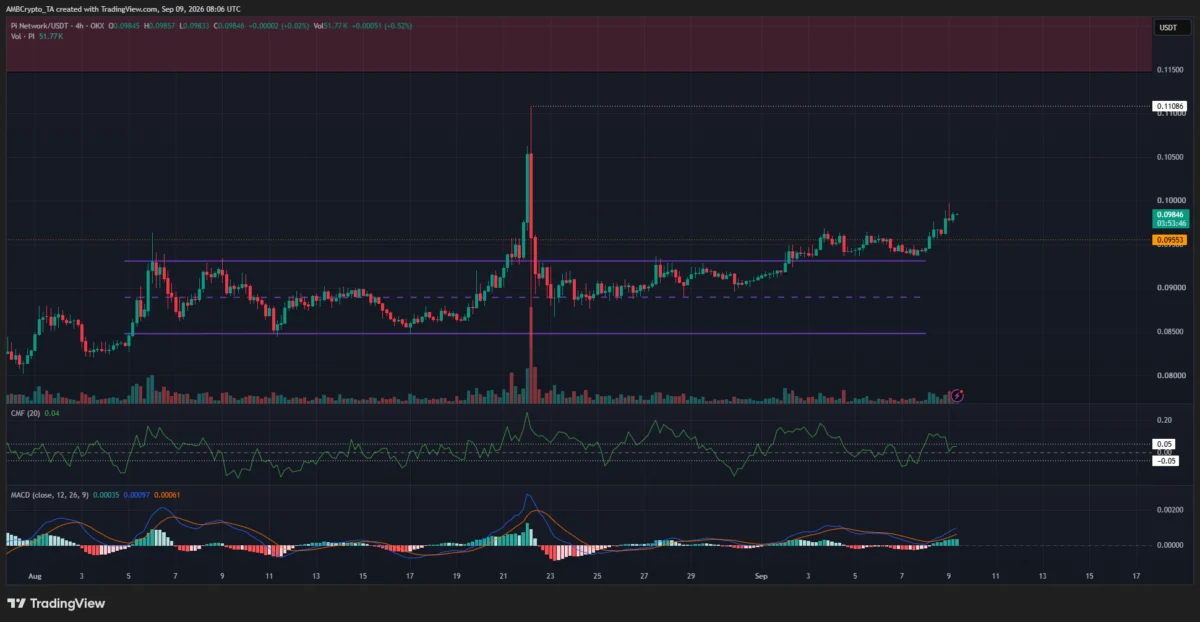
During the preceding month, PI price action was largely constrained within a horizontal range formation, fluctuating between $0.085 and $0.093. This prolonged consolidation phase frustrated momentum traders but served as a crucial accumulation zone where strong hands absorbed lingering sell pressure.
As the core team released updates regarding developer tools, market sentiment began to shift. Approximately a week prior to the current breakout, the token initiated a steady climb, outperforming the broader altcoin market and steadily eroding the upper boundaries of its established range.
Over the past 24 to 48 hours, buyers successfully mounted a decisive push above the $0.0955 local resistance zone. This move catalyzed a momentum surge, effectively transforming the former resistance band between $0.085 and $0.093 into a newly established structural support level. Consequently, the token has traded with renewed vigor, holding its gains even as broader market benchmarks experienced typical intraday volatility.
Technical Analysis and Market Indicators
A granular examination of the charts reveals a nuanced picture of Pi Network’s market health, characterized by short-term bullish momentum operating within the confines of a larger macro downtrend.
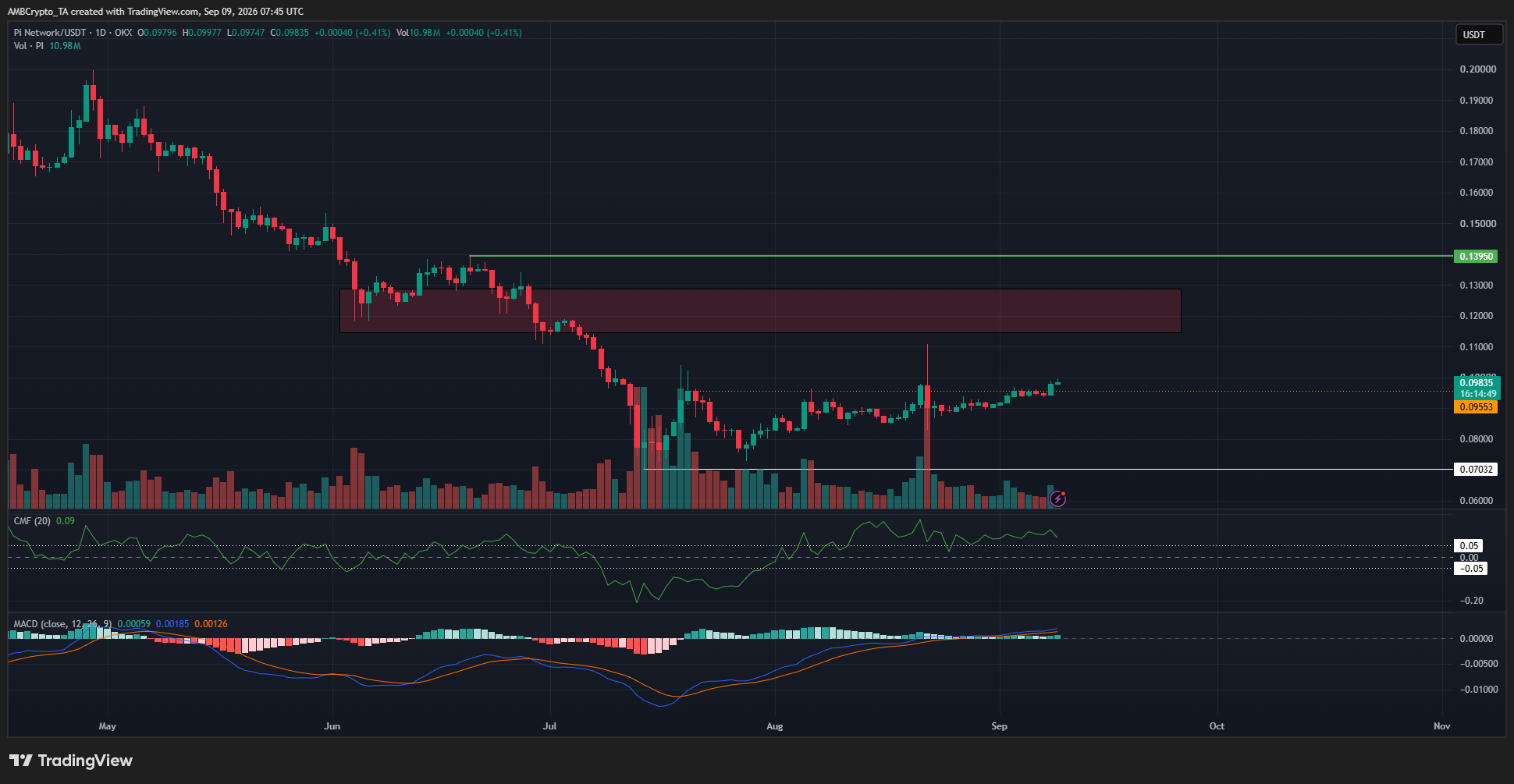
On the daily timeframe, key swing levels continue to dictate the broader structural boundaries. The relevant swing high for the macro bearish trend sits at $0.139, while the major swing low is established at $0.070. Although the token has broken local resistance, it remains subject to these wider parameters.
Nevertheless, intermediate technical indicators provide grounds for cautious optimism among market participants. The Chaikin Money Flow (CMF) indicator has remained comfortably above the +0.05 threshold for nearly a month. This sustained positive reading signifies a consistent, healthy influx of capital into the asset, disproving theories that the recent price spikes were merely short-lived, low-volume anomalies.
Additionally, the Moving Average Convergence Divergence (MACD) recently printed a bullish crossover above the zero line. In technical analysis, a zero-line MACD crossover typically signals a meaningful shift in momentum, validating the ongoing upward push.
Short-Term Hurdles and the "Glass Ceiling" Effect
Despite encouraging signals on the four-hour and daily charts, swing traders and long-term investors face several notable overhead obstacles. The short-term price action, while dynamic, is rapidly approaching heavy supply zones that could stall the current rally.
Immediate resistance is anticipated near the $0.11 local high. Beyond that lies a significant higher-timeframe supply zone spanning from $0.12 to $0.13. Furthermore, the psychological round-number resistance at $0.10 presents an immediate psychological barrier that bulls must definitively conquer and hold.
Shorter-term momentum indicators also hint at potential exhaustion. For instance, while the CMF has remained positive, recent readings suggest a minor tapering of buying pressure over the past few hours. This deceleration implies that the market may experience localized consolidation or a minor pullback as participants digest recent gains.
Fact-Based Analysis of Implications for Holders
The juxtaposition of improving developer metrics against a macro downtrend creates a complex risk-reward profile for holders of Pi Network.
From a fundamental standpoint, the integration of local storage and staking analytics directly addresses utility concerns. When developers build more sophisticated applications that leverage native staking mechanisms, the intrinsic demand for the underlying token typically strengthens over the long term. This organic utility provides a healthier foundation for price appreciation compared to speculative hype cycles.
However, from a technical perspective, prudent risk management remains paramount. Market analysts emphasize that the daily market structure remains technically bearish until proven otherwise. For a definitive, long-term trend reversal to occur, PI must orchestrate a decisive breakout past the major daily swing high at $0.1395.
Until that structural threshold is breached, cautious optimism is warranted. Swing traders operating within the current environment are advised to monitor key support zones—particularly the newly flipped $0.085–$0.093 range—while remaining cognizant of potential profit-taking activities as the token approaches the $0.12–$0.13 supply ceiling. As the network continues to roll out infrastructure updates, the interplay between developer adoption and spot market liquidity will ultimately dictate whether the current bullish momentum can mature into a sustained macro recovery.