As the April tax filing deadline approaches for U.S. taxpayers, a persistent shadow looms over the digital asset industry: the ambiguous and arguably punitive tax treatment of crypto staking rewards. Despite significant lobbying efforts and bipartisan congressional inquiries, the Internal Revenue Service (IRS) has yet to provide the clarity or regulatory relief demanded by industry participants. The current regime remains a point of friction, effectively forcing taxpayers into a double-taxation scenario that experts argue stifles innovation and hampers American competitiveness in the global blockchain economy.
The Mechanism of Double Taxation
The core of the issue lies in how the IRS classifies staking rewards—the assets earned by users who lock up their cryptocurrency to help validate transactions on Proof-of-Stake (PoS) networks. Under current guidance, these rewards are treated as ordinary income at the time they are received. This means the taxpayer must report the fair market value of the tokens as income based on the price at the moment they hit the digital wallet.
However, the tax burden does not end there. If the taxpayer later decides to sell, trade, or exchange those tokens, they are subject to capital gains tax on the difference between the sale price and the original cost basis (the value at the time of receipt). Critics of this framework argue that this "double-dip" approach is disconnected from the economic reality of staking, where assets are often locked for extended periods and are subject to extreme market volatility. By taxing rewards before they are even liquid or converted into fiat, the IRS imposes a financial obligation that may exceed the actual realized profit of the holder.

A Timeline of Legislative Frustration
The tension between Washington and the crypto sector is not new, but it has intensified over the past eighteen months.
- July 2025: Pro-crypto Senator Cynthia Lummis attempted to push a tax amendment as part of a broader legislative package, often referred to as the "Big Beautiful Bill." The amendment aimed to provide much-needed relief for miners and stakers, but the proposal failed to garner the necessary support to move forward.
- October 2025: The Senate Finance Committee held a series of high-level hearings. During these sessions, industry experts, including Coinbase’s Vice President of Tax, Lawrence Zlatkin, testified regarding the chilling effect of current tax policies. Zlatkin warned that the uncertainty is actively driving investors and service providers away from U.S.-based validators, favoring jurisdictions with more favorable regulatory environments.
- December 2025: A group of lawmakers, led by Representative Mike Carey, issued a formal letter to Treasury Secretary Scott Bessent and the acting Commissioner of the IRS. The correspondence characterized the existing staking tax regime as "burdensome" and "out of step" with the administrative priorities of the current executive branch.
- February 2026: As of early February, the IRS has remained silent regarding the December letter. This lack of responsiveness has solidified the "loophole" narrative—not because there is a benefit to be exploited, but because the lack of corrected guidance creates a permanent state of compliance uncertainty for investors.
The Economic Case Against Current Policy
The economic implications of this tax structure are significant. For institutional investors and retail participants alike, the primary concern is the complexity of reporting. Calculating the fair market value of thousands of micro-transactions, each occurring at different time stamps, presents a logistical nightmare for taxpayers.
Moreover, the argument for reform is rooted in national competitiveness. When U.S. validators are hindered by complex tax reporting requirements—or discouraged from participating entirely—the network security of PoS blockchains shifts toward overseas entities. Industry analysts suggest that if the United States aims to lead in the digital asset sector, it must treat staking rewards as a form of "production" rather than "income" at the point of receipt, perhaps deferring tax events until the assets are actually liquidated for fiat currency.
Legislative Hurdles: The CLARITY Act and Beyond
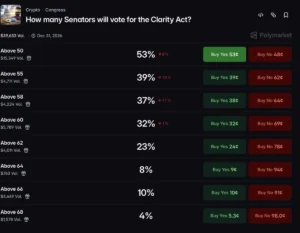
The hope for a statutory fix currently rests on the broader CLARITY Act, a legislative vehicle designed to establish a comprehensive market structure for digital assets. Within the debates surrounding this bill, lawmakers have discussed exemptions for small, day-to-day stablecoin transactions, which would allow for tax-free payments below a $200 threshold.

However, the integration of staking tax reform into the CLARITY Act remains tenuous. The legislative calendar is crowded, and the divide between those who view crypto as a financial instrument requiring strict oversight and those who view it as a technological infrastructure requiring supportive regulation remains wide. Without a clear directive from Congress, the IRS is unlikely to deviate from its current stance, leaving taxpayers to navigate an increasingly murky regulatory landscape as the 2026 filing season reaches its peak.
Implications for the 2026 Tax Season
For the average taxpayer, the current situation presents a high risk of "tax drift." Without specific guidance from the IRS addressing the nuances of staking, many are left to rely on interpretations provided by third-party accounting firms, which may vary wildly. This lack of uniformity increases the likelihood of audits and disputes.
Furthermore, the "loophole" mentioned by observers is essentially a vacuum. Because the IRS has not issued a formal ruling that aligns with modern blockchain technology, taxpayers are caught between the letter of the law and the technological reality of decentralized networks. If the IRS continues its silence, the judiciary may eventually become the arbiter of these disputes, as taxpayers begin to challenge assessments in tax courts.
Expert Perspectives on Regulatory Lag
Legal scholars and tax professionals note that the IRS’s delay is likely a result of the rapid evolution of the technology itself. Staking models have changed significantly in the last three years, moving from simple, locked staking to complex liquid staking derivatives and restaking protocols.

"The IRS is trying to apply 20th-century tax principles to a 21st-century decentralized network," says one policy analyst familiar with the Senate Finance Committee proceedings. "The regulatory lag is intentional; they are waiting for the market to reach a point of maturity where the tax implications become predictable. However, that delay is having the unintended consequence of pushing the entire industry toward more friendly, albeit less regulated, offshore jurisdictions."
Conclusion: The Path Forward
As the 2026 filing window narrows, the consensus among industry stakeholders is that immediate administrative relief is unlikely. While Senator Lummis’s dedicated bill remains in committee, and the broader CLARITY Act faces political headwinds, the burden remains on the individual taxpayer.
The lack of a clear, unified stance from the federal government suggests that taxpayers should maintain meticulous records of every staking transaction, including the exact time, the price of the asset at that time, and the subsequent sale price if liquidated. Until the IRS provides updated, modernized guidance, the ambiguity surrounding crypto staking will continue to serve as a significant barrier to the mainstream adoption of digital assets in the United States. Whether through a corrective ruling by the Treasury or a legislative mandate from Congress, the resolution of this issue is widely viewed as a prerequisite for the healthy maturation of the domestic digital asset economy.