As the November 3, 2026 midterm elections draw closer, prediction markets are signaling a significant shift in the political landscape of the United States. According to the latest odds on Polymarket, traders are increasingly favoring the Democratic Party to capture majorities in both chambers of Congress. This anticipated realignment carries substantial weight not only for traditional domestic governance but also for the future of digital-asset regulation, market structure oversight, and the legislative trajectory of landmark proposals like the CLARITY Act.
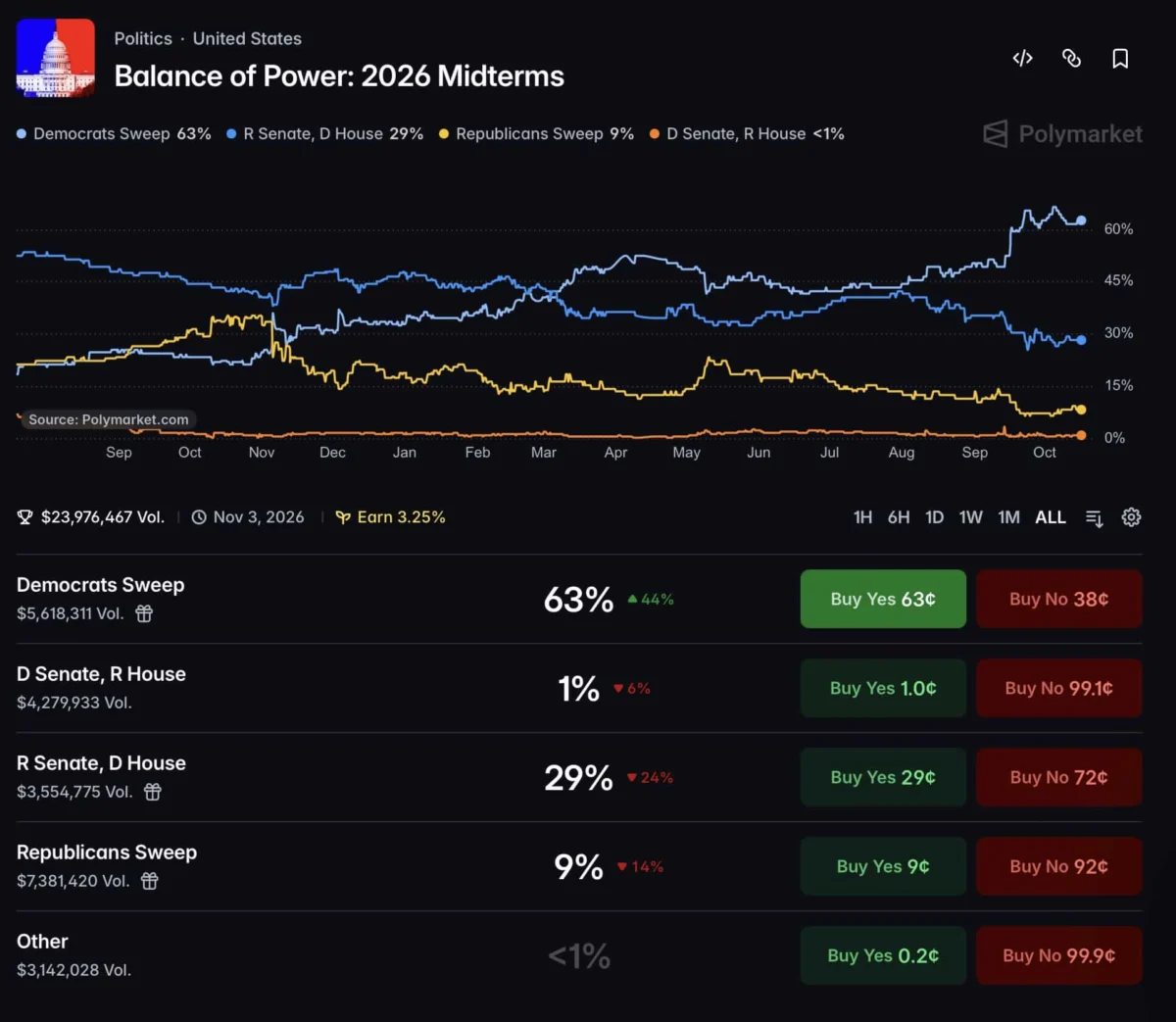
The current betting data highlights a robust expectation of a Democratic resurgence. Within Polymarket’s balance of power market—which has attracted roughly $24 million in total trading volume—a complete Democratic sweep of both the House of Representatives and the Senate is currently trading at 63%. Meanwhile, a split outcome featuring a Democratic House alongside a Republican Senate sits at 29%. Combined, these two metrics indicate a roughly 91% probability that Democrats will secure the 218 seats necessary to control the 435-member House, which is currently held by Republicans. Conversely, a complete Republican sweep is priced at a mere 9%, underscoring a dramatic re-evaluation of voter sentiment by market participants over the past year.
The Senate forecasting market, which has accumulated approximately $6.7 million in volume, tells a similarly compelling story of shifting momentum. Democrats are currently priced at a 65% chance to win the upper chamber, while Republicans trail at 38%. This dynamic represents a stark reversal from autumn 2025, when Republicans comfortably held a leading position with odds near 70%. The two parties’ trajectories crossed paths in March 2026, marking a turning point in trader confidence that has steadily solidified in favor of the Democrats as the midterms approach.

Chronology of the CLARITY Act and Legislative Gridlock
The potential transfer of power in the House introduces critical questions regarding the future of financial innovation and cryptocurrency policy in Washington. At the center of this legislative debate is the Digital Asset Market Clarity Act of 2025, officially designated as H.R. 3633. The bill, which seeks to establish comprehensive regulatory frameworks for digital-asset market structure and delineate the jurisdictional boundaries of the Securities and Exchange Commission (SEC) and the Commodity Futures Trading Commission (CFTC), has experienced a protracted and complex journey through Congress.
The chronology of H.R. 3633 highlights the challenges of passing specialized financial technology legislation in a polarized political environment:
- July 17, 2025: The House of Representatives successfully passes the CLARITY Act by a bipartisan vote of 294 to 134, demonstrating initial broad-based support for establishing clear regulatory definitions in the digital asset sector.
- Late 2025 to Early 2026: The legislation faces legislative hurdles and debates in the Senate, where differing priorities between banking and agricultural committees slow its progression.
- September 15, 2026: The legislative process hits a significant roadblock when a motion to reconsider the vote—by which cloture on a motion to proceed was not invoked—occurs on the Senate floor. Consequently, the bill stalls, leaving its path to enactment uncertain as the legislative calendar winds down.
Market observers and industry participants have closely monitored these legislative maneuvers. Despite setbacks in Congress, the broader digital asset market has demonstrated notable resilience. Amid macroeconomic headwinds, including persistent inflation data and shifting Federal Open Market Committee (FOMC) monetary policy meetings, major cryptocurrencies like Bitcoin have continued to hold strong valuations, defying pessimistic short-term sentiment often tied to legislative delays.
Policy Implications and Committee Leadership Dynamics
While prediction market odds reflect expectations of electoral outcomes, financial analysts and legal experts emphasize that market pricing does not guarantee the passage of specific bills. Nevertheless, a shift in congressional control would fundamentally alter the mechanisms of policy oversight.

If Democrats capture the House of Representatives, it would precipitate changes in committee chairmanships and investigative priorities. Committees such as the House Financial Services Committee and the House Agriculture Committee would likely see new leadership, altering how lawmakers approach digital-asset market structure, consumer protection, and the allocation of enforcement resources between federal regulators.
A Democratic-led House would not wield unilateral authority over federal policy—any legislation must still navigate the Senate and secure the signature of the president—but it would redefine the parameters of the legislative debate. Congressional scrutiny could pivot toward different compliance standards, investor safeguards, and decentralized finance (DeFi) oversight frameworks.
Broader Economic and Market Context
The convergence of midterm election speculation and cryptocurrency regulation underscores the growing intersection between digital finance and federal policymaking. As institutional participation in blockchain networks deepens, regulatory clarity has transformed from a niche topic into a mainstream economic issue influencing capital allocation and corporate strategy.
Although Polymarket data currently assigns a low 10% probability to a Republican retention of power, political analysts caution that prediction markets serve as real-time barometers of trader sentiment rather than infallible prophecies. Unexpected economic shocks, shifting geopolitical events, and late-breaking campaign developments can rapidly reprice electoral odds.

As the November 3, 2026 midterms approach, stakeholders across the traditional financial and digital asset sectors remain focused on the evolving political landscape. Whether the incoming Congress ultimately succeeds in passing comprehensive market structure legislation like the CLARITY Act will depend not only on which party controls the House and Senate, but also on the ability of lawmakers to forge bipartisan consensus on the future of financial technology oversight in the United States.