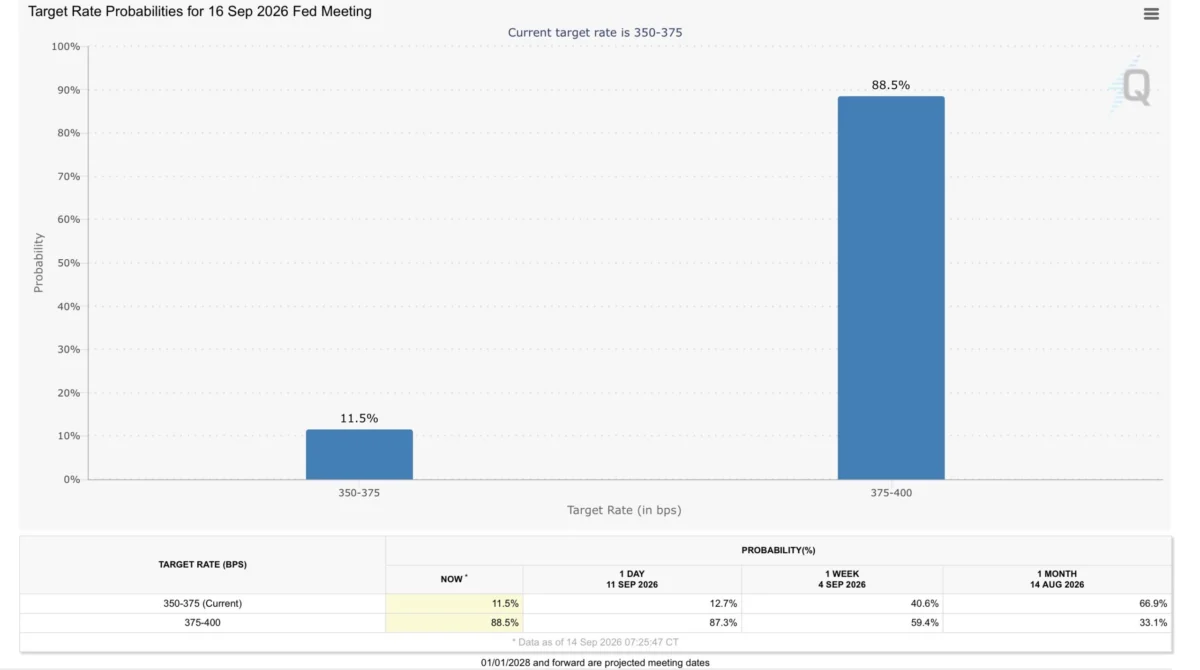
Prediction markets and institutional forecasting tools are registering a subtle recalibration regarding monetary policy expectations as the Federal Open Market Committee approaches its pivotal mid-September gathering. While a quarter-point interest rate hike remains firmly anchored as the market consensus, cross-venue probability metrics have retreated slightly from their aggressive post-Consumer Price Index peaks. This nuanced shift highlights an increasingly data-dependent financial landscape, where investors continuously parse incoming inflation prints, employment figures, and central bank commentary to anticipate the trajectory of the federal funds rate.
The Federal Reserve has maintained its benchmark target range at 3.50% to 3.75% throughout the entirety of 2026. A decision by the FOMC to implement a 25-basis-point increase would elevate this target to 3.75% to 4.00%, marking the central bank’s first official tightening maneuver since July 2023. As market participants prepare for the conclusion of the September 15–16 policy meeting—culminating in an official statement, a press conference by Fed Chair Kevin Warsh, and an updated Summary of Economic Projections complete with the latest dot plot—the financial ecosystem remains intensely focused on the broader macroeconomic implications.
Prediction Market Dynamics and Volume Expansion
Decentralized prediction platforms and specialized forecasting markets have evolved into prominent real-time sentiment gauges, frequently mirroring or leading traditional futures pricing models. In the wake of the August inflation data release on September 11, cross-venue probabilities for a 25-basis-point rate hike surged to a peak of approximately 81% within a 24-hour window. However, as the initial market reaction digested, these metrics experienced a modest cooling effect.
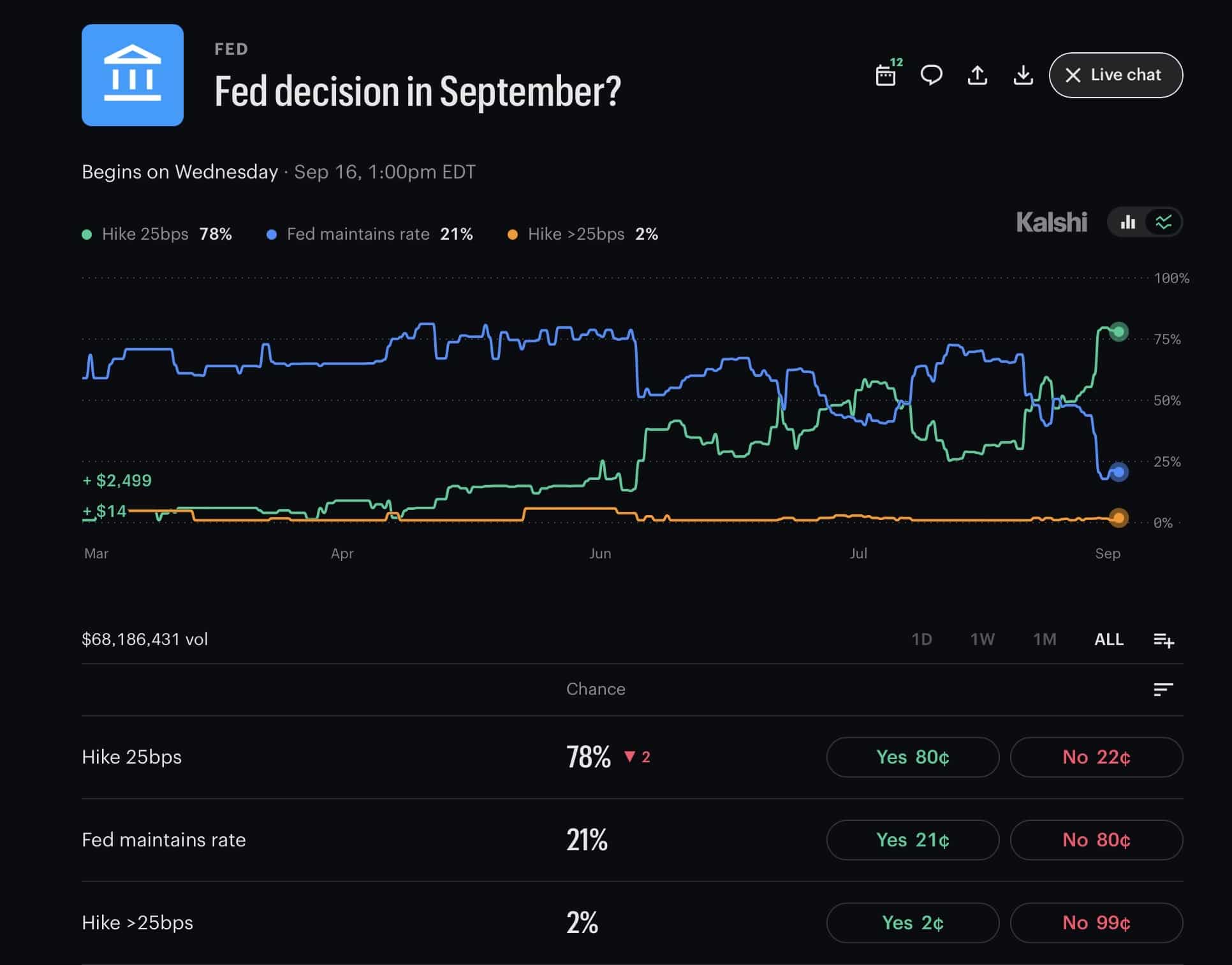
Data from Kalshi’s dedicated "Fed decision in September?" market illustrates this minor downward revision. As of September 14, contracts pricing a quarter-point hike stood at 78%, registering a 2-point decline over a 24-hour period. Concurrently, the probability assigned to the Federal Reserve maintaining its current rate structure was priced at 21%, while the likelihood of a more aggressive rate hike exceeding 25 basis points hovered at a negligible 2%.
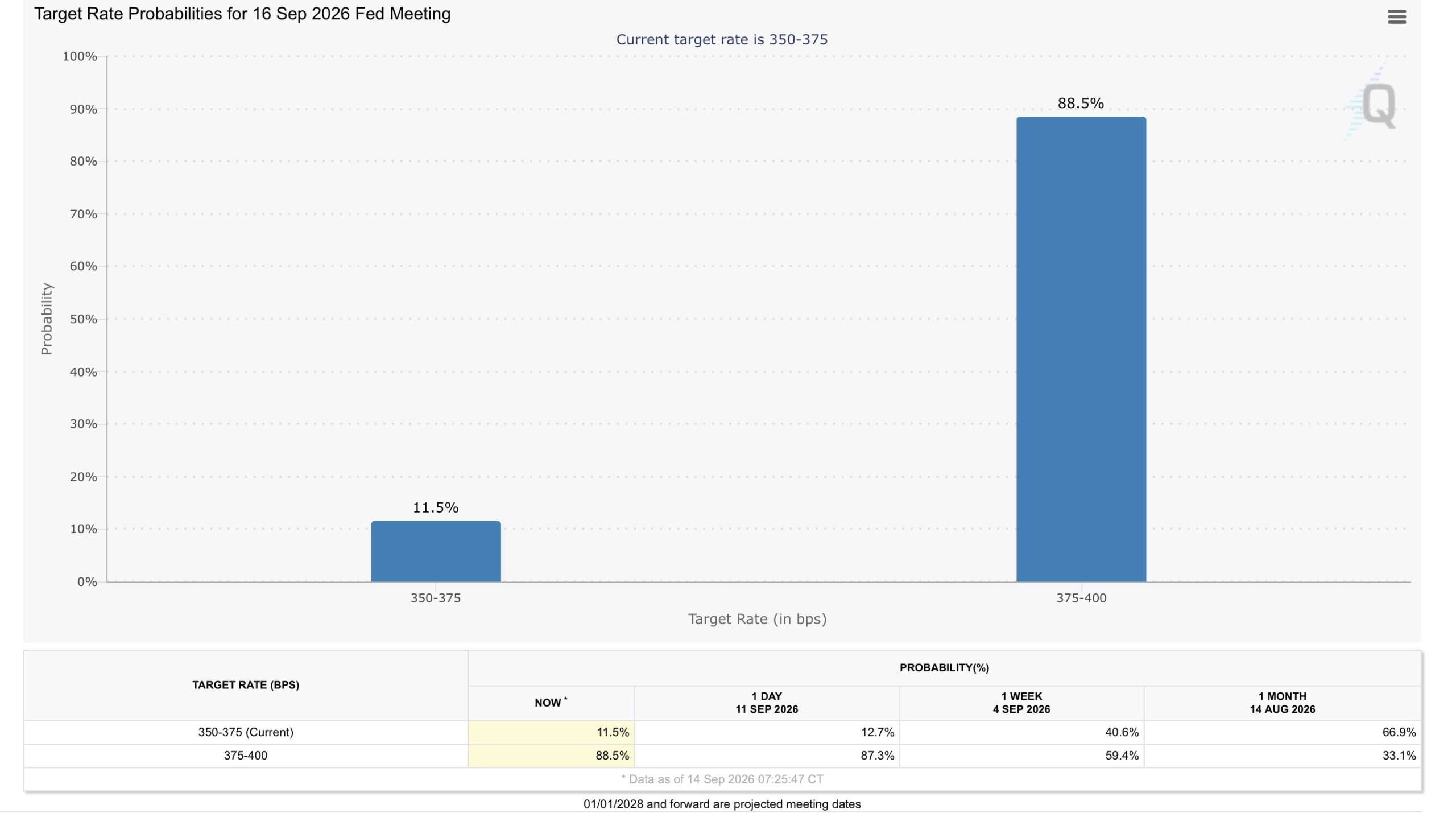
Despite the slight easing in percentage odds, cumulative trading volume across major prediction venues has expanded significantly. Polymarket’s global counterpart for the September Fed decision reported roughly $148.5 million in traded volume since its inception on May 13. Combined with Kalshi’s volume of approximately $68.2 million, total participation across the two primary prediction platforms surpassed $215 million, eclipsing the $192.6 million milestone recorded just days prior over the weekend. Meanwhile, traditional derivatives-based instruments, such as the CME FedWatch Tool, have consistently priced the meeting with slightly higher hawkish conviction, holding in the mid-80s following the inflation report.
The Chronology of a Live Meeting

The transformation of the September FOMC gathering from a widely expected policy pause into a live, highly contested rate-hike meeting unfolded over several weeks during the late summer of 2026. Reviewing the sequence of events underscores how quickly macroeconomic sentiment can pivot:
Mid-August 2026: Prediction markets assigned roughly a 1-in-4 probability to a September interest rate increase, as market participants largely anticipated prolonged monetary stability or subsequent easing cycles.
August 28, 2026: Federal Reserve Chair Kevin Warsh delivered a keynote address at the Jackson Hole economic symposium. Emphasizing the central bank’s unwavering commitment to its 2% Personal Consumption Expenditures (PCE) objective as a fixed target, Warsh highlighted that 12-month PCE stood at 3.7% while the six-month annualized rate registered at 4.1%. This hawkish framing transformed expectations within a single afternoon, shifting the upcoming September meeting into a financial coin toss.
Early September 2026: A robust U.S. employment report for August revealed nonfarm payroll additions of 162,000—substantially outpacing consensus expectations near 53,000—while July figures were revised upward from a negative print to a positive 21,000. This labor market resilience reinforced arguments for continued policy restraint.
September 10, 2026: The Producer Price Index (PPI) for August recorded a 0.4% monthly increase and a 5.4% annual rise, coming in a tenth of a point above consensus forecasts and further cementing inflationary pressures.
September 11, 2026: The Bureau of Labor Statistics published the August Consumer Price Index report, triggering the final surge in rate-hike probabilities across prediction markets and institutional forecasting tools alike.
Deconstructing the August Consumer Price Index Report
The macroeconomic foundation supporting the probability of a rate hike rests upon specific components within the August inflation data published by the Bureau of Labor Statistics. While headline metrics largely aligned with professional forecasts, underlying pressures within the report revealed persistent stickiness that challenged disinflationary narratives.
The Consumer Price Index rose 0.4% on a month-over-month basis in August, accelerating from a modest 0.1% increase in July. On an annual basis, the headline inflation rate held steady at 3.4%, matching the Dow Jones consensus estimate rather than resuming an upward trajectory.
The primary catalyst for surprise emerged within the core inflation metrics. Core CPI, which strips out volatile food and energy categories, advanced by 0.3% for the month, exceeding the 0.2% forecast. However, the annual core inflation rate eased to 2.4% from 2.5%, marking its lowest reading since March 2021 and aligning with overall expectations. Analysts noted that the hawkish interpretation of the report was driven entirely by monthly core acceleration and energy dynamics rather than a broad-based structural deterioration in annual price growth.
Energy sector volatility heavily influenced the headline figures. Gasoline prices surged 3.9% in August, reversing a 2.9% decline in July, and stood 27.4% higher compared to the same period in the previous year. According to the BLS, gasoline alone accounted for over a third of the total monthly increase across all items. The broader energy index climbed 2.1% month-over-month and 16.3% annually, with fuel oil registering a staggering 52% year-over-year increase.
Shelter costs, a persistent driver of inflation throughout the post-pandemic economic cycle, rose 0.3% following two consecutive months of 0.1% gains, though the annual shelter inflation rate continued a slow descent to 3.0% from 3.2%. Minor upward movements were also observed in food (up 0.1%), airline fares (up 2.7%), communication services (up 2.3%), education (up 0.8%), and used cars and trucks (up 0.4%). Conversely, certain commodities experienced deflationary pressures, with natural gas prices falling 1.1% and electricity dropping 0.2%.
Macroeconomic Analysis and Expert Perspectives
Economists and institutional strategists have offered varied interpretations of the data, with many concluding that the report tilts the balance of risks toward a more hawkish FOMC stance.
Kathy Bostjancic, chief economist at Nationwide, observed that the August inflation print failed to deliver the sustained disinflationary momentum that Chair Warsh had previously outlined as a prerequisite for maintaining current policy rates. Bostjancic specifically highlighted the risk that elevated petroleum, gasoline, and diesel prices could generate secondary spillover effects into broader goods and service sectors, ultimately unanchoring consumer inflation expectations. In response to these evolving risks, Nationwide adjusted its official economic forecast to project a quarter-point rate hike.
Because the official August Personal Consumption Expenditures (PCE) price index—the Federal Reserve’s preferred inflation gauge—will not be published until after the conclusion of the September policy meeting, the FOMC committee members will cast their votes without the benefit of that specific data point, elevating the significance of the CPI and PPI reports in their internal deliberations.
Broader Financial Implications and Cross-Asset Reactions
The prospect of tighter monetary policy and an upward adjustment in benchmark interest rates invariably generates ripple effects across diverse financial markets, ranging from sovereign debt to digital assets.
In traditional fixed-income markets, the immediate reaction to shifting rate expectations has been clearly documented in sovereign yield curves. Following Chair Warsh’s Jackson Hole address and the subsequent macroeconomic releases, the 2-year U.S. Treasury yield climbed to its highest level since late July, reflecting recalibrated expectations for short-term borrowing costs.
In contrast, the broader digital asset ecosystem—encompassing Bitcoin, Ethereum, decentralized finance (DeFi) borrowing protocols, and stablecoin yield structures—has navigated the macro repricing with less direct correlation in immediate price action. Historically, expectations of higher interest rates tend to strengthen the U.S. dollar and elevate short-term Treasury yields, conditions that can create headwinds for liquidity-sensitive asset classes. However, comprehensive market reporting following the August CPI release and subsequent prediction market fluctuations has not documented an immediate, outsized wave of liquidations or systemic volatility within major cryptocurrency derivatives markets, suggesting market participants are largely balancing macroeconomic uncertainty against crypto-specific supply and demand fundamentals.
As market participants await the official FOMC policy statement and the release of the updated Summary of Economic Projections, prediction markets will continue to serve as dynamic real-time instruments for sentiment analysis. While the probability of a September rate hike remains high, the ultimate policy path chosen by the Federal Reserve will depend heavily on the nuanced economic assessments delivered by leadership in the days ahead.