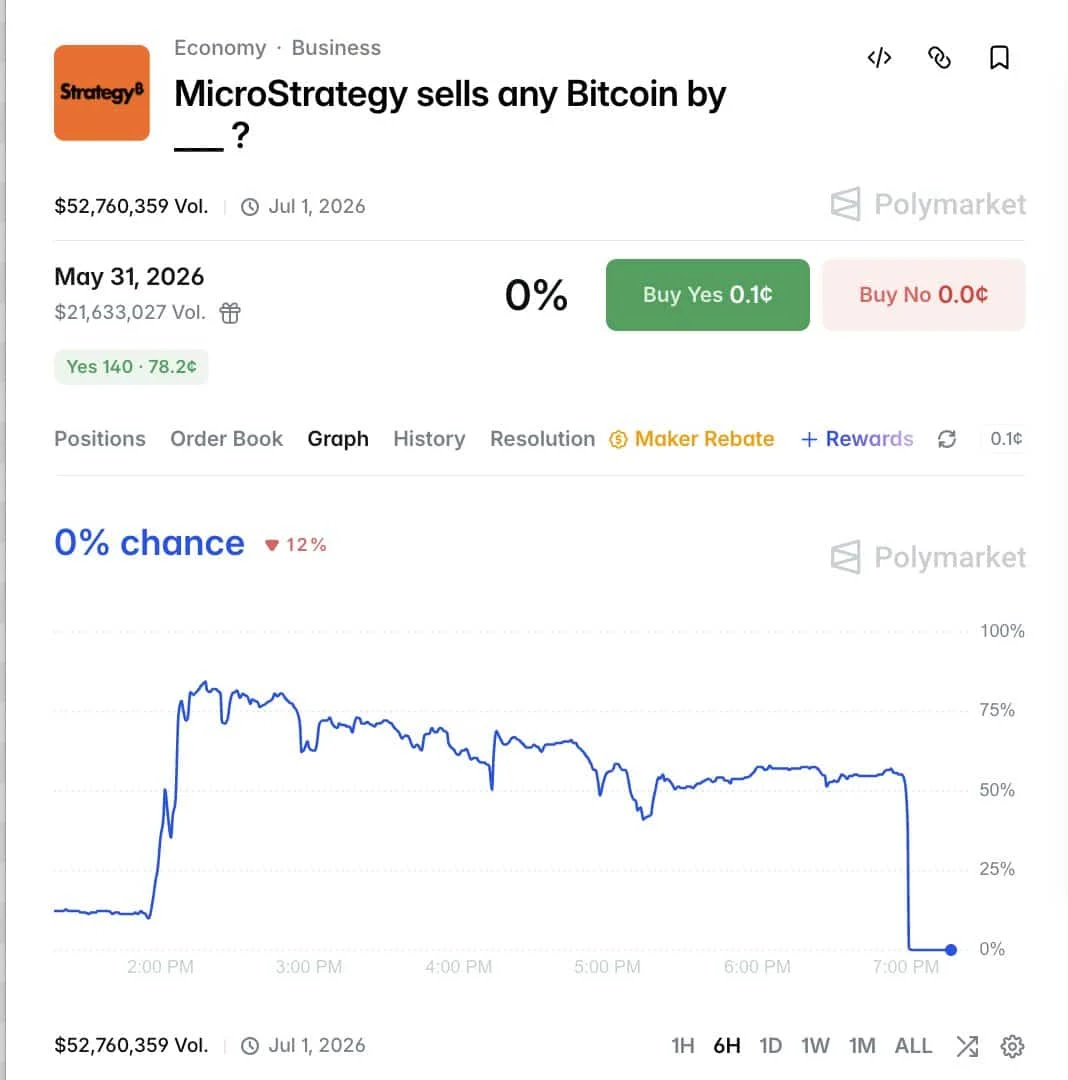
A high-stakes prediction market on Polymarket boasting over $80 million in total trading volume has officially entered its final dispute review phase following a controversial proposed resolution of “No.” The market in question hinged on whether Strategy, a prominent corporate holder of digital assets, would sell any portion of its Bitcoin treasury within a specific timeframe concluding on May 31. While corporate disclosures later confirmed that the firm did indeed execute a sale of 32 Bitcoin—valued at approximately $2.5 million—between May 26 and May 31, the timing of the public disclosure has triggered a massive governance showdown. Because the transaction was formally made public via a regulatory filing on June 1, Polymarket’s initial resolution mechanism ruled that the confirmation arrived outside the specified operational window.
The resulting clash has transformed into a critical test of decentralized oracle reliability, semantic precision in smart contracts, and user trust in prediction markets. With the final decision resting in the hands of UMA tokenholders, the outcome threatens to set a powerful precedent for how decentralized platforms handle the gray areas between real-world corporate actions and strict on-chain or time-bound parameters.
Chronology of the Event and the Disputed Window
Understanding the depth of the current controversy requires a close examination of the timeline surrounding Strategy’s asset management and the rules established by the Polymarket contract. The predictive market was structured around a straightforward premise: Would Strategy sell any of its Bitcoin holdings by midnight UTC on May 31?
For the vast majority of traders participating in the market, the metric of interest was the actual underlying economic event—the liquidation of digital assets by the corporate entity. Between May 26 and May 31, Strategy executed a transaction involving 32 Bitcoin, netting roughly $2.5 million. According to corporate documentation, this sale was directly tied to distributions associated with the company’s ongoing preferred stock program.
However, the transaction was not immediately broadcast to the public or captured by real-time blockchain tracking tools as an explicitly confirmed corporate treasury reduction before the May 31 deadline. Instead, Strategy officially disclosed the transaction in an SEC filing published on June 1—merely hours after the market’s temporal boundary had closed.
Polymarket’s initial interpretation of the rules centered on the lack of verifiable confirmation within the strict boundaries of the market’s lifetime. Because no public filing, official statement, or on-chain identifier definitively proved the sale prior to the expiration of May 31, the platform proposed resolving the market as “No.” To solidify this stance, platform moderators added a clarifying note specifying that any confirmations or disclosures emerging after the deadline would be deemed inadmissible for resolution purposes. This late-stage addition of clarifying criteria sparked immediate outrage across social media and platform discussion boards, setting the stage for an unprecedented escalation through the decentralized oracle infrastructure.

The Mechanics of the UMA Dispute System
Polymarket relies on the UMA optimistic oracle to handle market settlements. Under normal operating conditions, a proposed resolution is submitted to the oracle and stands unchallenged unless bonded market participants contest the outcome within a predefined challenge window. If a challenge is successfully raised and escalated, the responsibility shifts to UMA tokenholders, who participate in a token-weighted vote to determine the definitive truth according to the market’s resolution source and rules.
The current market concerning Strategy’s Bitcoin holdings has proven to be an anomaly within this architecture. This is at least the second time the market’s resolution has been formally challenged, pushing the system into a multi-tiered dispute sequence that UMA’s governance structure was rarely designed to handle repeatedly for a single liquidity pool.
Because multiple proposed resolutions were contested prior to this final review, the system has experienced significant strain. UMA tokenholders now face a hard deadline to issue a final ruling by 12:00 a.m. UTC on Wednesday. Failure to reach a decisive consensus by this timestamp risks clearing the order book and plunging the platform into logistical and financial uncertainty. Despite the intense debate over the semantic interpretation of the rules, order book pricing on Polymarket reflected approximately 99.9% odds attached to the “No” outcome in the final hours leading up to the vote, illustrating how capital adjusts to procedural momentum rather than the underlying philosophical arguments of the disputing traders.
Trader Reactions and the Debate Over “Truth” Versus “Technicalities”
The core friction point for the $80 million in capital locked within the market revolves around a philosophical divide: Should prediction markets reward those who bet on the literal physical and economic reality of an event, or should they strictly enforce formal, verifiable temporal parameters?
Traders holding “Yes” shares have voiced profound frustration, arguing that Polymarket effectively moved the goalposts by introducing clarifying criteria after the vast majority of the volume had already been traded under different assumptions. Critics of the “No” resolution point out that Strategy unquestionably sold Bitcoin within the specified date range, meaning the underlying economic event occurred as anticipated by those who backed the “Yes” side.
Social media sentiment has reflected a sharp erosion of confidence among certain segments of the user base. One prominent community comment captured the prevailing mood of dissatisfied participants, asserting that prediction platforms should “trade truth, not technicalities.” Others labeled the situation unbelievable, warning that resolving a market against the known physical reality of a corporate asset sale—simply because of a bureaucratic reporting delay—damages the credibility of decentralized forecasting tools.
Conversely, defenders of the platform’s approach argue that decentralized prediction markets must operate on strict, immutable rules to remain functional at scale. Without rigid definitions regarding what constitutes verifiable proof within a specific timeframe, oracle systems would be forced to engage in subjective interpretations of intent, opening the door to widespread manipulation, systemic bias, and endless litigation. In this view, the absence of public verification before the deadline makes a “No” resolution the only legally sound outcome under the literal text of the smart contract parameters.
Broader Implications for Polymarket and the Prediction Market Industry
The resolution of this high-volume dispute carries profound implications that stretch far beyond the immediate financial interests of the traders holding positions in the Strategy Bitcoin market. As prediction markets increasingly capture mainstream attention and process hundreds of millions of dollars in capital—particularly during political and macroeconomic cycles—the reliability and neutrality of their settlement layers become paramount.
First, the incident highlights the pressing need for greater precision in market formulation. Creators of high-volume prediction contracts must anticipate the nuances of corporate reporting delays, time zones, and the distinction between event execution and public disclosure. Ambiguities in contract wording inevitably shift the burden of decision-making onto optimistic oracles like UMA, which are fundamentally designed to process binary factual questions rather than adjudicate complex contractual disputes.
Second, the controversy tests the resilience and scalability of decentralized governance tokens as arbiters of truth. When millions of dollars hang in the balance, token-based voting systems can become vulnerable to strategic voting, voter apathy, or economic incentives that diverge from objective fairness. If UMA tokenholders uphold the “No” resolution, it will reinforce a strict, legalistic interpretation of prediction market rules across the industry. If they overturn it, it may establish a precedent that prioritizes material reality over strict technical deadlines, potentially complicating future dispute resolutions.
Ultimately, the resolution of the Strategy Bitcoin market dispute will serve as a foundational case study for the maturation of decentralized finance and prediction infrastructure. As the ecosystem continues to scale, platforms like Polymarket will need to refine their rule-writing standards and dispute mechanisms to ensure that user trust remains intact while preserving the mathematical and deterministic integrity required for decentralized applications to thrive.