The recent volatility in the cryptocurrency market has tested the resolve of many retail investors, yet for institutional giants, the pullback from recent highs has served as a strategic entry point rather than a cause for alarm. According to John D’Agostino, Head of Institutional Strategy at Coinbase, major market players—including sovereign wealth funds, family offices, and large government-backed investment entities—are demonstrating a profound shift in sentiment. Rather than liquidating positions following the decline from the $70,000 range to approximately $60,000, these institutions are actively seeking to expand their holdings, signaling a long-term conviction in Bitcoin as a core financial asset.
This divergence between retail panic and institutional accumulation highlights a maturing market infrastructure. While the price of Bitcoin fluctuated significantly last week—dipping toward $59,500 before recovering to stabilize around $63,000—the underlying commitment from the "smart money" sector has remained largely unshaken.
A Chronology of Recent Market Movement
The recent market correction did not occur in a vacuum. Bitcoin’s trajectory over the past month has been characterized by a push toward record highs followed by a sharp, rapid retracement. Earlier in the month, Bitcoin was trading comfortably above $70,000, fueled by optimism surrounding macroeconomic trends and continued institutional inflows.
However, mid-week trading saw a sudden shift. A confluence of factors—including a broader "risk-off" sentiment in global equities, concerns over rising interest rates, and a temporary cooling of enthusiasm regarding regulatory developments—triggered a cascade of sell orders. Within 48 hours, the asset shed nearly 15% of its value, bottoming out at roughly $59,500.
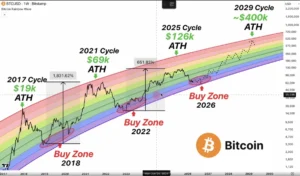
Despite this volatility, the rebound was equally swift. By the end of the week, the asset managed to reclaim the $63,000 support level. This recovery, according to analysts, was not merely a retail-driven bounce but was supported by significant buy-side pressure from entities that had previously purchased at the $100,000 and $125,000 price targets—levels that were widely projected by analysts earlier in the cycle. The fact that these institutions are increasing their exposure at a 40% discount from those targets suggests a long-term valuation model that remains robust despite short-term price fluctuations.

Institutional Strategy: The Shift from Speculation to Accumulation
John D’Agostino’s recent remarks during a CNBC interview underscore a critical transition in the digital asset landscape. Historically, institutional involvement in crypto was viewed as speculative and high-risk. Today, however, the narrative has shifted toward asset preservation and long-term allocation.
D’Agostino emphasized that he is unaware of any major institutional entities facing "dangerous levels of leverage" or the risk of imminent liquidation. This is a marked improvement from previous market cycles, such as the 2022 collapse, which were largely driven by over-leveraged entities and a lack of risk management. Today’s institutional holders are better capitalized, have more sophisticated hedging strategies, and view Bitcoin as a commodity with a fixed supply, similar to digital gold.
Notably, interest from Middle Eastern sovereign wealth funds has emerged as a key theme. These entities, which typically prioritize capital preservation and long-term growth, have reportedly begun viewing price corrections as prime opportunities to increase their allocations. This interest is not driven by the hope of a quick profit but by a strategic desire to hedge against currency devaluation and inflationary pressures in the global fiat economy.
ETF Exposure and Market Resilience
One of the most compelling metrics of this institutional resilience is the status of spot Bitcoin ETFs. Even with the sharp price decline, investors have maintained over $750 billion in exposure through these regulated vehicles. The steady performance of these ETFs, despite the volatility, suggests that institutional capital is "sticky."
Data indicates that while retail investors showed a slight tendency to trim positions during the $60,000 dip, institutional inflows remained relatively flat or positive. This suggests that the ETFs are acting as a stabilizing force, providing a regulated bridge for capital that would otherwise remain on the sidelines. The existence of these ETFs has also brought a new level of scrutiny and transparency to the market, which, according to D’Agostino, is exactly what institutional investors require before committing large tranches of capital.
Macroeconomic and Geopolitical Headwinds
While the focus remains on price, market participants must also contend with a complex geopolitical environment. CNBC host Joe Kernen pointed to several external pressures that are currently weighing on the market:

- Risk-Off Sentiment: Investors are moving toward cash and short-term government bonds as global economic uncertainty persists.
- Interest Rates: The ongoing battle against inflation by central banks continues to exert pressure on non-yielding assets.
- Geopolitical Tensions: Ongoing instability in the Middle East, particularly regarding the Strait of Hormuz, has introduced significant "risk premiums" into global markets.
D’Agostino acknowledged these concerns but maintained that they do not alter the fundamental investment thesis for Bitcoin. He argued that price volatility is a characteristic, not a bug, of an asset class that behaves like a commodity. As Bitcoin becomes increasingly integrated into the global financial system, it is subject to the same macro pressures as oil, gold, or silver. However, unlike traditional commodities, Bitcoin’s regulatory framework is actively improving. Enhanced infrastructure and clearer legal guidelines in major jurisdictions have made the current market significantly more resilient than it was during the downturns of 2020 or 2022.
Implications for the Future of Digital Assets
The behavior of large-scale investors during this recent correction offers a glimpse into the future of the asset class. As Bitcoin moves closer to mainstream institutional adoption, the market is beginning to display the characteristics of traditional financial markets.
The "buy the dip" mentality, once the hallmark of aggressive retail traders, has been adopted by institutional desk traders who utilize systematic accumulation strategies. This shift reduces the impact of "flash crashes" and creates a more stable price floor. Furthermore, the lack of systemic liquidation risk mentioned by D’Agostino suggests that the "froth" has been removed from the market, leaving behind a foundation built on long-term conviction rather than short-term leverage.
Looking ahead, the primary focus for institutional investors will remain the interplay between regulatory clarity and macroeconomic stability. If inflation data remains sticky and interest rates stay elevated for longer than anticipated, the short-term volatility in Bitcoin will likely persist. However, the willingness of sovereign wealth funds and family offices to increase their exposure at the $60,000 level serves as a strong indicator that the institutional "floor" for Bitcoin is moving upward.
Ultimately, the market is signaling that the era of viewing Bitcoin as a high-risk gamble is drawing to a close. In its place, a new era is emerging where Bitcoin is treated as a foundational component of a diversified institutional portfolio. As the infrastructure continues to mature and the regulatory environment clarifies, the recent price action may eventually be remembered not as a period of fear, but as a critical moment of accumulation for those with the foresight to look past the short-term noise.
At the time of writing, Bitcoin continues to consolidate, trading in the $63,000 to $64,000 range, with market observers closely watching for signs of sustained volume to confirm that the bottoming process is complete. While external pressures remain, the consensus among major stakeholders is clear: the long-term case for Bitcoin has never been more compelling.