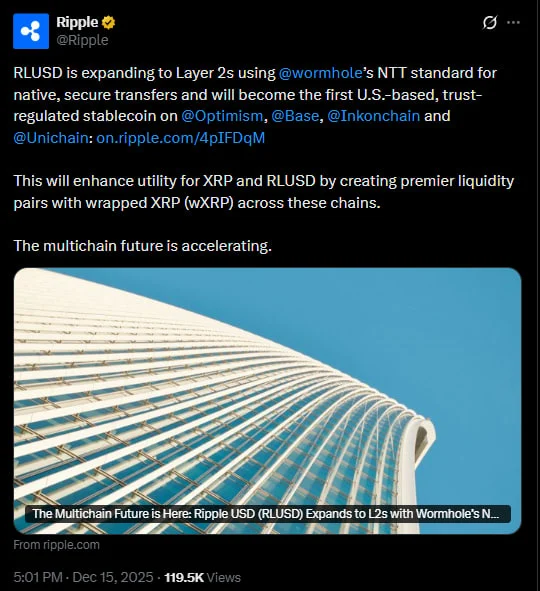
The cryptocurrency landscape is undergoing a profound structural evolution, shifting away from isolated, single-chain ecosystems toward a dynamic, interoperable multi-chain paradigm. As institutional and retail participants increasingly demand frictionless cross-chain liquidity based on utility and market opportunities, stablecoins have cemented their role as the indispensable gateway to the decentralized economy. Acknowledging this shifting paradigm, blockchain infrastructure firm Ripple has announced the expansion of its U.S. trust-regulated stablecoin, Ripple USD (RLUSD), into multiple Ethereum Layer 2 (L2) scaling networks.
The initiative, officially disclosed on December 15, marks a critical developmental milestone ahead of the asset’s anticipated public rollout in 2026, pending final regulatory clearances. The ongoing testing phase encompasses prominent L2 ecosystems including Base, Unichain, and Ink, utilizing Wormhole’s advanced interoperability framework to ensure secure, streamlined value transfer across disparate blockchain networks. This strategic deployment positions Ripple to capture active user volume in high-traffic environments while bridging the gap between traditional regulatory compliance and on-chain capital efficiency.
The Strategic Importance of Ethereum Layer 2 Networks
Layer 2 scaling networks have rapidly established themselves as the epicenter of everyday blockchain activity. While layer-one networks like Ethereum offer unmatched security and decentralization, they frequently grapple with network congestion and elevated transaction fees during periods of peak demand. In contrast, L2 solutions execute transactions off the main chain or via rollups, offering significantly higher throughput, minimal latency, and fraction-of-a-cent fees.
Because these networks serve as the primary venues for decentralized applications (dApps), decentralized finance (DeFi) protocols, and emerging digital payment systems, they represent natural focal points for stablecoin liquidity. By introducing RLUSD to these high-activity zones, Ripple is aligning its asset directly with where developers and users are actively transacting.
The initial rollout phase utilizes Optimism-based architecture as a foundational bridge, establishing initial connectivity across Unichain, Ink, and Base. This phased deployment allows Ripple to test the scalability, stress resistance, and interoperability of RLUSD under real-world market conditions without compromising on network security.
Technological Foundation: Leveraging Wormhole’s NTT Standard
A central technical challenge in multi-chain stablecoin deployment is maintaining asset integrity and uniform value across different blockchain environments without fracturing liquidity. To address this, Ripple has partnered with Wormhole, integrating the cross-chain protocol’s Native Token Transfers (NTT) standard.
The NTT framework enables RLUSD to flow seamlessly between distinct blockchain ecosystems while preserving native token issuance and centralized governance. Under this architecture, Ripple retains direct control over the minting and burning of RLUSD, ensuring strict regulatory oversight and compliance management. Simultaneously, users benefit from the cryptographic security and native liquidity movement afforded by Wormhole’s interoperability infrastructure.
Jack McDonald, Senior Vice President of Stablecoins at Ripple, emphasized the strategic importance of this technological integration and its role in bridging traditional finance with decentralized architectures.
"RLUSD is designed from the ground up to be the trusted, liquid medium necessary for users to seamlessly enter, interact with, and exit the entire digital asset economy," McDonald stated. "By launching RLUSD, the first U.S. Trust Regulated stablecoin on these L2 networks, we are not just expanding utility; we are setting the definitive standard where compliance and on-chain efficiency converge."

Chronology and Regulatory Roadmap
The evolution of Ripple’s stablecoin initiative reflects a deliberate, compliance-first strategy designed to navigate complex regulatory frameworks across global jurisdictions:
- Late 2023 to Early 2024: Ripple initiates internal development of its proprietary U.S. dollar-pegged stablecoin, aiming to address counterparty risk and transparency concerns prevalent in earlier stablecoin generations.
- Mid-2024: Regulatory discussions intensify as Ripple seeks appropriate chartering under U.S. trust frameworks, positioning the asset to meet stringent reserve-backing, auditing, and anti-money laundering (AML) standards.
- December 15, 2025: Ripple formally announces the expansion of RLUSD testing onto Ethereum Layer 2 platforms—specifically Base, Unichain, and Ink—utilizing Wormhole’s NTT standard.
- 2026 (Projected): Subject to final regulatory approvals and the successful conclusion of multi-chain testing phases, RLUSD is scheduled for its official public debut and commercial deployment.
This methodical timeline underscores Ripple’s commitment to building institutional trust. Unlike algorithmic or loosely regulated stablecoins that historically faced catastrophic failures, RLUSD is engineered to maintain a strict one-to-one peg backed by secure, liquid reserves managed under regulatory supervision.
Macroeconomic Context and Market Performance
The rollout of RLUSD occurs against a backdrop of broader macroeconomic uncertainty and subdued digital asset markets. Cryptocurrency valuations have experienced downward pressure, reflecting broader macroeconomic headwinds and cautious sentiment among institutional allocators.
As of mid-December 2025, the broader digital asset market exhibits signs of contraction. Bitcoin (BTC), the industry’s benchmark asset, has encountered persistent resistance, struggling below the $90,000 threshold and recently changing hands near $87,700. Concurrently, Ripple’s native asset, XRP, has traded defensively, hovering around $1.93 following a modest 3% correction over a 24-hour window.
Despite short-term price volatility across major tokens, institutional infrastructure development has continued unabated. Market analysts note that stablecoins often serve as a safe harbor during market downturns, allowing traders to park capital in dollar-denominated digital assets without exiting the blockchain ecosystem entirely. By expanding RLUSD’s footprint into efficient L2 networks, Ripple is positioning its ecosystem to capture transaction volume regardless of directional market trends.
Broader Implications for the XRP Ledger and Digital Finance
The integration of RLUSD into Ethereum L2 environments is not merely an isolated product launch; it represents a strategic reinforcement of the broader XRP ecosystem. While the XRP Ledger (XRPL) remains the core settlement layer for Ripple’s cross-border payment solutions, connecting its stablecoin to external high-volume networks broadens its utility profile.
Stablecoins are the lifeblood of modern crypto-economics, facilitating arbitrage, powering automated market makers (AMMs), serving as collateral in lending protocols, and acting as the preferred medium for cross-border merchant settlement. By making RLUSD natively accessible across Base, Unichain, and Ink, Ripple ensures that its compliant stablecoin can participate fully in the fragmented liquidity pools that define contemporary decentralized finance.
Furthermore, this multi-chain expansion highlights a broader trend within enterprise blockchain adoption: the acceptance of cross-chain interoperability as a necessity rather than a luxury. Financial institutions exploring tokenized assets and on-chain settlement require assets that can traverse different technological stacks securely and efficiently. By combining U.S. trust regulatory compliance with Wormhole’s cross-chain infrastructure, Ripple aims to capture a significant share of the burgeoning institutional stablecoin market, which has increasingly become dominated by a handful of legacy issuers.
As the industry looks ahead to the formal public launch of RLUSD in 2026, the success of these Layer 2 testing phases will serve as a crucial litmus test. If Ripple can successfully demonstrate that strict regulatory compliance can coexist with decentralized speed, low cost, and multi-chain flexibility, RLUSD could redefine the operational standards for enterprise-grade digital currency.