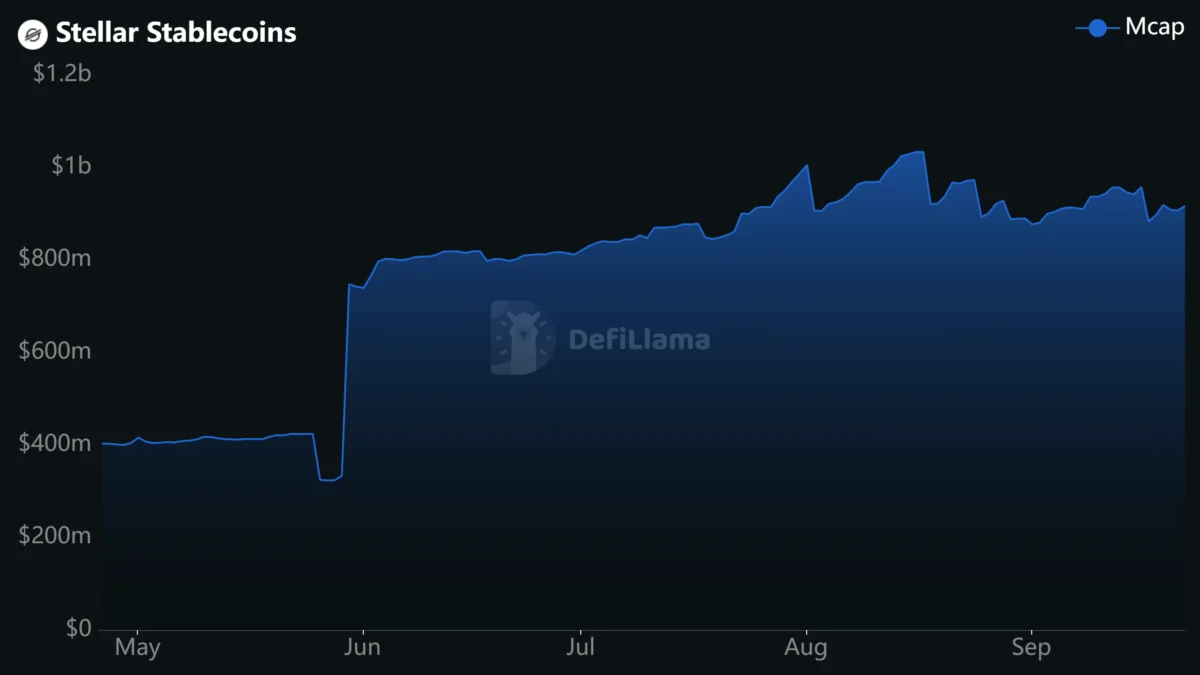
Stellar (XLM) experienced a notable bullish resurgence on September 22, rallying 6.84% to climb back toward the $0.22 threshold following weeks of largely consolidated and subdued price action. The upward momentum materialized as aggressive buyers successfully reclaimed the critical $0.2000 psychological level, pushing the digital asset firmly into the established $0.2020 to $0.2075 demand zone. Rather than succumbing to another wave of bearish rejections—a pattern that had plagued the token during previous retracements—market participants utilized this zone as a launchpad. This dynamic propelled XLM past $0.2075 and toward $0.2200, mirroring the structural integrity of the breakout that initially formed in August.
The successful retest of this high-interest zone underscores a strengthening foundation of buyer participation in an area historically backed by heavy volume. Furthermore, trading volumes expanded concurrently with the recent price appreciation, lending increased market credibility to the breakout and signaling a broadening base of institutional and retail investor participation. Despite a minor press-time pullback toward $0.2118, market analysts note that as long as XLM maintains a support floor above $0.208, the broader short-term uptrend remains structurally intact, paving the way for a potential secondary assault on the $0.2227 resistance ceiling. Conversely, a failure to hold this reclaimed territory could invite downward pressure, leaving the token vulnerable to a retracement toward the deeper $0.180 to $0.185 liquidity pocket.

Chronology of the Rally and Market Structure
The late-September price expansion did not occur in a vacuum; it represents the continuation of a broader structural recovery that began taking shape late in the third quarter. In August, Stellar demonstrated its initial strength by executing a commanding 44% rally from a local swing low of $0.1550. This aggressive leg established the crucial demand blocks that currently dictate the token’s technical parameters.
Following the August peak, XLM entered a cooling-off period characterized by low-volatility consolidation and minor downward drift. Market observers interpreted this consolidation as a healthy digestion of gains. The quiet accumulation phase culminated on September 22, when surging buy-side volume shattered local resistance and validated the durability of the August breakout zones. While the September 22 rally of 6.84% remains modest compared to the explosive 44% surge observed weeks prior, it illustrates sustained market interest. Analysts emphasize that for XLM to match the magnitude of its previous leg, bulls must decisively overcome the $0.2227 barrier. Clearing this specific hurdle would clear the runway for a push into the broader $0.235 to $0.260 overhead supply zone. However, market technicians caution that reaching this upper echelon signifies trend continuation rather than true price discovery, as the asset still trades well below its historical all-time high of approximately $0.93.
Expanding On-Chain Liquidity and Stablecoin Dynamics
Beyond the immediate technical price action, Stellar’s fundamental network metrics highlight a rapidly expanding utility ecosystem that extends far beyond speculative retail trading. A primary driver of this fundamental growth is the network’s surging on-chain liquidity, anchored heavily by its stablecoin infrastructure. Stellar’s total stablecoin market capitalization has successfully pushed past the $0.9 billion mark, providing deep, reliable liquidity pools optimized for cross-border payments, foreign exchange, and instantaneous settlement.
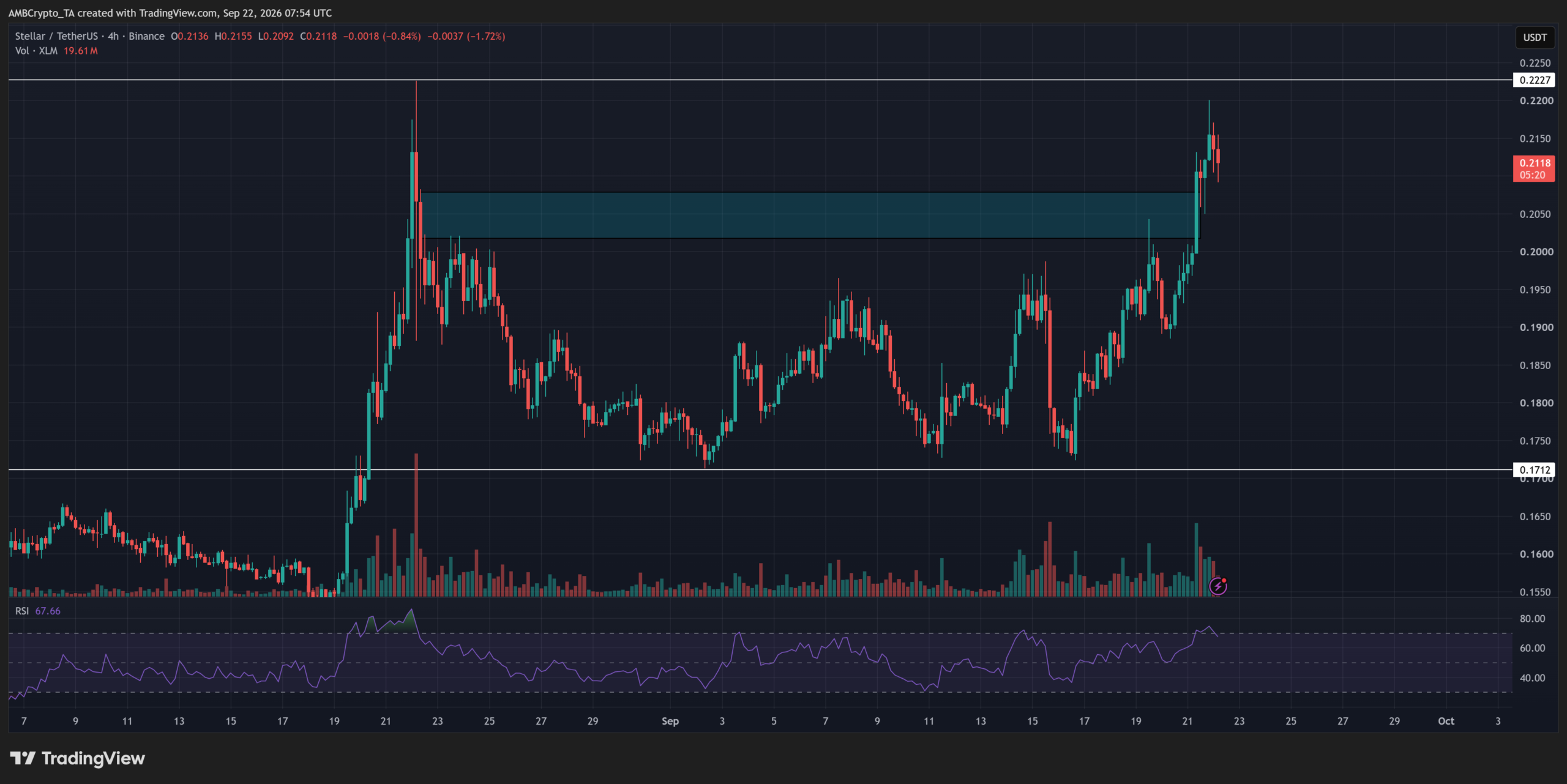
More telling than the sheer capitalization figure is the velocity at which these stablecoins circulate across the network. Over a representative thirty-day trailing period, stablecoin transfers on Stellar averaged an impressive $8.94 billion. This volume represents a turnover rate of more than nine times the total outstanding stablecoin supply, indicating high-frequency, repeated settlement flows traversing the network’s liquidity base. Such velocity is vital for institutional adoption, as enterprise-grade payment rails require constant liquidity movement rather than passive capital storage. Financial technology analysts view this high transaction velocity as empirical proof that Stellar is actively fulfilling its core mandate as an efficient, low-cost settlement layer for global financial institutions.
The Rise of Tokenized Real-World Assets (RWAs)
Complementing the robust stablecoin activity is Stellar’s rapidly accelerating adoption within the tokenized Real-World Asset (RWA) sector. The total aggregate value of tokenized RWAs hosted on the Stellar network has scaled to an impressive $3.33 billion, reflecting a growing migration of traditional financial instruments onto distributed ledger technology.
This macro growth is supported by a growing user base. Addresses actively holding and interacting with RWA products expanded by 10.23% over the assessment period, pushing the total number of unique RWA participants to 21,124. Furthermore, transaction volumes tied directly to these tokenized assets have maintained a healthy average of $542.41 million. By bridging traditional fixed-income products, commodities, and fiat-backed instruments with blockchain rails, Stellar has successfully positioned itself as a premier destination for asset tokenization. This evolving network foundation helps insulate XLM from purely speculative market cycles, tying the token’s long-term viability directly to sustained economic throughput and real-world utility.
Market Implications and Future Outlook
The convergence of technical price resilience and robust on-chain fundamentals presents a compelling narrative for Stellar as the fourth quarter approaches. From a macroeconomic perspective, the network’s ability to process billions of dollars in stablecoin and RWA transfers without congestion or spikes in transaction fees demonstrates high scalability. This operational efficiency is particularly attractive to institutional partners seeking reliable infrastructure for tokenized finance and international remittances.
For market participants and traders, the immediate focus remains locked on the $0.208 support level and the $0.2227 resistance ceiling. A sustained defense of the lower bound would signal that buyers are firmly in control of the trend architecture, reducing the likelihood of a steep capitulation toward the $0.180 support zone. On the other hand, a decisive breakout above $0.2227 would validate the thesis of ongoing trend continuation, opening the door for a measured test of the $0.235–$0.260 supply block.
Ultimately, while macroeconomic headwinds and broader cryptocurrency market volatility will continue to influence short-term price fluctuations, Stellar’s expanding liquidity metrics and growing institutional footprint provide a solid structural floor. As tokenized finance continues its gradual integration into mainstream financial systems, networks demonstrating high capital velocity and reliable settlement capabilities—such as Stellar—are uniquely positioned to capture long-term market share, regardless of short-term speculative noise.