As geopolitical tensions simmer between Washington and Beijing, prediction markets are heavily discounting the likelihood of a major diplomatic pivot regarding the geopolitical status of Taiwan. Ahead of the anticipated September 24, 2026, summit between U.S. President Donald Trump and Chinese President Xi Jinping in Washington, data from decentralized forecasting platforms indicates that traders see virtually no chance of an explicit American endorsement of Beijing’s sovereignty claims over the self-governing island.
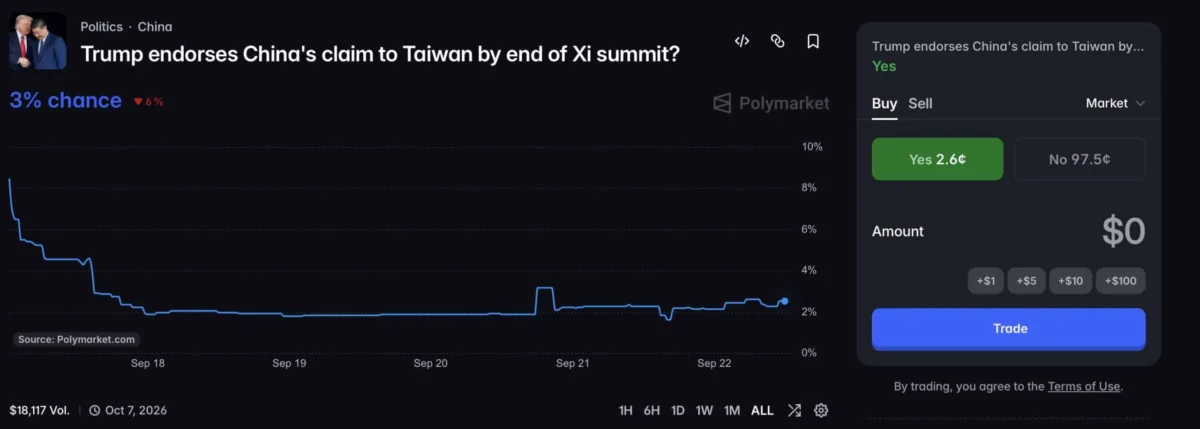
According to Polymarket data updated on September 22, 2026, the implied probability of a "Yes" resolution on whether Trump will explicitly validate China’s territorial claims by the conclusion of the high-stakes meeting hovers between 2% and 3%. Conversely, traders are pricing a staggering 97.6% probability that the U.S. leader will maintain standard diplomatic ambiguity rather than crossing a historical red line that would upend decades of American foreign policy.
This narrow wager highlights a critical distinction in geopolitical forecasting: the market is not measuring broader diplomatic friction, trade negotiations, or routine security talks. Instead, it relies on a binary condition—whether the U.S. president explicitly states on the global stage that Taiwan is an inalienable part of China.
Understanding the Polymarket Contract and Historical U.S. Policy

To accurately interpret the single-digit probability assigned to the contract, analysts emphasize the importance of understanding the precise wording of the prediction market. The contract does not hinge on whether Taiwan is discussed during the bilateral meetings, nor does it measure whether Washington adjusts its complex web of arms sales, economic sanctions, or tech controls.
For the "Yes" outcome to trigger, Donald Trump would have to fundamentally alter the longstanding U.S. "One China" policy, which formally acknowledges Beijing’s claim over Taiwan without officially endorsing it. Historically, successive U.S. administrations across both political parties have maintained strategic ambiguity, walking a fine line designed to deter a unilateral Chinese invasion while preventing Taipei from declaring formal independence.
Market intelligence indicates that prediction platforms centered on national security and foreign policy outcomes routinely draw sharp boundaries between standard rhetorical friction and formal policy reversals. While traders acknowledge that Trump and Xi will undoubtedly address regional security and economic cooperation, an abrupt and explicit abandonment of Taiwan’s sovereignty status is viewed by market participants as an extreme statistical outlier.
Chronology and Background Leading to the September 2026 Summit
The upcoming Washington summit represents the second face-to-face meeting between Trump and Xi in 2026, following an earlier diplomatic engagement in Beijing in May. However, the path to the September 24 encounter has been fraught with mounting anxiety among U.S. allies in the Indo-Pacific region.

In May 2026, remarks made by President Trump regarding U.S. arms sales to Taiwan triggered widespread concern across diplomatic circles in Taipei and neighboring allied capitals. Trump described ongoing military aid packages as a potential "negotiating chip" in broader bilateral trade talks with Beijing, leading foreign policy experts to question whether Washington’s security commitments to Taiwan could be leveraged for economic concessions.
The volatility surrounding the summit escalated further in mid-September. On September 12, reports from regional outlets indicated that Beijing had issued stern warnings, threatening to cancel the Washington summit entirely if the White House approved any new packages of defensive arms sales to Taiwan ahead of the leaders’ meeting.
Despite these high-stakes maneuvers and threats of a diplomatic boycott, analysts note that the core dispute between the two superpowers remains anchored in trade imbalances, technology restrictions, and maritime security, rather than a sudden ideological conversion by Washington on the issue of sovereignty.
Market Analysis and Expert Outlook
Financial and geopolitical research firms have weighed in on the likely outcomes of the summit, urging caution against expectations of a "grand bargain." Economic advisory firms, including Yardeni Research, have suggested that while the summit is unlikely to yield groundbreaking geopolitical breakthroughs, it could serve to extend an ongoing trade truce and facilitate selective commercial agreements.

Potential areas of cooperation identified by analysts include agricultural purchases, commercial aviation deals involving Boeing, and negotiations over critical mineral and rare-earth supply chains. However, these pragmatic commercial outcomes are viewed as separate from the core sovereignty questions monitored by national security prediction markets.
The strict parameters of the Polymarket contract have also drawn broader scrutiny regarding the intersection of decentralized prediction markets and classified intelligence. Recent regulatory and law enforcement actions—including the arrest of a military member accused of leaking classified information tied to national security wagers on prediction platforms—have heightened regulatory oversight of how predictive contracts utilize real-time geopolitical intelligence.
Implications for U.S.-China Relations and Global Markets
The near-consensus pricing on Polymarket offers a revealing window into how institutional and retail traders process geopolitical risk. While broader macroeconomic indicators, such as equity market volatility and cryptocurrency fluctuations, frequently react to headlines concerning Taiwan Strait tensions, the prediction market data suggests that professional and retail forecasters do not expect a structural collapse of U.S. strategic posture in East Asia.
As the September 24 summit approaches, market participants will continue to monitor official readouts from Washington and Beijing for any deviation from established diplomatic norms. Nevertheless, barring an entirely unprecedented and unheralded pivot in executive branch foreign policy, the quantitative data indicates that the foundational parameters of the U.S. approach to Taiwan will remain firmly intact.