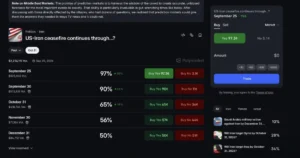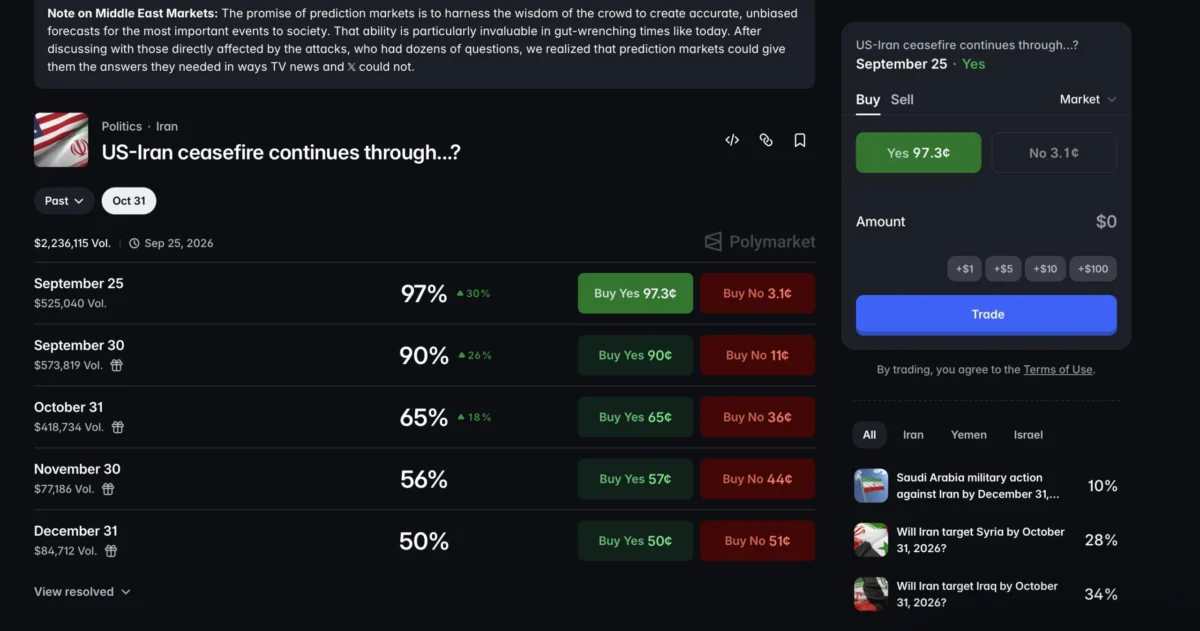
Prediction markets are registering a high degree of short-term confidence regarding the stability of the ongoing, albeit fragile, US-Iran geopolitical situation. According to data sourced directly from Polymarket event tracking pages, decentralized finance traders are pricing the continuation of a US-Iran ceasefire at approximately 97% for a deadline of September 25. Meanwhile, the contract looking toward a slightly extended horizon of September 30 indicates a roughly 90% probability of holding.
This noticeable discrepancy between the two near-term closing dates illustrates how quickly market confidence erodes as the temporal window expands. Despite ongoing regional volatility, diplomatic channels remain open, and public commentary from high-ranking political figures has injected a wave of optimism into predictive trading circles. However, financial analysts and geopolitical observers emphasize that these percentages do not reflect a finalized, comprehensive peace treaty. Rather, they represent hyper-specific, binary bets tied to whether a qualifying United States military action occurs before the designated timestamps.
Understanding the Mechanics of Military-Event Prediction Markets
To interpret these prediction market metrics accurately, observers must examine the technical conditions governing the smart contracts. The resolution of Polymarket’s Iran-focused contracts hinges strictly on whether the United States military executes a qualifying offensive action against Iranian targets before the expiration of each contract.
In this context, traders are wagering on immediate restraint rather than a permanent diplomatic resolution. Diplomatic setbacks, verbal sparring matches, proxy skirmishes in the Middle East, or commercial shipping disruptions in vital trade corridors do not inherently trigger a negative resolution for the contract. The outcome flips from "Yes" to "No" exclusively if an official, qualifying US military operation is officially launched and verified.
The market’s high baseline of optimism—sitting at 97% for September 25—stems primarily from recent statements delivered by US leadership and subsequent diplomatic maneuvers by Iranian officials. On September 22, President Donald Trump addressed the media, expressing optimism that a formal settlement could be reached sooner than previously anticipated. Concurrently, Iranian Foreign Minister Abbas Araghchi engaged in high-stakes talks with international intermediaries, formally submitting Tehran’s baseline terms for reopening the strategic Strait of Hormuz. These terms reportedly included demands for the lifting of the existing US naval blockade and the release of billions of dollars in frozen Iranian assets. While neither development constitutes a legally binding treaty or a permanent cessation of hostilities, the diplomatic engagement was sufficient to heavily incentivize bullish behavior among short-term speculators.
Chronology of a Fragile Framework: From MoU Collapse to Ongoing Mediation

The current speculative landscape does not exist in a vacuum; it is built upon the wreckage of previously failed diplomatic frameworks. To fully grasp the fragility of the 97% and 90% pricing metrics, one must review the tumultuous timeline of US-Iran relations throughout 2026.
The foundational framework for the current diplomatic track was a memorandum of understanding (MoU) established in June 2026. This agreement was deliberately crafted to establish a lasting pause in hostilities following a series of kinetic exchanges and military strikes in February of the same year. The MoU outlined a clear roadmap: the reopening of the Strait of Hormuz to international shipping, the cessation of direct military friction, and the immediate launch of a 60-day diplomatic window dedicated to resolving deep-seated disputes over Iran’s nuclear enrichment program and international sanctions.
However, the agreement proved exceptionally fragile. Throughout June and early July, violations were reported on both sides. Incidents involving renewed US tactical strikes and persistent Iranian-backed proxy attacks on commercial shipping in regional waters shattered the fragile trust. By early July 2026, President Trump officially declared that the June framework had collapsed, leading to a return of intermittent military exchanges and heightened economic warfare.
Despite the collapse of the formal bilateral framework, back-channel diplomacy never truly ceased. Throughout August and into September 2026, regional intermediaries—notably diplomatic representatives from Pakistan and Qatar—stepped in to fill the mediation vacuum. These nations have facilitated indirect talks aimed at preventing a full-scale regional war, even as core disagreements regarding nuclear oversight, ballistic missile development programs, and comprehensive sanctions relief remain fundamentally unresolved.
Key Variables Driving Prediction Market Volatility
Market intelligence analysts monitoring US-Iran prediction market odds note that traders are continuously pricing incoming data against four primary variables. Any sudden movement in these specific vectors has historically proven capable of swinging contract prices within minutes:
- US Military Posture and Deployment Shifts: Movement of carrier strike groups, strategic bomber deployments, or changes in regional force readiness directly threaten the 97% and 90% "Yes" thresholds.
- Iranian Compliance and Signaling: Official statements from Tehran regarding uranium enrichment thresholds, cooperation with international nuclear inspectors, and the security of maritime trade routes serve as major sentiment drivers.
- Proxy Dynamics and Regional Flashpoints: Activity involving aligned militia groups in Lebanon, Yemen, and Iraq remains a persistent catalyst for unexpected escalation, regardless of direct bilateral talks between Washington and Tehran.
- New Diplomatic Proposals: Sudden announcements of high-level summits, prisoner swaps, or interim economic relief packages frequently trigger immediate upward spikes in peace-oriented prediction contracts.
Historical Precedents: How Crypto and Prediction Markets React to Geopolitics
The intersection of decentralized prediction markets and geopolitical conflict has created a new paradigm for real-time sentiment analysis. Unlike traditional stock markets, which often experience delayed reactions to breaking news, platforms like Polymarket aggregate global liquidity and human sentiment into immediate, quantifiable probabilities.
Previous episodes in the ongoing US-Iran conflict have demonstrated just how rapidly these prediction market odds can swing. For instance, earlier diplomatic overtures earlier in the year caused sudden spikes in peace probabilities, which subsequently triggered relief rallies across broader financial markets, including notable upward rebounds in Bitcoin and other major cryptocurrency assets as macro-risk sentiment temporarily eased.
However, market analysts frequently caution against reading too much permanence into these short-term percentage shifts. Prediction markets measure trader sentiment and specific contractual triggers, not necessarily the underlying health of geopolitical stability. A contract pricing a 97% chance of peace over a three-day window simply indicates that traders do not expect a major military strike within those 72 hours. It does not mean the decades-long structural conflict between Washington and Tehran has been resolved.
Implications and Broader Market Outlook
As the September 25 and September 30 deadlines approach, trading volume on these specific Polymarket contracts is expected to intensify. Market participants ranging from retail speculators to institutional macro analysts are utilizing these decentralized prediction tools as a real-time barometer for tail-risk events.
The implications extend far beyond the realm of crypto-native prediction platforms. In an era where geopolitical headlines break across social media platforms before making their way to traditional wire services, decentralized markets offer a raw, capitalized reflection of global anxiety and optimism.
For now, the overarching message from the order books is one of guarded, near-term relief. With the September 25 contract holding firm at 97%, the collective capital of the prediction market suggests that major kinetic escalation is unlikely in the immediate future. Yet, with the slightly longer September 30 contract sliding to 90%, traders are overtly acknowledging the persistent volatility and unpredictability that characterizes modern statecraft in the Middle East. As long as the primary variable—a qualifying US military action—remains a possibility, these odds will continue to react with acute sensitivity to every diplomatic whisper and tactical maneuver emanating from Washington and Tehran.