Leading cryptocurrency analysts have issued stark predictions regarding Bitcoin’s (BTC) trajectory, forecasting a significant price bottom in October 2026. This bearish outlook, rooted in historical market cycles and technical indicators, suggests that the world’s largest cryptocurrency could experience a substantial decline to as low as $30,000 before embarking on its next long-term recovery phase. These projections arrive amidst ongoing debates about the evolving nature of the crypto market, particularly with the increased institutional involvement and the advent of spot Bitcoin Exchange-Traded Funds (ETFs).
Deep Dive into the 400-Day Cycle Prediction
Crypto market analyst Bee, known for his rigorous adherence to historical patterns, has provided a definitive timeline for the conclusion of the current Bitcoin bear market. His analysis, shared across prominent financial platforms, hinges on a recurring 400-day cycle pattern that has consistently marked market tops and bottoms throughout Bitcoin’s 13-year trading history. This cyclical framework, which has proven remarkably resilient across various market phases, suggests that the present downward pressure is part of a larger, predictable pattern.
According to Bee’s detailed assessment, Bitcoin is currently 252 days into what he identifies as its cyclical bear phase. Historically, these bear phases have consistently lasted between 364 and 400 days. This mathematical extrapolation indicates that the leading cryptocurrency still faces an additional 112 to 148 days of intense downward pressure. If this historical pattern holds true, a true and sustainable recovery would only commence after this period of capitulation and price discovery concludes.
Based on the precise timeline derived from this historical setup, Bee estimates that Bitcoin’s absolute price bottom for this cycle is likely to occur in October 2026. His accompanying charts and calculations suggest a potential price floor in the vicinity of $30,000 by the first week of that month. Such a decline would represent a more than 75% drop from the anticipated or recently observed all-time highs, which analysts have pegged near $126,000. This drastic reduction would mark the likely capitulation point before the market resets for its subsequent growth phase.
Historical Context of Bitcoin’s Market Cycles

Bitcoin’s price movements have historically been characterized by distinct bull and bear cycles, often influenced by its halving events, which reduce the supply of new Bitcoin. While halving cycles typically span approximately four years, technical analysts like Bee argue that shorter, more immediate cycles also play a crucial role in dictating short-to-medium term price action. The 400-day cycle is one such observed phenomenon, demonstrating a remarkable consistency even through periods of immense volatility and market paradigm shifts.
Past cycles, for instance, saw significant drawdowns following periods of euphoric growth. The 2017 bull run, which saw Bitcoin soar close to $20,000, was followed by a prolonged bear market in 2018, often dubbed "crypto winter," where prices fell by over 80%. Similarly, the 2021 bull market, which pushed Bitcoin to new highs, was succeeded by a significant correction in 2022 and 2023. These historical precedents lend credence to the idea that severe drawdowns are not anomalies but rather integral components of Bitcoin’s market evolution. The consistent recurrence of the 400-day pattern, spanning over a decade, suggests an underlying market structure that transcends immediate catalysts.
The "This Time Is Different" Debate: ETFs and Institutional Influence
A significant point of contention among market participants and analysts revolves around the argument that "this cycle is different." Many investors and commentators suggest that the current market environment, characterized by the widespread adoption of spot Bitcoin ETFs and increasing institutional involvement from major financial players like BlackRock, the world’s largest Bitcoin ETF provider, might mitigate the severity or even alter the nature of traditional bear markets. The rationale is that institutional capital provides a more stable and continuous demand floor, potentially preventing the deep capitulation seen in previous cycles driven primarily by retail sentiment.
However, analyst Bee strongly counters this narrative. He emphasizes that each past cycle, despite its unique set of macro-economic conditions, technological advancements, or prevailing market narratives, also had its own reasons for being considered "different" at the time. Yet, the historical 400-day pattern persisted without a single deviation. Bee points out that the fundamental market structure and human psychology, which often drive these cycles of greed and fear, remain largely unchanged, regardless of new financial instruments or participants. He argues that this recurring structure has held through various changing narratives and broader market developments for over a decade, providing no compelling reason to believe the current cycle will be an exception. The influx of institutional money, while providing liquidity and legitimacy, might simply amplify existing cyclical tendencies rather than eliminate them.
Confirmation from Other Analysts: MACD Indicator Points to Q3/Q4 2026 Bottom
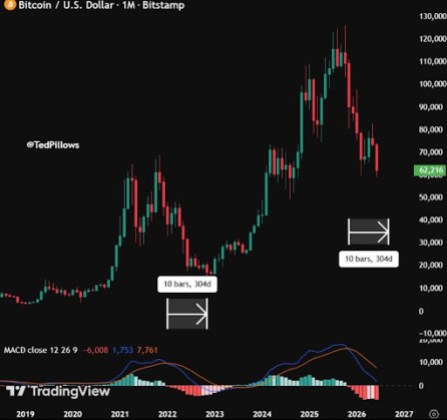
Further reinforcing the bearish sentiment and the projected timeline, another prominent crypto analyst, Ted Pillows, has independently forecasted a similar timeframe for Bitcoin’s bear market bottom. Pillows’ analysis, shared across social media, focuses on the Moving Average Convergence Divergence (MACD) indicator, a widely used momentum oscillator in technical analysis that reveals the strength, direction, momentum, and duration of a trend.

Pillows observed that in 2022, following the emergence of a monthly MACD bearish cross – a technical signal indicating a shift from bullish to bearish momentum – Bitcoin took approximately 10 months to reach its definitive price bottom. Applying a similar historical correlation to the current market conditions, Pillows projects that Bitcoin is likely to reach its final price floor either by the end of the third quarter (Q3) of 2026 or the beginning of the fourth quarter (Q4). His detailed chart analysis points towards a likely bottom target range between $30,000 and $40,000, aligning closely with Bee’s prediction.
The convergence of these two independent analyses, utilizing different technical methodologies (cyclical patterns and momentum indicators), lends significant weight to the October 2026 bottom projection and the $30,000-$40,000 price target. This dual confirmation suggests a strong underlying technical basis for these bearish expectations.
Rejection of a $100,000 Bitcoin in 2026 and Long-Term Outlook
Beyond the immediate bear market bottom, Ted Pillows also addressed investor hopes for a rapid long-term rebound. He explicitly crushed expectations for Bitcoin to reach the $100,000 mark in 2026, projecting that a bullish run back to such levels is highly unlikely within the year. This assessment suggests that even after a bottom is established, the recovery phase is anticipated to be gradual rather than explosive, requiring time for consolidation and accumulation before significant upward momentum can be sustained.
Bee’s analysis further elaborates on the broader market cycle, noting that the historical 400-day bear market typically follows a bull run lasting approximately 1,064 days. This implies that once the final cycle bottom is reached, the market effectively resets, potentially paving the way for a fresh, multi-year bull market. The implication is that while the short-to-medium term outlook is bearish, the long-term prospects for Bitcoin remain robust, with a new cycle of growth expected to commence once the current downturn concludes.
Implications for Investors and the Broader Crypto Ecosystem
A potential decline of Bitcoin to the $30,000-$40,000 range, representing a 75% or more drawdown from its peak, would have significant implications across the cryptocurrency landscape. For existing investors, particularly those who entered the market during the recent bull run, it could mean substantial unrealized losses and a test of conviction. This period often leads to "capitulation," where discouraged investors sell their holdings at a loss, creating selling pressure that pushes prices further down.
Miners, who are crucial to Bitcoin’s network security, would face increased pressure on their profitability. With lower Bitcoin prices and persistent operational costs, less efficient mining operations might be forced to shut down, leading to a consolidation within the mining industry. This, in turn, could impact network hash rate and overall security, though Bitcoin’s robust design has historically weathered such challenges.
For the broader altcoin market, a significant Bitcoin correction typically translates to even more pronounced declines. As Bitcoin often acts as the market’s bellwether, a deep bear market for BTC can trigger a wider sell-off across various altcoins, many of which have higher beta (volatility) relative to Bitcoin. This could lead to a cleansing of speculative projects and a renewed focus on fundamental utility and technological innovation.
However, such bear markets are also historically viewed as opportunities for long-term investors to accumulate assets at discounted prices. The "smart money" often enters during these periods of fear and uncertainty, positioning themselves for the subsequent bull run. The projected bottom in October 2026, if accurate, would provide a clear window for strategic accumulation before the market potentially embarks on its next growth phase.
Conclusion: Navigating the Anticipated Downturn
The converging analyses from Bee and Ted Pillows paint a consistent picture of a prolonged Bitcoin bear market culminating in October 2026, with price targets ranging from $30,000 to $40,000. These predictions, grounded in historical patterns like the 400-day cycle and reliable technical indicators such as the MACD, challenge the notion that institutional involvement will entirely insulate Bitcoin from its inherent cyclical volatility. While the entry of institutional capital and spot ETFs represents a significant maturation of the crypto market, analysts suggest that fundamental market dynamics, including human psychology and supply-demand forces, continue to exert a powerful influence.
Investors are advised to prepare for continued downward pressure over the coming months, with the possibility of a substantial price correction from current levels. The consensus among these analysts is clear: patience will be a key virtue for navigating the anticipated final leg of this bear market. However, for those with a long-term perspective, the projected bottom could ultimately signify a pivotal moment, marking the end of a challenging period and the dawn of a new, potentially prosperous, market cycle for Bitcoin. The debate between historical precedent and new market variables continues, but for now, the technical indicators strongly point towards a significant re-evaluation of Bitcoin’s price in the near future.